How we monitor NYC commercial mortgage maturities for brokers in 2026 (and why ACRIS makes it hard)
Where commercial mortgage maturity data actually comes from, why New York City's public records don't contain a maturity date, and how Circlemark turns recorded documents into a verified, weekly-refreshed list of loans coming due.
By Andrew Zhong, founder of Circlemark · · Updated · 14 min read · Figures as of Oct 24, 2026
Key numbers. The Mortgage Bankers Association counts $875 billion of commercial and multifamily mortgages maturing in 2026 — 17% of everything outstanding — with another $652 billion in 2027. In New York City, we currently track 166,134 commercial loans across the four ACRIS boroughs, of which — are active and mature within twelve months of today. And the single most important fact about all of them: the public record that documents every one of those loans does not contain a maturity date.
Skip the search. Type an address and the lookup reads the recorded instrument for you — lender, amount and maturity — free, no account. Or search every loan in your market on a free seat: no card, 10 owner reveals, 60 searches, nothing expires.
This post explains where commercial mortgage maturity data actually comes from, what New York's records do and don't tell you, how we fill the gap without pretending, and how that turns into a list a broker can call.
Why NYC loan maturities matter right now
The national maturity wall is well covered. Two things make New York specific.
The first is the rate reset. Loans originated in 2016–2021 at 3–4.5% are coming due into a market where new commercial debt prices well above that — S&P Global puts the average rate on new CRE loans at 6.24% against 4.76% on the debt they replace. Every maturity is a decision: refinance at a higher rate, extend, inject equity, or sell. Each of those decisions needs a broker.
The second is the rent-stabilized book. Bisnow, citing Atrium's data, reports that lending on NYC rent-stabilized buildings fell 74% from $27.6 billion in 2019 to $11.3 billion in 2025, while delinquency on pre-1974 buildings rose from 3.7% to 11.5% in two years. Roughly $131 billion of debt sits on 852,000 units, much of it with regional banks whose books changed hands in 2023. Those borrowers face maturity with unfamiliar lenders — and unlike a trophy office tower, nobody is writing a news story about a 40-unit walk-up in Flatbush. It only shows up in the county record.
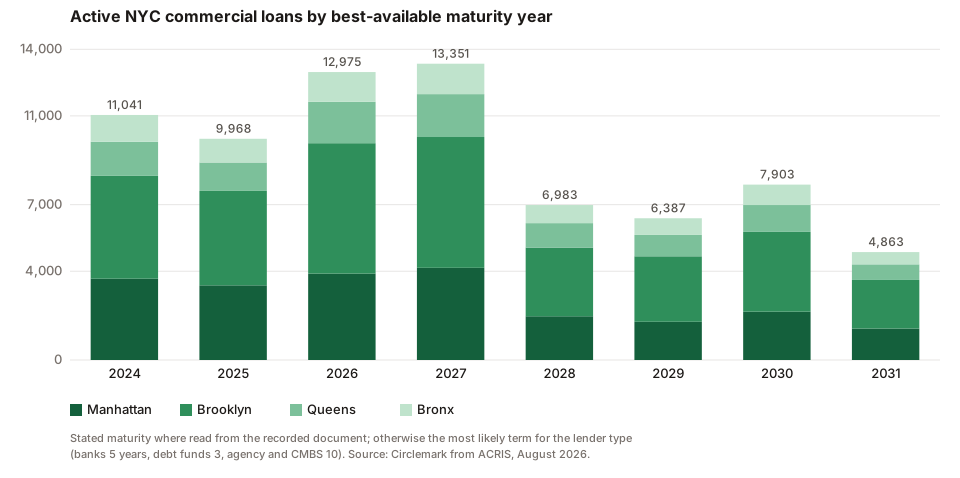 Active NYC commercial loans by best-available maturity year. Stated where read from the recorded document, otherwise the modelled term for the lender type. 2026–2027 is the local wall: 2016–17 originations plus 2021–22 bank loans on five-year terms.
For the securitized slice, Morningstar DBRS expects more than $100 billion of CMBS to mature in 2026 with over half unlikely to repay at maturity. But that's the slice everyone can see. In our New York cohort, identifiable CMBS is under 1% of maturing loans. Banks are 73%, private lenders and debt funds most of the rest. The broker market is the bank market — and bank loans have no servicer disclosure. The only public trace of them is the recorder.
Where commercial mortgage maturity data actually comes from
There are exactly three kinds of source, and they are not interchangeable.
| Source | What it holds | Who it covers | Maturity? |
|---|---|---|---|
| County recorder (NYC: ACRIS) | Every recorded mortgage, consolidation, deed, satisfaction, assignment, modification | All loans, all lenders | No field. Only if stated in the scanned document |
| Securitization disclosure (SEC ABS-EE, agency) | Loan-level monthly data: balance, rate, DSCR, occupancy, servicing status | Public conduit CMBS only (~375 trusts) | Yes, stated |
| Trade press / vendor estimates | Deal announcements, "estimated" dates | Whatever got written about | Not a source of record |
Every commercial mortgage data product is some blend of the first two, plus modelling. The differences that matter are which blend, whether the vendor tells you which dates are modelled, and how fast they notice a loan has died.
ACRIS mortgage search: what the records do and don't tell you
ACRIS — the NYC Department of Finance's Automated City Register Information System — is published as open data. The Real Property Master file lists every recorded document with its type, amount, document date, and recording date; Legals map each document to a tax lot (borough–block–lot); Parties give the borrower and lender; References cross-index later documents (satisfactions, assignments) to the instrument they act on. We've ingested 371,734 lifecycle events this way.
What ACRIS gives you for a loan: the amount, the date it was signed, the date it was recorded, the lender and borrower as recorded, the parcel, and the document type. What it does not give you: the term, the maturity date, the interest rate, the current balance, or whether the loan has been modified since — unless a later recorded document says so.
Six ACRIS quirks trip up naive pipelines, and each one produces wrong data in a specific way:
Loans are recorded as sets, not rows. A typical New York refinance is a CEMA: a gap mortgage for the new money, plus a consolidation agreement (M&CON or a large AGMT) that merges it with the prior notes into one loan. Take any single row and you either report the gap mortgage (far too small) or double-count principal across the set. We classify the whole recorded set: the consolidation instrument carries the loan amount, split notes are summed, and superseded notes are marked so they never surface as separate loans. In our data, 136,511 notes were superseded this way.
The document date and the recording date are different facts — and one of them is typed by hand. Recording trails signing by weeks, sometimes months, so a maturity modelled from the recording date can be off by a quarter. We use the document date. But the document date is keyed in by a clerk and ACRIS doesn't validate it: about one in two thousand mortgages carries an impossible year — 0200-09-04 for a note recorded in September 2008, 0106-03-10 for a 2016 CEMA — always the real year with one keystroke dropped and zero-padded. Left alone, those dates push a modelled maturity eighteen centuries into the past. We bound every date against its recording date, fall back to the recording date when the keyed one is impossible, and label the fallback as modelled rather than inventing a year.
Sub-$2 million Manhattan "mortgages" are mostly condo units. A citywide dollar floor either drowns the dataset in residential noise or drops real outer-borough commercial deals. We use per-borough floors ($2 million in Manhattan, $1 million elsewhere) and a parcel-level commercial verdict from PLUTO, the city's assessor dataset.
A $5 million "mortgage" on Park Avenue is usually somebody's apartment. The dollar floor and the assessor dataset together still miss the biggest source of residential noise: condominium and co-op units. Each condo unit is its own tax lot, and PLUTO — the assessor file that tells you what a lot is — has no row for unit lots, so a property-centric filter sees a $4 million Chase mortgage at 25 Central Park West and cannot tell it from a building loan. The recorder can: every ACRIS legal carries a property-type code — SC single residential condo unit, SP co-op unit, D1–D4 one-to-four family, PS parking space — and in our cache the single most common code, by a wide margin, is SC. Until we applied it, 38% of the "commercial" loans we tracked in Manhattan were homes with jumbo mortgages, and most of the 30-year bank notes we were reading for reset terms were 7/1 and 10/1 ARMs on condos. A loan on a residential unit is now excluded unless it blankets three or more of them — that is a sponsor's inventory loan, which is very much commercial. Any NYC "commercial loan" list that isn't doing this is roughly a third condo mortgages. Since September 2026 the one-to-four family houses are handled as their own opt-in segment rather than dropped — at $1 million and up in the outer boroughs they are investor debt, and we read their recorded rate riders instead of modelling a maturity; see NYC investor house loans in 2026.
The "recorded borough" is the recording office, not the property's borough. This one silently deletes most of the outer boroughs. ACRIS tags every document with a recorded_borough, and it is natural to read it as "where the property is". It isn't — it's which register office processed the filing, and since e-recording took over, most Brooklyn, Queens and Bronx documents are processed through the Manhattan register. The share of parcels whose real borough differs from the recording borough, by year of recording:
| Recorded in | Parcels in a different borough than recorded_borough |
|---|---|
| 2004–2005 | 2% |
| 2007 | 27% |
| 2010 | 65% |
| 2014 | 75% |
| 2020–2026 | 55–68% |
Filter by recording borough — as we did in our first build — and the Bronx appears to have had one commercial mortgage since 2025. The parcel's borough is the first digit of its tax lot (the BBL), so it is always recoverable; the county has to come from there, and the dollar floor has to be applied by the parcel's borough, not the office that stamped the document.
Satisfactions don't cite the mortgage's document ID — and most NYC loans are never satisfied at all. ACRIS's References file links a satisfaction to the loan it pays off by CRFN (the City Register File Number), not by the document ID that every other dataset keys on; older instruments are cited by reel and page. Match on document ID and you link a fraction of a percent of satisfactions — every "active" loan in your list stays active forever. The deeper trap is that New York borrowers mostly don't satisfy loans when they refinance: they consolidate them into the next CEMA, because a consolidation avoids paying mortgage recording tax again on the old principal. In a sample of 200 loans from 2010–2014 that looked active, only 36 had ever been cited by a satisfaction, but 174 had been cited by a later consolidation agreement. "No satisfaction on file" is not evidence a loan is alive. You have to follow every later instrument that cites the loan — by CRFN — and treat a consolidation as the supersession it is.
Estimated vs. stated maturity: how we label every date
This is the part of the method we think matters most, and the part most vendors don't disclose.
Because ACRIS has no maturity field, every maturity date in every NYC product is one of three things:
- Modelled — an assumed term added to the document date. This is what "estimated maturity" means in practice across the industry, and it is where most products quietly pick one number. We don't: New York commercial loans are commonly 5, 7 or 10 years (3 for bridge and construction), so we keep every plausible term for the lender type — a filter for "maturing in the next 12 months" matches a loan if any of them lands there, and the row says which one ("≈ 5-yr"). The headline date is the most common term for that lender type: five years for banks, three for debt funds, ten for agency and CMBS.
- Read from the recorded document — the scanned mortgage states the note's maturity, term, and often the rate. We read it with a vision model, keep only high-confidence extractions, and cite the document.
- Stated in securitization disclosure — for conduit CMBS, the trust's monthly ABS-EE filing states maturity, balance, and servicing status.
Every field in Circlemark carries a provenance tier — recorded, public dataset, computed, extracted from image, or modelled — and the publishing rule is simple: a modelled maturity never renders as a fact. In the app it wears an ≈ marker; a stated maturity is bold and links to its document.
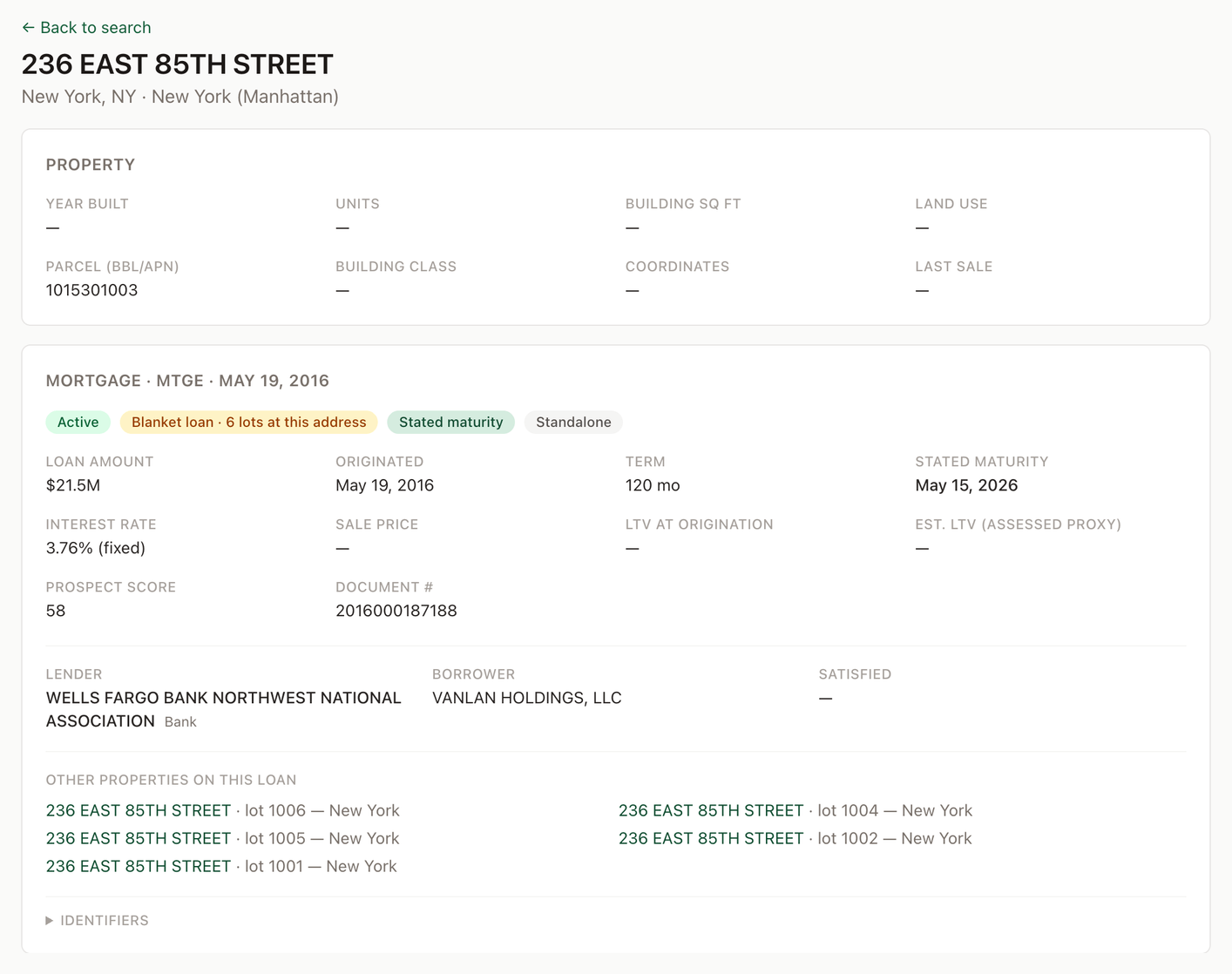 A loan whose maturity and rate were read from the recorded document: both render as stated facts with the document cited. A modelled maturity on the same page would carry an ≈ marker and a "term assumed" badge instead.
Here is what that honesty costs, in numbers. Of the loans we track, 37,879 have a maturity read from the recorded instrument. Plain mortgages state their terms about a quarter of the time; consolidation agreements almost never do — we read a 50-page CEMA end to end and found no maturity anywhere, because the amended note is an unrecorded exhibit. For those loans, the modelled date is the best any county-records product can do, and we say so rather than hide it behind a filter.
We think this is a genuine difference. Of the products we could verify, only PropertyShark labels its maturity dates as estimated on its own subscription page. Reonomy, Crexi, CoStar, and Actovia present a maturity filter without a published method. If a broker emails an owner about "your loan maturing in March" and the date was a guess, the broker — not the vendor — looks uninformed.
Keeping it current: the five guards
Stale data doesn't lose one lead; it disproves the product. In our own testing before these guards existed, a meaningful share of loans that looked active in the recorder had in fact been repaid, superseded, or foreclosed — 1,516 of them sat on collateral that had already been sold at auction. Email a broker about a loan that no longer exists and you've proven you don't have current data, to the one person whose job is knowing that. So the pipeline runs five guards every week, per borough:
- Satisfied. A recorded satisfaction or release, matched through References by CRFN and by document ID, removes the loan from the active set. Partial releases and partial satisfactions — a parcel freed from a blanket mortgage — are recorded as events but do not retire the loan.
- Superseded. A later consolidation (
M&CON, or a CEMAAGMT) that cites the loan replaces it: the old note is folded into the new one and stops being a separate maturity. This is the normal way a New York loan ends, and it is the guard most county-record products don't have. - Modified or assumed. A later modification declaration, assumption, or extension agreement flags the loan: its stated terms are superseded and must be re-verified before anyone cites them. 29,071 loans carry that flag today.
- Foreclosed. New York records foreclosure outcomes as ordinary deeds whose grantor is the court-appointed referee. We detect them by parcel; 3,313 loans in our book sit on collateral that was sold at auction, and none of them show as active.
- Distressed. Assignment of a loan to a special servicer, a recorded judgment against the parcel, or a deed-in-lieu to the lender flags a loan as distressed — the earliest signal the recorder offers before a foreclosure completes.
One limit worth stating plainly: lis pendens — the notice that a foreclosure lawsuit has been filed — lives with the courts, not the recorder, and the court system prohibits automated extraction. No county-records product has it unless it licenses a title-industry feed. Ours doesn't yet.
Turning maturities into commercial mortgage leads
The useful window is 6 to 18 months before maturity: early enough that the owner hasn't committed, late enough that the decision is real. The search is built around that:
- Maturity window on the best available date (stated if we have it, modelled otherwise, always labelled)
- Borough, property type, loan size, lender — including the lender's normalised identity, so "JPMORGAN CHASE BANK NA" and "J P MORGAN CHASE BK" are one lender
- Loan purpose from the recorded set: purchase money, CEMA refinance, split note
- Distressed only — the special-servicer, judgment, and deed-in-lieu signals above
- Two LTVs: at origination where the loan financed a purchase, and a current proxy from the assessed value (labelled as a proxy, never an appraisal)
- Prospect score that peaks in the 6–18 month window and discounts modelled dates
Each row links to the property, every mortgage on it, the other properties on a portfolio loan (22,321 active NYC loans secure more than one tax lot — how to read them), and the provenance of every field.
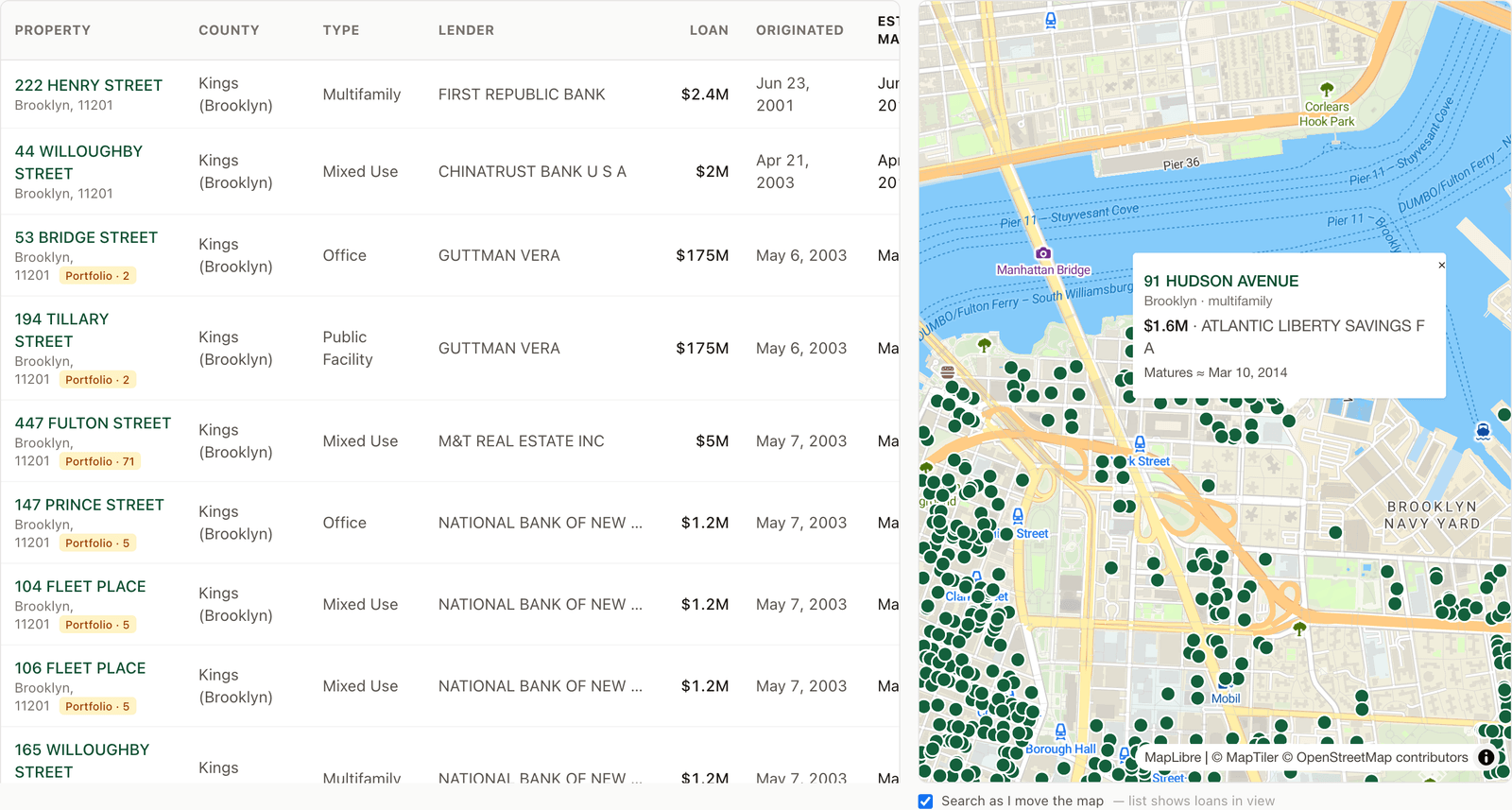 One query, filtered to $5M+ portfolio loans maturing within three years. The map view shows the same rows as points: pan it and the list re-scopes to what is visible; click a point for the loan.
How Circlemark compares
Only facts we could verify from vendors' own pages or published reviews; blanks mean we couldn't confirm.
| Source of maturity | Labels estimates? | NYC depth | Published price | |
|---|---|---|---|---|
| Circlemark | County record + document extraction; ABS-EE and agency disclosure for the securitized slice | Yes — per field, with citations | Four boroughs, all lenders, weekly | From $149/mo (data), $299/mo with outreach |
| PropertyShark | ACRIS aggregation | Yes ("estimated maturity dates") | Strong | $59.95–$169.95/mo |
| Reonomy (Altus) | County records + CMBS overlay | Not disclosed | National | From $400/mo (annual) |
| Actovia | Recorded mortgages + agency/CMBS | Not disclosed | NYC-native | ~$319–$389/user/mo (reported) |
| Crexi Intelligence | Public records + CMBS; rates estimated | Not disclosed | National | $249/user/mo or $2,388/yr |
| CRED iQ / Trepp | Servicer data | Stated (securitized loans only) | CMBS only | Enterprise |
The honest summary: for securitized loans, servicer-data products know more than any county record can. For the 70% of NYC maturities held by banks, the county record is the only source there is — and the question is whether your vendor tells you which dates it made up. What users of the national platforms report going wrong, the mechanism behind each failure, and six questions to ask before trusting a maturity date are in their own post: Reonomy alternatives for CRE loan data.
Known limitations
- Most maturities remain modelled until read from a document, and CEMA notes are usually unrecorded. We label rather than guess.
- Staten Island (Richmond County) is not in ACRIS and is not yet covered.
- Modifications recorded without a cross-reference to the original loan are missed — the guard is only as good as the clerk's indexing.
- Lis pendens filings are not included (courts, not the recorder).
- Current balances, DSCR and occupancy exist only in securitization disclosure; for conduit loans matched to their recorded instrument we hold them, but do not yet show them.
- Borrowers are LLCs; the people behind them are resolved from public records — how, and how often it works, is in the LLC-owner post.
If you broker commercial refinancings or sales in New York, the search is open. Every number in this post is live from the same database — figures refresh hourly, and the methodology is documented in full.
Frequently asked questions
- Is a commercial mortgage maturity date public record in New York City?
- Usually not as a data field. ACRIS records the mortgage, its amount, its date, and the parties, but has no maturity, term, or interest-rate field. The maturity is only public if it is written into the scanned document itself — common for plain mortgages, rare for consolidation agreements, where the note is typically an unrecorded exhibit.
- How does Circlemark estimate a maturity date from ACRIS?
- When the recorded document doesn't state one, we model the plausible terms for that lender type — 5, 7 or 10 years for banks, 3 or 5 for debt funds and bridge-style agreements, 10 for agency and CMBS — and keep all of them: a maturity filter matches if any plausible term lands in the window, and the row says which one. The headline estimate is the most common term for that lender type, labelled ≈ and never presented as a fact. Where the document states a maturity, we read it from the scan and cite the document.
- How often is the data updated?
- Each borough is re-read from the county recorder weekly. Lifecycle events — satisfactions, consolidations, assignments, modifications, assumptions, referee's deeds — are matched back to the original loan by CRFN and document ID, so a paid-off, superseded, or foreclosed loan never appears as active.
- How far ahead should a broker contact an owner about a maturing loan?
- The refinance process typically starts 6 to 18 months before maturity, and most vendors and lenders suggest opening the conversation 12 to 18 months out. Our prospect score peaks in that window.
- Does this cover CMBS loans?
- Conduit CMBS loans appear in ACRIS like any other mortgage and are included. Their stated maturity, rate and servicing status live in the trust's monthly SEC ABS-EE disclosure rather than the county record, and are attached to the recorded loan — matched by the disclosed address, amount and date, a note cut for one trust to the whole it came from. In our New York cohort, identifiable CMBS is under 1% of maturing loans — banks are 73%.
- Why do so many old NYC mortgages still look active in ACRIS?
- Two reasons. New York borrowers usually refinance by consolidating the old loan into a new CEMA rather than satisfying it, because a consolidation avoids paying mortgage recording tax again on the old principal — so there is often no satisfaction on file for a loan that is long gone. And when a satisfaction is filed, ACRIS References cite the loan by CRFN, not by document ID, so pipelines that match on document ID miss almost all of them. A loan is only 'active' if no later instrument — satisfaction or consolidation — cites it.
- What is the difference between MTGE, AGMT, and M&CON in ACRIS?
- MTGE is a mortgage. AGMT is an agreement, which in New York is often a consolidation, extension, or modification agreement. M&CON is a mortgage and consolidation — the CEMA instrument that combines prior notes into one loan. Reading any one of them alone gets the loan amount wrong; the recorded set has to be classified together.
Sources
- MBA: 17 Percent of Commercial and Multifamily Mortgage Balances to Mature in 2026 (Feb 9, 2026)
- Morningstar DBRS via Commercial Property Executive: $100B in CMBS Loans Mature This Year (Jan 22, 2026)
- Bisnow: NYC rent-stabilized lending data from Atrium (Mar 3, 2026)
- NYC Open Data: ACRIS Real Property Master
- NYC Open Data: ACRIS Real Property References (cross-references by CRFN)
- New York Tax Law § 255 — supplemental mortgages (the CEMA exemption from mortgage recording tax)
- NYC Open Data: ACRIS Document Control Codes
- NYC Department of City Planning: PLUTO
- SEC: Regulation AB asset-level disclosure (Form ABS-EE)
- PropertyShark subscriptions page (describes maturity dates as estimated)
Check one building
Type an address and see the mortgages recorded on it — lender, amount and the maturity read from the instrument. Free, no account.
Searches New York City. Only the house number and street matter — leave off the unit.
Read next
- NYC's 2026 maturity wall, borough by borough: $5.9B stated, $2.5B already past due
A per-borough data brief on New York City's 2026 commercial mortgage maturity wall — stated maturities only, read from the recorded instruments: 274 loans and $5.9B coming due in 12 months, 166 loans and $2.5B already matured and still open, 13 already carrying a distress filing. Every number traces to the record.
- Loan maturity leads: how CRE brokers source refinance deals before the balloon (2026)
A loan maturity lead is a commercial mortgage coming due on a property whose owner you can reach. Lead vendors sell them by the month or by the piece; the county record gives them away, with the one fact no vendor shows — whether the loan is still there. Of 130 Dallas–Fort Worth apartment loans past a stated maturity this year, 62 already carry a newer mortgage on the same lot; in New York, where few instruments print a date, it is 19 of 49. How to source the leads, which are real, and when to call.
- How to find maturing commercial loans in 2026: the three sources, the tools that search them, and a list you can pull today
Every maturing-loan list is built from the same three sources: the county recorder, securitization disclosure, and a model. This is how to search each one yourself, what each can and cannot tell you, how the tools that package them compare on price and on whether they admit which dates are guesses, and where to pull a list for New York or Texas without an account.
More on New York City
- How the New York City record is read — what is different about the market's public record, what we cover there, and the live counts.
- Loans maturing by county: Manhattan · Bronx · Brooklyn · Queens — each county's maturity windows, collateral mix and the lenders behind the loans coming due, counted from the record.
- Every New York City post
Guides to the public record
The rest of the series — how brokers find loans, owners and maturities in the county record.
- How to find maturing commercial loans
- Loan maturity leads: sourcing refinance deals before the balloon
- Is this commercial loan in default?
- Past maturity, no payoff recorded: what it means
- Where maturity data comes from
- Find the owner behind an LLC (New York)
- Find the owner behind an LLC (Texas)
- Search ACRIS for commercial mortgages
- How to read a recorded mortgage or CEMA
- How to read a blanket mortgage in ACRIS
- Who lends on NYC commercial real estate
- Who lends on Texas commercial real estate
- Reonomy alternatives for loan data