Why a third of every NYC 'commercial loan' list is somebody's apartment
35% of the mortgages that clear a commercial dollar floor in New York City are condo units, co-ops and one-to-four family houses. Here is why the standard property-centric filter can't see them, the one ACRIS field that can, and what our own data looked like before and after we applied it.
By Andrew Zhong, founder of Circlemark · · Updated · 9 min read · Figures as of Oct 24, 2026
Key numbers. Of the active New York City mortgages in our database that clear a commercial dollar floor — $2 million in Manhattan, $1 million in the other boroughs — 47,403 of 134,644, or 35%, are homes: a single condominium unit, a co-op unit, a one-to-four family house, a parking space or a storage room. In Manhattan the share is 31%; in Brooklyn 47%. Among Manhattan loans of $2–5 million it is 46%. Until this week, most of them were in our product too.
This post is about how that happens to every property-centric data tool in New York, the one public field that fixes it, and what our own numbers looked like before and after. If you have ever bought a "commercial mortgage" list and called an owner who turned out to be a dentist with a two-bedroom on the Upper East Side, this is why.
The $31 million mortgage on one apartment
Start with a concrete example. ACRIS — the city's recorder — holds a $31 million mortgage from First Republic Bank recorded against a single tax lot at 432 Park Avenue. Every rule a commercial-loan pipeline applies says yes: the amount clears any floor by an order of magnitude, the lender is a bank, the document is a standard MTGE, the address is Park Avenue. The collateral is one apartment.
It isn't an outlier. The same query returns a $28 million Bank of America mortgage on a townhouse at 10 East 78th Street, a $24 million loan on a house on Morton Street, and, a few thousand times over, $2–5 million loans from JPMorgan Chase, Wells Fargo, Citibank and Citizens on units at 25 Central Park West, 25 Columbus Circle, 1049 Fifth Avenue and 200 East 79th Street. Manhattan's residential jumbo market is large enough that, at a $2 million floor, it is nearly half of what looks like the $2–5 million commercial market.
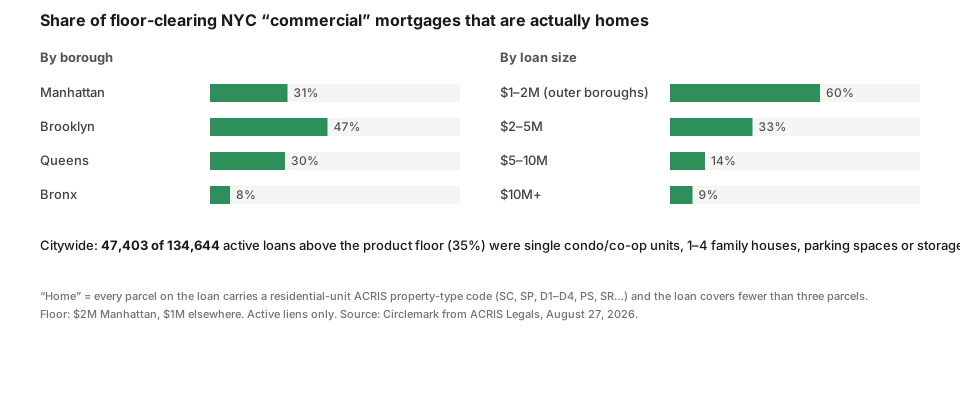 "Home" means every parcel on the loan carries a residential-unit property-type code in ACRIS and the loan covers fewer than three parcels. Active liens only, above the per-borough product floor.
Brooklyn is worse than Manhattan, for a different reason: at a $1 million floor, brownstones. One-, two- and three-family houses in Park Slope, Bed-Stuy and Carroll Gardens carry $1–3 million mortgages as a matter of course, and 47% of Brooklyn loans above the floor are on them.
Why the standard filter can't see them
Every commercial-loan product built on county records uses the same two-part test: a dollar floor, and a property-type check against the assessor's land-use file — in New York, the Department of City Planning's PLUTO. If PLUTO says the lot is a one-family house, the loan is dropped; if it says apartment building, office or store, the loan is kept.
The test fails on condominiums, and the failure is structural. In New York a condominium building is split into a billing lot for the whole building (lot numbers 7501 and up) and one unit lot per apartment (lot numbers 1001 to 6999). A mortgage on an apartment is recorded against the unit lot. PLUTO has a row for the billing lot — and no row at all for the unit lots. Ask PLUTO what lot 1-1347-1120 is and the answer is silence, not "residential". A pipeline that treats "unknown" as "not proven residential" — which is the only defensible default when you are trying not to drop real deals — waves every condo unit through.
Co-op units fail the same way for a related reason (the loan is on shares, recorded against the building's lot with a unit designation), and one-to-four family houses fail on a judgment call: PLUTO does flag them as residential, but a $5 million mortgage on a "one-family" is usually a townhouse conversion or a development site, so most pipelines — ours included, until now — override the residential flag above some amount. That override is right for the Morton Street developer and wrong for the East 78th Street mansion, and there is no way to tell them apart from PLUTO.
So the two sources that everyone uses — the amount and the assessor — are exactly the two that cannot answer the question for the lots where it matters most.
The field that answers it
The recorder can. Every ACRIS document has a Legals record for each lot it touches, and every Legals record carries a two-letter property_type code that the filer supplies when the document is recorded. The code describes the collateral on that lot, at that document, which is precisely the granularity PLUTO lacks. The city publishes the code table as open data:
| Code | Meaning | Treated as |
|---|---|---|
SC |
Single residential condo unit | Home |
SP / MP |
Single / multiple residential co-op unit | Home |
D1 – D4 |
Dwelling only, 1–4 family | Home |
PS / SR / MR / CK |
Parking space, storage room, maid's room, condo unit without kitchen | Home (accessory) |
D5 / D6 |
Dwelling only, 5–6 family | Commercial |
AP |
Apartment building | Commercial |
F1 / F4 / F5 |
1–6 family with store or office | Commercial |
MC / BS |
Multiple residential condo units / bulk condo sale | Commercial (sponsor or investor) |
CC / CP |
Commercial condo / co-op units | Commercial |
CR / OF / IB / RB |
Commercial real estate, office, industrial, retail | Commercial |
VL / VN / VR |
Vacant land | Commercial |
In our cache of 340,000 Legals records, the most common code by a wide margin is SC — 499,000 lot entries, three times the next code. It was sitting in the raw data the whole time; we were storing it and not reading it.
The rule we now apply is short. A parcel whose code is in the "home" group is marked non-commercial at ingest, before any enrichment. A loan is excluded from the product when every parcel it covers is a home and it covers fewer than three of them. The second clause matters: a $63.7 million Oaktree loan recorded against 108 SC units is a sponsor's inventory loan; an M&T mortgage across twenty-one two-family houses is an investor's portfolio. Those are commercial deals with one maturity date and one borrower, and they stay. A condo plus its parking space does not.
Multifamily is untouched. Apartment buildings, five- and six-family houses, mixed-use with a store on the ground floor, commercial condos — the collateral a broker actually works — all keep their codes and their place in the product.
Update, September 21, 2026. One-to-four family houses (
D1–D4) have since become their own segment rather than an exclusion. Brokers who work $1 million-plus investor loans on outer-borough houses asked for them, and at that size the collateral is overwhelmingly a rental, not a home. They are in the product under the property type Residential 1–4 Units, off by default — an "all types" search still returns commercial collateral only — and we read the recorded Fixed/Adjustable Rate Riders for their reset dates rather than modelling a maturity. The condo and co-op rule above is unchanged. The write-up is NYC investor house loans in 2026.
What it did to our own numbers
We publish our method so that the numbers can be checked, which means publishing the corrections too. Applying the rule and re-projecting the database changed the New York picture by more than any other single fix we have made:
| Before | After | |
|---|---|---|
| Active commercial loans tracked | ~116,000 | 90,158 |
| Loans maturing within 12 months | ~53,000 rows | 13,586 loans |
| Loans maturing in 2026 / 2027 | ~13,000 / ~13,000 | 6,535 / 7,271 |
| Maturities read from the recorded document | 7,163 | 3,240 |
| Portfolio loans (more than one lot) | 42,779 | 22,321 |
Two of those rows deserve a note.
The stated maturities. More than half of the maturities we had read from scanned documents were on homes. That is not a reading error — a residential mortgage states its maturity on page one, which is exactly why the extraction hit rate on those documents was so good. It was a targeting error: we were paying to read the wrong documents.
The rate resets. Earlier this week we read 3,786 long-dated bank notes — stated maturities 25 to 30 years out, the standard form for New York bank lending — looking for the adjustable-rate rider that says when the fixed period ends, because for a 30-year bank note the rate reset, not the maturity, is the refinancing event. We found riders on 2,015 of them: 10-year fixed on 63%, 7-year on 26%, 5-year on 9%, then floating with semi-annual or annual adjustment. It looked like a $4 billion reset wave in 2031–32. Nine in ten of those loans were condo ARMs — 7/1 and 10/1 adjustable-rate mortgages from First Republic, Chase and Wells Fargo on Manhattan apartments. On commercial collateral the stated-reset cohort is a few dozen loans. The mechanics we learned are real and now run in the weekly pipeline; the wave was not.
We have corrected the two earlier posts on this site that quoted the inflated figures, and the chart of maturities by year now shows commercial collateral only.
What this means if you buy loan data
Three practical points.
Ask the vendor how they handle condo unit lots. Not "do you filter residential" — every vendor says yes — but specifically how a loan recorded against a lot with no assessor record is classified. If the answer is the dollar floor, a third of the list is apartments, and the share rises as the floor falls. A list of $1–2 million loans in the outer boroughs is 60% homes.
Check the lender mix. A commercial list heavy with MERS as nominee, Wells Fargo, Chase, Citibank, Citizens and Bank of America in the $2–5 million band is a residential list. Those are the city's largest jumbo lenders; their multifamily and commercial books are real but they are not where the volume in that band comes from. Who is, counted from the record: Chase, then Cathay, Webster and the community banks.
Weight small multifamily correctly. The flip side of the fix is that genuine small commercial collateral — a six-family in Ridgewood, a mixed-use on Flatbush Avenue — is a larger share of the true market than the inflated counts suggested. When 35% of the noise is removed, the signal is the bank-financed 5-to-50-unit building, which is also the loan with no securitization disclosure and no servicer data. The recorder is its only public trace, which is why reading the recorder correctly is the whole job.
Every loan in Circlemark now carries the ACRIS property-type code on its parcels, the classification is applied at ingest so new recordings are handled the same way, and the rule is on the methodology page alongside the rest. If you find a home in the product, the property page cites the document — send it to us and we will fix the code table.
Frequently asked questions
- Why do condo mortgages show up in commercial loan databases?
- Because the usual way to tell a home from a building is the assessor's land-use file, and in New York the assessor file (PLUTO) has no record for condominium unit lots. A $4 million mortgage on one apartment at 25 Central Park West is recorded against its own tax lot, that lot is invisible to PLUTO, and any tool that filters on property type plus a dollar floor lets it through as a commercial loan.
- How can you tell a residential mortgage from a commercial one in ACRIS?
- Every recorded document's Legals record carries a property-type code. SC is a single residential condo unit, SP a co-op unit, D1 to D4 are one-to-four family dwellings, PS is a parking space. AP is an apartment building, CR commercial real estate, CC a commercial condo unit, OF an office building. The code is on the lot the loan is recorded against, not on the building, so it works exactly where the assessor data doesn't.
- Is multifamily still commercial under this definition?
- Yes. Apartment buildings (AP), five- and six-family houses, mixed-use with stores, commercial condos, and any loan that blankets three or more residential units — a sponsor's inventory loan or an investor's portfolio of two-family houses — are all commercial collateral. Only loans on a single dwelling unit, or a unit plus its parking space or storage room, are homes.
- How much of a NYC commercial loan list is residential?
- In our data, 35% of active mortgages above the product floor — 47,403 of 134,644 — were on a single condo unit, co-op unit, one-to-four family house, parking space or storage room. Manhattan was 31%, Brooklyn 47%, Queens 30%, the Bronx 8%. Among $2–5 million Manhattan loans it was 46%.
- Does excluding homes change the maturity picture?
- Substantially. Before the fix we showed roughly 13,000 NYC commercial loans maturing in each of 2026 and 2027; on commercial collateral only it is about 6,500 and 7,300. The 30-year bank notes we had been reading for rate-reset terms turned out to be 7/1 and 10/1 adjustable-rate mortgages on condos in nine cases out of ten.
- Where does Circlemark's data come from?
- The NYC Department of Finance's ACRIS records (Master, Legals, Parties, References), the Department of City Planning's PLUTO file, and the scanned recorded instruments themselves, which we read for stated maturity, rate and reset terms. Every field carries the document it came from.
Sources
- NYC Open Data: ACRIS Real Property Legals (property_type per recorded document)
- NYC Open Data: ACRIS Property Types Codes
- NYC Department of City Planning: PLUTO (no rows for condominium unit lots)
- NYC Department of Finance: Condominium billing lots and unit lots (BBL conventions)
- MBA: 17 Percent of Commercial and Multifamily Mortgage Balances to Mature in 2026
- The Real Deal: $20B of NYCB multifamily loans reset by 2027 (Oct 2024)
Check one building
Type an address and see the mortgages recorded on it — lender, amount and the maturity read from the instrument. Free, no account.
Searches New York City. Only the house number and street matter — leave off the unit.
Read next
- ACRIS commercial mortgage search: a broker's guide to the NYC register (2026)
ACRIS indexes every mortgage recorded in Manhattan, the Bronx, Brooklyn and Queens, and it is free. It also indexes the wrong things for a broker: the document, not the loan; the amount, not the maturity; the satisfaction by a number nobody else uses. How to search it by building, by borrower and by lender, what to read in the result list, where the open-data mirror helps, and why no ACRIS search can produce a list of loans coming due.
- How we monitor NYC commercial mortgage maturities for brokers in 2026 (and why ACRIS makes it hard)
Where commercial mortgage maturity data actually comes from, why New York City's public records don't contain a maturity date, and how Circlemark turns recorded documents into a verified, weekly-refreshed list of loans coming due.
- NYC ARM resets in 2027: what the riders say the rate becomes
ICE counts 186,020 adjustable-rate mortgages resetting nationally in 2027. In New York City the recorded Fixed/Adjustable Rate Riders say what those loans re-set to: the initial rate, the index, the margin and the caps on 5,563 active $1M+ loans with a stated first rate change — 384 of them in 2027 and 361 in 2028. The margins, the cap forms that decide the first year, and the 1,346 riders that still name one-year LIBOR.
More on New York City
- How the New York City record is read — what is different about the market's public record, what we cover there, and the live counts.
- Loans maturing by county: Manhattan · Bronx · Brooklyn · Queens — each county's maturity windows, collateral mix and the lenders behind the loans coming due, counted from the record.
- Every New York City post
Research from the county record
The rest of the briefs — one market, one lender or one cohort, counted from the recorded instruments and dated to the pull.
- Gas station, convenience store and car wash loans
- NYC ARM resets in 2027: what the riders say
- The debt behind Austin's renters' market
- Are banks back in commercial real estate lending?
- NYC rent-stabilized building loans coming due
- Why Texas files every warehouse as "commercial"
- NYC's 2026 maturity wall, lender by lender
- NYC investor house loans and the ARM wall
- DFW's 2026 maturity wall, county by county
- NYC's 2026 maturity wall, borough by borough