How to find the owner of a commercial property in NYC (2026)
Find a NYC commercial property owner's name, title, email and phone from public records, even behind an LLC. Four city records, measured on 123,989 loans.
By Andrew Zhong, founder of Circlemark · · Updated · 20 min read · Figures as of Oct 22, 2026
You can't get it from the state — New York's LLC Transparency Act doesn't apply to LLCs formed in New York or Delaware — but four city records name a person for 85% of NYC commercial loans over $1 million: the HPD registration's officers, DOB NOW permit contacts, the signature page of the recorded mortgage in ACRIS, and the assessor's owner of record.
Skip the search. Type an address and the lookup reads the recorded instrument for you — lender, amount and maturity — free, no account. Or search every loan in your market on a free seat: no card, 10 owner reveals, 60 searches, nothing expires.
Of the 123,989 active commercial mortgages of $1 million or more in New York City's four ACRIS boroughs, 74,333 — 60% — are held by an LLC, corporation, partnership or trust, and those loans average $13.1 million against $2.3 million for the ones held in a person's name. The bigger the deal, the more certain it is that the recorder will hand you a shell with a street address for a name. Every broker who works maturities runs into the same wall: the loan is real, the maturity is real, and the borrower is "1140 [STREET] OWNER LLC".
The obvious hope — that the state would finally publish who is behind these entities — was cancelled before it started. New York's LLC Transparency Act took effect on January 1, 2026, and it will not help you. A 2024 chapter amendment removed the public database, so filings go to a system open only to government agencies and law enforcement. Then FinCEN's March 2025 rule, which the Act's definitions follow, dropped US-formed companies from the federal regime, and a December 2025 veto of the bill that would have restored them left the Act covering only LLCs formed outside the United States. An LLC formed in New York or Delaware, which describes nearly every borrower entity in ACRIS, files nothing at all. For a broker, the Act changes nothing.
What does answer the question is a set of city records that each, for their own reasons, require a natural person's name. None of them covers everything. So rather than list them, we measured them: for every active NYC commercial loan over $1 million, which public records name a person tied to the borrower, its building, or the instrument itself? The answer is that 85% of loans have at least one, and the sources rank in a way that is worth knowing before you spend money on a data vendor.
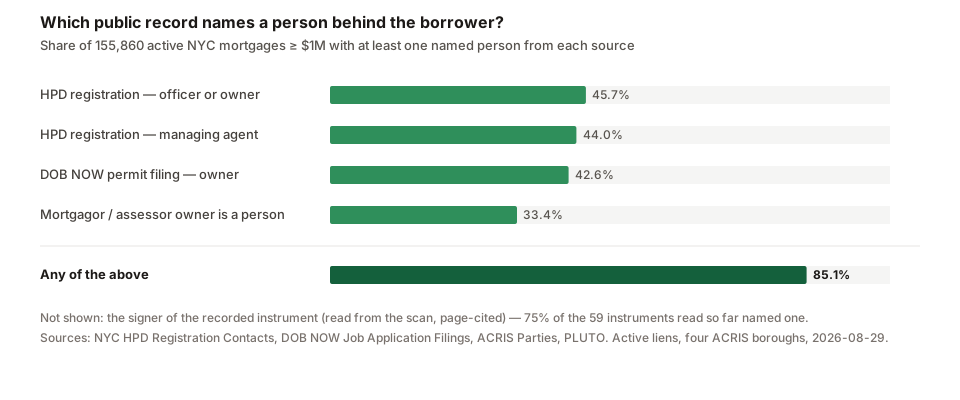 Active liens above $1 million, four ACRIS boroughs. A loan counts for a source if that source names a natural person on any parcel securing the loan, on the borrower entity, or on the recorded instrument. Measured 2026-08-29.
1. The HPD registration: the officers an LLC must name
Every multiple dwelling in New York — three or more residential units — must be registered with the Department of Housing Preservation and Development each year under Housing Maintenance Code §27-2097. The statute is the reason this record is so good: when the owner is a corporation, the registration must include the names and business addresses of its officers and of any person whose share of ownership exceeds twenty-five percent; and every registration must designate a managing agent who is a natural person over 21 with a residence or business office in the city. HPD needs someone to serve with legal notice, so a shell will not do.
The city publishes the whole thing as open data. Registrations (203,887 of them) map to a borough, block and lot; contacts (782,000 rows) hang off each registration with a type — HeadOfficer, Officer, Shareholder, IndividualOwner, JointOwner, Agent, SiteManager — and a name, title and business address. For a building held by "141 [Street] Owner LLC" you get, in the registration's own words, something like "J. Doe, Principal, 141 [Street], New York NY" — a person, a title, a business address.
Across our loan book, an HPD registration names an officer or owner for 41.5% of active commercial loans over $1 million, and a managing agent for 39.4%. That is the ceiling for this source, and it is a structural one: HPD registers residential buildings. Office, retail, industrial, hotel and land have no registration, so the coverage is really "most of multifamily" and "none of the rest".
Two things to know when reading it. The HeadOfficer is usually the principal — the person who can say yes to a refinance — while an Agent is the management company's employee, who can route you to ownership but does not decide anything. And the addresses are business addresses: for a small landlord that is often their home; for an agent it is the management office.
2. The signature page of the recorded instrument
This is the source nobody uses, because it is not in any index. ACRIS's structured data gives you the mortgagor as "1140 [STREET] OWNER LLC" and nothing more. But ACRIS also serves the scanned instrument, page by page, and a mortgage or consolidation agreement has to be signed — by a person, in a stated capacity, with a notary acknowledgment recording who appeared:
By: /s/ [signature] — Jane Doe, Managing Member
That line is the borrower's decision-maker, in the borrower's own filing, with the title the borrower chose. It is also, in provenance terms, the best evidence there is — read off the recorded document rather than compiled from it.
We read the last pages of 59 instruments on active loans and found a named borrower-side signer with a title on 44 (75%). The mechanics matter if you try this by hand: the signature block and the acknowledgment sit just before Exhibit A (the legal description) and the riders, so on a typical 34-page mortgage they are around pages 25–30, not the last page. ACRIS does not tell you how many pages a document has — it serves a placeholder image past the end rather than an error — so you page forward until the scans stop being scans. Consolidation agreements and CEMAs are signed by both sides; take the mortgagor's block, not the bank's.
The signer's name comes with no address of its own. Pair it with the mortgagor's mailing address from ACRIS Parties, which is on the same document and is usually where the LLC's principal actually receives mail.
3. DOB NOW permit filings: the owner on every job
Every permit application filed with the Department of Buildings since 2019 names the property owner — first name, last name, owner type, and for a corporation the business name. It is filed by the owner's architect or expediter, so the "owner" is whoever they typed, and on a large project it is sometimes the construction manager's contact rather than the principal. But it covers the buildings HPD does not: a permit gets pulled on an office lobby renovation or a retail build-out just as it does on an apartment building.
DOB NOW owners exist for 39.1% of loans in our book, and the overlap with HPD is only partial — which is why the combined number is so much higher than either alone. Weight it below the HPD officer and the signer, and above nothing.
4. When the borrower is a person after all
For 40.0% of loans the recorder or the assessor already names a natural person: the mortgagor of record is "SMITH, JOHN" rather than an LLC, or the assessor's owner of record is. These are the smaller loans — the $2.3 million average above — and they come with the best address of all: the mortgagor's mailing address on the ACRIS Parties record, which is where the bank sends the statements.
Outside New York: the state that publishes officers
Texas is the mirror image. There the state itself publishes who runs an LLC — every Texas corporation, LLC and limited partnership reports its officers and managers to the Comptroller each year, and the Comptroller's entity search lists them free — and the appraisal district names the owner of record with a mailing address on every parcel. The Texas guide walks those records in the same order as this one. The ranking in the next section, and the two routes to a phone number after it, hold in both states.
5. What the state gives you (and doesn't)
The Department of State's entity search returns the LLC's name, county, formation date, and an address where the Secretary of State will forward process — often the formation service's address, not the owner's. It does not list members or managers, and the LLC Transparency Act does not change that for the public. Use it for one thing: confirming the exact legal name and formation date when two similar LLCs are in play.
Together: 85% of loans, and a clear order of preference
Stacked, the sources name at least one person for 84.9% of active NYC commercial loans over $1 million. The remaining 15% skew commercial (no HPD), permit-quiet (no DOB), and held in an entity (no person of record) — which is exactly the population where the signature page earns its keep. It earns it elsewhere too, which is why we now read it for every loan someone unlocks rather than only where the record is silent (see the Grand Concourse case below).
When a loan has several names, rank them by how close they stand to the decision:
- The signer of the instrument — committed the entity to the loan.
- HPD officers, owners and >25% shareholders — the entity's own filing of who runs it. Within a registration, the person HPD designates as head officer outranks the other officers whatever title they typed; the designation is the filing, the title box is free text.
- The person of record (mortgagor or assessor owner) — the small-landlord case.
- DOB filing owners — real people, sometimes one step removed.
- Managing agents — the door, not the decision-maker.
When the disclosure names no borrower
Some loans reach the public domain without a borrower at all. A mortgage that was securitised — packaged into a CMBS trust, or sold to Freddie Mac and reported in a K-deal — is disclosed to investors property by property: address, unit count, balance, rate, maturity, servicer. The borrower line is blank, or reads "N/A". A disclosed loan is matched first to the instrument the county recorded at its address, and that instrument carries the mortgagor, the building's HPD registration and the signature page; what follows is the remainder, where the county has no instrument. Across active New York loans in our data that is roughly 960 loans and $26 billion, the bulk of it CMBS.
For an apartment building this is an inconvenience rather than a wall. The HPD registration is filed about the building, not the loan, so the officers are still there. For an office tower, a hotel, a retail condo or a ground-up development — no registration, often no recent permit, an entity as mortgagor — all four routes above come back empty. The loan is completely documented and nobody is named anywhere.
What is left is the building's own trade, which is more public than people expect. An institutional sale of size is reported, and the report names the buyer. The building's leasing or management page names the operator. Three checks, in this order:
- Search the address in the trade press. Not the LLC — the street address and the building's name, against Commercial Observer, The Real Deal, Bisnow, Crain's. A purchase, a refinancing or a foreclosure is written up, and the write-up names the sponsor and dates the deal.
- Confirm it on the firm's own site. A real owner lists the building in its portfolio. If the firm's site never mentions the address, you have a press mention, not a confirmation.
- Check the leasing page for the operator. "Professionally managed by …" names the management company, which is who answers the phone but usually not who signs.
Two cautions, and they are the whole difference between this and a public record. A press report is evidence that a sale happened on a date, not a record of who holds title today; an unreported sale since makes your answer quietly stale, and the loan's origination date is a useful cross-check — a sponsor named in a 2019 article alongside a 2019 acquisition loan is corroborated by the record, one named alongside nothing is not. And an operator is not an owner: a management company or a leasing brokerage on the building's website tells you who runs the property, not who decides on the debt. Keep the two labelled separately, and never let the easier answer stand in for the harder one.
Three people called "owner", and only one of them decides
The records above produce three different kinds of person, and the word "owner" is attached to all of them. On the HPD registration the head officer is the entity's own filing of who runs it. On a permit the owner contact is whoever the architect typed in — often the management company's project manager, sometimes the contractor's. On the instrument the signer committed the entity to the loan. Only the first and the last decide anything about the building.
The trap is that the three are not equally findable, and the order of findability is the reverse of the order of authority. A permit contact comes with an employer, and business-contact databases are indexed by employer, so a lookup finds them. A head officer comes with the LLC, which no database lists as anyone's employer, so the same lookup finds nothing. A tool that leads with whoever it could reach will therefore lead with the manager, the leasing agent or the general contractor's coordinator, with the person who can sign a refinance sitting two rows down with a blank next to their name. We measured this on the people behind eleven loans from a broker's own session in September 2026: of 33 owners and officers, the ones a vendor answered first were managers and contractors in most cases, and on two of the eleven properties the person the card led with was not the owner at all — one was the property manager, one a contractor's permit contact. Both mistakes were visible in the record itself. The head officer's registered address matched the LLC's address on the deed; the contractor's employer was a construction company in Suffolk County.
The fix is a rule, not a vendor: rank by role first, and treat "can we reach them" as a separate question with its own answer. The decision-maker leads whether or not there is a number next to them, and the reachable manager is shown as the way in today.
There is a fourth kind of tie, inside the HPD registration itself. An LLC with two partners registers both as "Member"; HPD's form also asks which one is the head officer, and the answer is not in the title box. On a 66-unit building on the Grand Concourse the registration lists two members, one designated head officer, and for a month our card led with him because his name sorted first — the right person, for the wrong reason. Across the city that tie existed on 2,646 registrations, and on the ones where the alphabet fell the other way the card led with the wrong officer. The designation now counts as a title. And when we then read the signature page of the building's $10.1 million consolidation, it named the other member as managing member: the head officer runs the building, the managing member signs its debt, and for a loan conversation the second is who you want. Both facts are on the card; the signer leads.
The LLC is not the firm
The second thing the same 33 people taught us is why the owner's row was blank. Every business-contact source, whether it is a B2B database or a waterfall of them, matches a person at an employer. Hand it "the head officer of 476 [Street] LLC" and it has nothing to match, because a single-asset LLC exists on paper only; nobody lists it on a profile. Hand it the same person at the firm they actually run, and it answers.
The public record almost never names that firm. The HPD registration gives the LLC and a business address; the permit gives a manager's employer, which is the wrong firm; the deed gives the LLC. So the step that matters is one the records cannot do for you: from the officer's name, title and office address, establish the operating company — the investment, ownership or brokerage firm whose principal they are — and only then go looking for a work email. In our test the record named an operating firm for about a third of the principals. For the rest, establishing the firm turned four blank rows into work emails at four different firms, every one of them a company the officer founded or runs, and every one of them absent from the city's records.
Two cautions. An address shared by several firms produces the wrong firm as easily as the right one; a busy floor of a downtown tower houses a brokerage, a lender and three management companies, and the one that registers the most buildings is not the one your officer runs. And the firm has to be confirmed on a page that names the person, or it is a guess with a bill attached.
Office versus home: which route finds a phone
Phones come from two different kinds of source, and each needs a different key.
A skip trace is keyed on a residential address. It returns the people associated with that address, their mobiles, landlines and personal mailboxes, with Do-Not-Call and litigator flags. Keyed on the building, it returns tenants; keyed on an office, it returns the office's other occupants. Keyed on the owner's own home, it works: in our test it returned a mobile for 3 of 3 owners whose registered address was a residence, and for 0 of those registered at an office. The address on the HPD registration is a business address, which for a small landlord is home and for a firm's principal is the firm.
A business-contact lookup is keyed on a person at a firm, and it is the only route for someone who registers everything at the office. Once the firm was established, it returned a mobile for 5 of 10 office-registered principals, people no skip trace could touch. It is also the more expensive route per attempt, so it belongs after the cheaper one, not before.
Where does an office-registered owner's home address come from? Sometimes from their other filings: the same person registered at a residence for a building they hold personally. Sometimes from the open web, if a house was bought in their own name. In our test the web produced a usable home address for 2 of 12 such people, and one of those yielded a mobile. It is a fallback, not a plan.
Mobile, switchboard, home line, and the flag that matters more
The number that comes back needs a label before anyone dials it, and the labels are not decoration.
- A mobile from a business-contact source is the number a principal answers.
- A home line from a skip trace reaches the household. Useful for a small landlord, useless for a fund.
- An office line published on the firm's website is a switchboard. It is the same number on every officer of that firm, and on our test three or four people per building shared one. It is not a contact for the person; it is a contact for the firm.
- A Do-Not-Call flag outranks all of the above. Of the mobiles the skip trace returned in our test, three of five carried it. A DNC mobile is not a win; it is a number you may not cold-call.
Email has the same three kinds: a work mailbox at the firm, a personal mailbox from the skip trace, and the firm's general inbox from its website. The general inbox reaches the firm's reception. For a small owner the personal mailbox is often the one that gets read.
One more thing the record does that a list will not warn you about: the city spells people differently on different filings. The same managing member's surname loses a vowel between one year's registration and the next; a partner's is transliterated two ways across two buildings of the same partnership. Each spelling looks like a different person, each gets its own lookup, and the one that gets answered is not always the one on the loan you care about.
What the test looked like in aggregate
Eleven NYC loans a broker had asked about, 33 owners and officers behind them, every public source above plus a published-web lookup, a business-contact lookup and a skip trace, run in September 2026:
| People | |
|---|---|
| A mobile number, first pass | 3 |
| A work or personal email, first pass | 8 |
| A switchboard number only | 8 |
| Nothing from any source, first pass | 16 |
| Operating firm established, of those the record named none for | 7 of 32 |
| New work emails from those firms | 4 |
| Mobiles for office-registered principals via the firm route | 5 of 10 |
| Mobiles via a home address | 3 of 3 with a home, 0 of the rest |
The honest reading is that the public record finds the person on most loans, that a name alone reaches nobody, and that the two things a broker needs after the name — the firm the person runs and the address where they live — are exactly the two things the record leaves out. Guards that stay on regardless: accept a vendor answer only when the returned name matches the person you asked about; keep every Do-Not-Call and litigator flag; never autodial or text without consent.
How Circlemark does it
Every loan on Circlemark carries the people the public record ties to it — HPD officers and agents, DOB owners, the person of record, and the instrument's signer where we have read it — and shows, before any click, who is there by role and source: "Head officer · HPD registration", "Managing Member · signed the recorded instrument". One credit unlocks the names, firms and addresses for that property, with each source and provenance tier next to the name, and looks for a work email: the decision-maker's first, then the next principal's only until someone can be reached; anyone else's is a free ask from the card. The same click reads the last pages of the leading instrument, and who signed for the borrower lands on the card within about a minute, with the title they signed under. The card leads with the decision-maker on record, ranked by role, source and title, whether or not a contact has been found yet; when it has not, the best-ranked person who can be reached today is shown beside them, labelled as exactly that. Where the record names only the LLC, Circlemark establishes the operating firm the person runs and shows it next to their name. Where the record names nobody at all — the securitised loan above — it identifies the owning or operating firm from a page that names both the building and the firm, links that page and dates the sale, and shows the firm's principals as being at the owner firm rather than on the record, because that is what they are. A direct phone is an add-on per person, charged only when a number is found; numbers are labelled mobile, home line or via the firm, the lane that supplied each one is named, and a Do-Not-Call number is shown greyed and unlinked. Nothing is guessed; a number we cannot verify is not shown. If a card looks wrong, "Re-check contacts" asks the sources again about the top people and replaces your view with what they say now, one credit — yours to decide, because a re-check can lose an answer a source no longer returns as easily as it drops a stale one. Where the people panel sits on the record page, and how to reach a record from a market-wide search, is in the search tutorial.
Here is what the card says before anything is spent. The borrower is an LLC, and the line under it is the count by source — how many people the record names behind that LLC and which filing named each of them. No name is shown, because none has been bought; the point of the line is that you can tell whether there is anything to buy.

Read it as the sources section above reads: two of the three came from the HPD registration, which an owner of a multiple dwelling must file and keep current, and the third from a permit filing. A building whose card says no principal named on the public record is one where the registration, the permits and the assessor are all silent — and the post's fourth and fifth routes are what is left.
That is the difference between a contact database and a public-record method: you can see why a name is there, who actually decides, and you only pay when it turns into a way to reach someone.
Frequently asked questions
- How do I find out who owns an LLC that owns a building in NYC?
- Not from the state. New York's Department of State lists an LLC's name, formation date and an address for service of process. The LLC Transparency Act that took effect on January 1, 2026 applies only to LLCs formed outside the US, and even those filings are open only to law enforcement. The people are in the city's records instead: the HPD property registration (officers and any shareholder over 25% for a corporate owner, plus a managing agent), the DOB NOW permit filings (the owner's name and business), the signature page of the recorded mortgage or deed in ACRIS, and, for the smallest owners, the assessor's owner of record.
- What is a Head Officer on an HPD registration?
- When a multiple dwelling (three or more units) is owned by a corporation or LLC, Housing Maintenance Code §27-2097 requires the annual registration to name the entity's officers and any person owning more than 25% of it, with business addresses, plus a managing agent who is a natural person with a New York office. HPD labels the principal officer 'HeadOfficer'. It is the single most reliable public name for a person behind a NYC multifamily LLC — in our data it exists for 46% of active commercial loans over $1 million.
- Does ACRIS show the owner of an LLC?
- The indexed data shows the LLC, not the person. But ACRIS also serves the scanned instrument, and every mortgage, consolidation agreement and deed ends with a signature block ('By: ___, Managing Member') and a notary acknowledgment naming who appeared to sign. Reading those pages named a borrower-side signer with a title on 75% of the instruments we have read so far. The pages sit just before Exhibit A, around page 25–35 of a typical 34-page mortgage.
- Can I get a phone number for the person behind an LLC?
- Sometimes, and which route works depends on where the person registers. An owner who registers at home can be skip-traced: keyed on that address, a skip-trace vendor returned a mobile for 3 of 3 such owners in our September 2026 test, and nothing for anyone registered at an office, where the answer is the office's other tenants. An owner who registers everything at the office — the principal of a firm — is reached the other way round: identify the firm they run, then ask a business-contact vendor for that person at that firm; that route returned a mobile for 5 of 10 office-registered principals. Managing agents almost never match either way; call the management company instead.
- Who is the borrower on a securitised (CMBS or Freddie Mac) loan?
- The disclosure usually does not say. A securitised loan is reported to investors property by property — address, balance, rate, maturity — with the borrower line blank or "N/A", because the borrower is a single-purpose LLC formed for that building. For an apartment building the HPD registration still names the officers. For an office tower or a hotel, no city record names anyone, and the sponsor has to come from the reported sale: the trade press names the buyer and dates the deal, and the firm's own portfolio page confirms it. That is evidence of a sale on a date, not a record of title.
- Why does the manager show up instead of the owner?
- Because the manager is easier to find, not because the manager owns anything. A permit filing names the management company's employee with their employer; the HPD registration names the entity's head officer with only the LLC. Contact vendors key on an employer, so the manager comes back with an email and the owner comes back with nothing, and a tool that leads with whoever it could reach will lead with the manager. Rank by role first — signer, officer, person of record, permit contact, agent — and treat reachability as a separate question.
- Is it legal to contact a property owner found through public records?
- Yes, for personal business outreach. Email under CAN-SPAM needs accurate headers, a postal address and a working opt-out. Calls need the number scrubbed against the Do-Not-Call registry and no autodialer or prerecorded voice without consent; texts need consent. Vendors flag DNC and TCPA-litigator numbers for exactly this reason — honour the flags.
- Why doesn't the New York LLC Transparency Act make owners public?
- It was narrowed twice before taking effect. The original 2023 bill created a public searchable database of LLC beneficial owners; the 2024 chapter amendment removed public access, so the law that took effect on January 1, 2026 stores the information in a database available only to government agencies and law enforcement. Then, because the Act borrows the federal Corporate Transparency Act's definition of a reporting company, FinCEN's March 2025 rule exempting US-formed companies narrowed it to LLCs formed outside the United States, and Governor Hochul's December 2025 veto of the bill that would have restored New York LLCs left it there. A New York or Delaware LLC files nothing.
Sources
- NYC Open Data: HPD Registration Contacts (owner officers, shareholders, managing agents per multiple dwelling)
- NYC Open Data: HPD Multiple Dwelling Registrations (registration → BBL)
- NYC Administrative Code §27-2097 — Registration; who must be named
- NYC Open Data: DOB NOW Build – Job Application Filings (owner name, owner business name)
- NYC Open Data: ACRIS Real Property Parties (mortgagor name and mailing address)
- Holland & Knight: New York LLC Transparency Act — reporting limited to non-U.S. LLCs after the December 19, 2025 veto of S8432
- ABA Business Law Today: Beneficial ownership reporting and the New York LLC Transparency Act (database not public)
Check one building
Type an address and see the mortgages recorded on it — lender, amount and the maturity read from the instrument. Free, no account.
Searches New York City. Only the house number and street matter — leave off the unit.
Read next
- How to find the owner of a commercial property in Texas, even behind an LLC (2026)
Texas is the opposite of New York: the state itself publishes who runs an LLC. The appraisal district names the owner of record and a mailing address, the Comptroller's franchise-tax search lists the officers and managers every LLC must report each year, and the deed of trust's signature page names who committed the entity to the loan. Where each one is, what it costs (one search is $1, the rest are free), and which one reaches a decision-maker.
- NYC ARM resets in 2027: what the riders say the rate becomes
ICE counts 186,020 adjustable-rate mortgages resetting nationally in 2027. In New York City the recorded Fixed/Adjustable Rate Riders say what those loans re-set to: the initial rate, the index, the margin and the caps on 5,563 active $1M+ loans with a stated first rate change — 384 of them in 2027 and 361 in 2028. The margins, the cap forms that decide the first year, and the 1,346 riders that still name one-year LIBOR.
- ACRIS commercial mortgage search: a broker's guide to the NYC register (2026)
ACRIS indexes every mortgage recorded in Manhattan, the Bronx, Brooklyn and Queens, and it is free. It also indexes the wrong things for a broker: the document, not the loan; the amount, not the maturity; the satisfaction by a number nobody else uses. How to search it by building, by borrower and by lender, what to read in the result list, where the open-data mirror helps, and why no ACRIS search can produce a list of loans coming due.
More on New York City
- How the New York City record is read — what is different about the market's public record, what we cover there, and the live counts.
- Loans maturing by county: Manhattan · Bronx · Brooklyn · Queens — each county's maturity windows, collateral mix and the lenders behind the loans coming due, counted from the record.
- Every New York City post
Guides to the public record
The rest of the series — how brokers find loans, owners and maturities in the county record.
- How to find maturing commercial loans
- Loan maturity leads: sourcing refinance deals before the balloon
- Is this commercial loan in default?
- Past maturity, no payoff recorded: what it means
- Where maturity data comes from
- How NYC loan maturities are monitored
- Find the owner behind an LLC (Texas)
- Search ACRIS for commercial mortgages
- How to read a recorded mortgage or CEMA
- How to read a blanket mortgage in ACRIS
- Who lends on NYC commercial real estate
- Rent-stabilized building loans in New York
- Who lends on Texas commercial real estate
- Why Texas files every warehouse as "commercial"
- Reonomy alternatives for loan data