Where commercial mortgage maturity data actually comes from
Every CRE maturity date in every data product traces to one of three sources: the county recorder, securitization disclosure, or somebody's model. What each one covers, what each one hides, and the questions to ask any vendor before you trust a date — with New York and Texas as the worked examples.
By Andrew Zhong, founder of Circlemark · · 6 min read · Figures as of Oct 22, 2026
Key numbers. The Mortgage Bankers Association counts $875 billion of commercial and multifamily mortgages maturing in 2026 — 17% of everything outstanding — and S&P Global expects the wall to peak in 2027. Every refinance, extension, recapitalization, and forced sale in that wave starts from the same question: when does the loan come due? And here is the industry's inconvenient foundation: for most commercial loans in America, no public dataset contains that date.
Skip the search. Type an address and the lookup reads the recorded instrument for you — lender, amount and maturity — free, no account. Or search every loan in your market on a free seat: no card, 10 owner reveals, 60 searches, nothing expires.
Every maturity date in every CRE data product — ours included — traces back to one of exactly three sources. Knowing which one produced the date you're looking at is the difference between a prospecting edge and an embarrassing phone call.
The three sources
| Source | What it holds | Who it covers | Maturity? |
|---|---|---|---|
| County recorder | Every recorded mortgage, deed of trust, satisfaction, assignment, modification | All loans, all lenders — the whole market | No field. Only if written in the scanned document |
| Securitization & agency disclosure (SEC ABS-EE, Freddie K-deals, HUD) | Loan-level monthly data: balance, rate, maturity, servicing status | Public conduit CMBS and agency deals only | Yes, stated |
| Models & trade press | "Estimated" dates; deal announcements | Whatever got modelled or written about | A guess, of varying honesty |
Everything on the market is a blend of these. The questions that separate products are which blend, whether modelled dates are labelled, and how fast a dead loan leaves the list.
Source 1: the county recorder — everything, except the one date you want
The United States records property debt in roughly 3,000 county-level offices, each with its own index, format, and quirks. What they share: the recorder indexes that a loan exists — document type, parties, date, usually an amount — and almost never when it matures. The term lives inside the scanned instrument, if the drafting attorney put it on a recorded page at all.
When the attorney did put it on a recorded page, this is what the first source gives you — a date, and the document it came off:
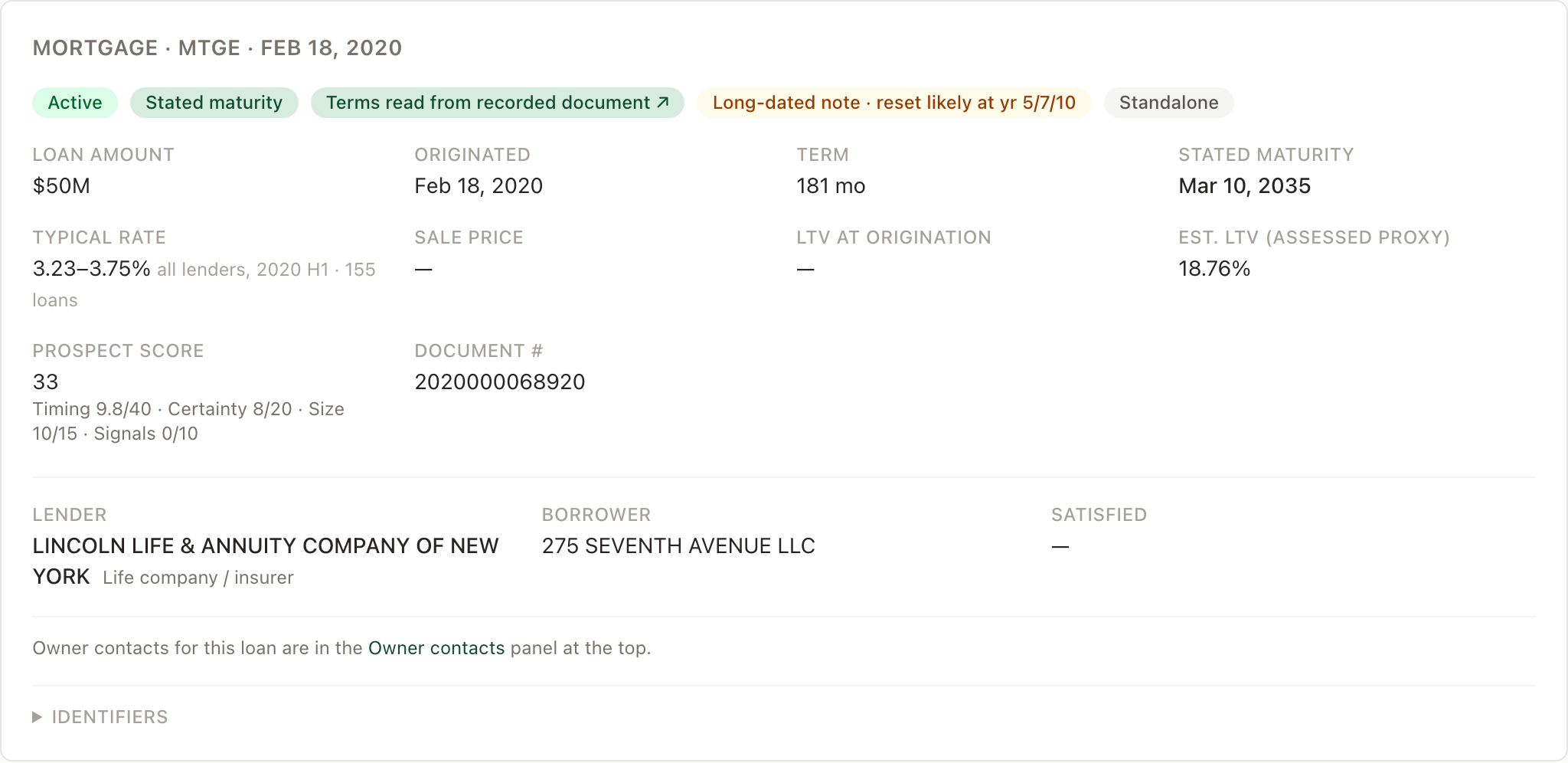
A fifteen-year note from a life company, the maturity printed on the instrument, the instrument one click away, and the amber badge saying the thing a stated maturity does not: on paper this long the rate resets years before the note comes due, so the date that starts a conversation is not the one in the maturity field. That is one loan. The next one along may give up nothing but an origination date, and then the third source below is all there is.
Two markets we work in daily show how differently that plays out:
New York City (ACRIS). The index is open data and rich — amount, parties, parcel, document type — but a typical NYC refinance is recorded as a set (a gap mortgage plus a consolidation), most loans are never formally satisfied because consolidating avoids re-paying mortgage recording tax, and satisfactions cite loans by a different key than the one most pipelines match on. Get any of that wrong and your "active loans maturing next year" list is fiction. We wrote up the full mechanics in how we monitor NYC maturities, why a third of naive NYC lists is somebody's apartment, and how blanket loans record across parcels.
Texas (Dallas–Fort Worth). County-clerk portals index deeds of trust with parties and dates but no amount and no maturity at all — both live on page one of the scanned instrument, which is where we read them from. Property identity comes from the appraisal districts rather than the index, and pre-foreclosure shows up as statutory §51.002 notices posted in county folders that are overwritten monthly — blink and the record is gone. Different state, same lesson: the recorder covers everyone and tells you almost nothing directly. Coverage details are on our Dallas–Fort Worth page.
The recorder's compensating virtue is lifecycle. Satisfactions, consolidations, assignments, modifications, and foreclosure instruments are all recorded too. Matched correctly (in New York alone we've matched 371,508 lifecycle events), they are what keeps a paid-off loan from surfacing as a lead — the single most common defect in cheap loan lists.
Source 2: securitization and agency disclosure — perfect data, thin slice
Public conduit CMBS is the opposite regime: SEC-mandated ABS-EE filings disclose loan-level data monthly — balance, rate, DSCR, occupancy, servicing status, and yes, a stated maturity. Agency multifamily paper (Freddie K-deals, Fannie DUS, HUD) discloses similarly.
The catch is coverage. In our New York cohort, identifiable CMBS is under 1% of maturing loans; banks hold 73% — and bank balance sheets disclose nothing loan-level. Securitization data is a superb supplement (we use it to attach stated terms to loans the recorder already knows), but any product leaning on it as the primary source is describing the visible sliver of the market and calling it the whole.
Source 3: the model — where "estimated maturity" comes from
Since the recorder has no maturity field and disclosure covers a sliver, every broad maturity list is substantially modelled: origination date plus an assumed term. This is legitimate — commercial terms cluster hard around 5, 7, and 10 years (3 for bridge) — and it is what "estimated maturity date" means on every platform that shows one.
The honesty questions are where products diverge:
- Is the modelled date labelled as modelled? Or does it render exactly like a stated fact?
- Which term was assumed — and is it one number or the plausible set? A 2019 bank loan might be a 5 or a 7; a list that quietly picked one term misses half the window.
- Was the stated date read when available? The scanned instrument often does state the maturity; reading it (in New York we've extracted 37,210 stated maturities from recorded documents) converts guesses into facts.
- When did lifecycle last run? An estimate on a loan that was consolidated away two years ago isn't early — it's wrong.
Our own answers are the methodology: every field carries a provenance tier, all plausible terms are kept and shown, and a modelled maturity never renders as a fact — it wears an ≈ in the app, in exports, and in what our Claude connector tells an AI assistant.
What this means for a broker's list
The blend you want, in order: recorder as the spine (it's the only source that covers your whole market), lifecycle matched aggressively (so the list only contains living loans), stated dates read from documents wherever they exist, disclosure attached for the securitized slice, and models — labelled — for the rest. Then work the 12–18-month window, because that's when refinance conversations actually start.
That is what we build, metro by metro: 165,828 loans tracked in New York City with — active and maturing within twelve months, Dallas–Fort Worth ingesting now, searchable on the web or inside Claude. Wherever you get your list — ask it the four questions above first.
Frequently asked questions
- Is a commercial mortgage's maturity date public record?
- The mortgage is public — the maturity date usually isn't a data field. County recorders index the document, amount, date, and parties; the term lives inside the scanned instrument, if it's written there at all. Only securitized and agency loans (a minority of the market) disclose maturities as structured data.
- How do brokers find commercial loans that are about to mature?
- Three ways, usually blended: recorder data plus a modelled term (origination date + the typical term for that lender type), stated dates read from the recorded documents themselves, and securitization disclosure for the CMBS/agency slice. The practical questions are whether the vendor tells you which is which, and whether paid-off or consolidated loans have been removed.
- What does 'estimated maturity date' mean on a CRE data platform?
- A modelled guess: the origination date plus an assumed term, most commonly five, seven, or ten years. It is the industry's standard practice and perfectly useful for prospecting — the failure mode is presenting it as a fact, or picking a single term and hiding the assumption.
- How far ahead of maturity should you contact a property owner?
- The refinance process typically starts 6–18 months out, and most lenders and advisors suggest opening the conversation 12–18 months before maturity — which means a useful list has to see loans coming well before the year they come due.
- Why doesn't CMBS data cover most of the market?
- Public conduit CMBS discloses beautifully — loan-level, monthly, stated maturities — but it is a thin slice. In our New York cohort, identifiable CMBS is under 1% of maturing loans; banks, which disclose nothing loan-level, hold 73%. The broker market is mostly the bank market, and the only public trace of a bank loan is the county record.
- How big is the 2026 CRE maturity wall?
- The Mortgage Bankers Association counts $875 billion of commercial and multifamily mortgages maturing in 2026 — 17% of everything outstanding — and S&P Global expects the wall to peak in 2027. Most of it is not trophy assets in the news; it's ordinary buildings financed by banks, visible only in county records.
Sources
- MBA: 17 Percent of Commercial and Multifamily Mortgage Balances to Mature in 2026 (Feb 9, 2026)
- S&P Global: Commercial real estate maturity wall peaks in 2027
- SEC: Regulation AB asset-level disclosure (Form ABS-EE)
- Freddie Mac Multifamily securitization program (K-Deal loan-level disclosure)
- NYC Open Data: ACRIS Real Property Master
- Texas Property Code §51.002 — notice of foreclosure sale
Check one building
Type an address and see the mortgages recorded on it — lender, amount and the maturity read from the instrument. Free, no account.
Read next
- How to find maturing commercial loans in 2026: the three sources, the tools that search them, and a list you can pull today
Every maturing-loan list is built from the same three sources: the county recorder, securitization disclosure, and a model. This is how to search each one yourself, what each can and cannot tell you, how the tools that package them compare on price and on whether they admit which dates are guesses, and where to pull a list for New York or Texas without an account.
- Loan maturity leads: how CRE brokers source refinance deals before the balloon (2026)
A loan maturity lead is a commercial mortgage coming due on a property whose owner you can reach. Lead vendors sell them by the month or by the piece; the county record gives them away, with the one fact no vendor shows — whether the loan is still there. Of 130 Dallas–Fort Worth apartment loans past a stated maturity this year, 62 already carry a newer mortgage on the same lot; in New York, where few instruments print a date, it is 19 of 49. How to source the leads, which are real, and when to call.
- Ask Claude which CRE loans mature next year: Circlemark now provides an MCP connector
Commercial mortgage maturity data now answers questions in plain English. How we put over 100,000 NYC loans inside Claude via the Model Context Protocol, what an AI assistant can and can't do with recorded-document data, and why the connector never presents a modelled maturity as a fact.
Guides to the public record
The rest of the series — how brokers find loans, owners and maturities in the county record.
- How to find maturing commercial loans
- Loan maturity leads: sourcing refinance deals before the balloon
- Is this commercial loan in default?
- Past maturity, no payoff recorded: what it means
- How NYC loan maturities are monitored
- Find the owner behind an LLC (New York)
- Find the owner behind an LLC (Texas)
- Search ACRIS for commercial mortgages
- How to read a recorded mortgage or CEMA
- How to read a blanket mortgage in ACRIS
- Who lends on NYC commercial real estate
- Rent-stabilized building loans in New York
- Who lends on Texas commercial real estate
- Why Texas files every warehouse as "commercial"
- Reonomy alternatives for loan data