Ask Claude which CRE loans mature next year: Circlemark now provides an MCP connector
Commercial mortgage maturity data now answers questions in plain English. How we put over 100,000 NYC loans inside Claude via the Model Context Protocol, what an AI assistant can and can't do with recorded-document data, and why the connector never presents a modelled maturity as a fact.
By Andrew Zhong, founder of Circlemark · · Updated · 6 min read · Figures as of Oct 22, 2026
Key numbers. We track 165,828 commercial loans across the four ACRIS boroughs, — of them active and maturing within twelve months of today — against a national backdrop of $875 billion of commercial and multifamily debt coming due in 2026. As of this week, that dataset answers questions in plain English, inside Claude: Circlemark now provides a Model Context Protocol connector.
That sentence deserves immediate deflation. There is no new AI in our product. What shipped is a door: an MCP server that lets an assistant you already use call the same search and reveal machinery the web app uses, under your account, with every provenance rule intact. This post is about what that's actually good for, where we drew the lines, and how to connect.
What a broker can ask
MCP — the Model Context Protocol — is an open standard for giving AI assistants tools. Connect Circlemark, and Claude gains these tools:
| Tool | What it does | Cost |
|---|---|---|
search_loans |
Search loans by maturity window, borough or county, size, lender, distress signals, borrower or street | Free, within your plan's daily limits |
get_property |
One property and every loan recorded on it — the assessor's record, owner of record, sale history, each mortgage's terms and status, distress signals, the other properties on the loan, and links to the recorded documents | Free (counts as a property view) |
find_lenders |
Who has closed loans like yours — institutions ranked by recorded closings in a market, county, property type and size band, each dated to its last deal | Free (counts as a search) |
get_lender |
One lender's recorded footprint — closings by county, type and quarter, size band, the names the clerk recorded it under, its last 20 closings | Free (counts as a property view) |
reveal_contacts |
Unlock the people behind a property's loan — principals from the public record, each citing its source, plus work emails | 1 credit (free if already unlocked) |
find_phone |
Run the direct-phone lanes for one named person | 5 credits, charged only when a number lands |
add_to_watchlist, remove_from_watchlist, list_watchlist |
Pin, unpin and list the properties you are tracking | Free |
get_credit_balance |
This month's allowance and usage | Free |
Which turns a workflow that used to be filters-and-columns into a conversation:
You: Which multifamily loans in Brooklyn over $2M mature in the next 12 months? Sort by size.
Claude (calls
search_loanswithcounty: ["nyc-kings"],due: "next12m",amountMin: 2000000): There are 214 matches. The largest is a $28.5M loan from 2016 on a 96-unit building in Crown Heights — the maturity is modelled (≈ 10-yr bank term, nothing stated on the recorded document). Three of the top ten carry stated maturities read from the instrument itself…You: Who's behind the Crown Heights one?
Claude: Revealing contacts costs 1 credit from your monthly allowance — you have 287 left. Proceed?
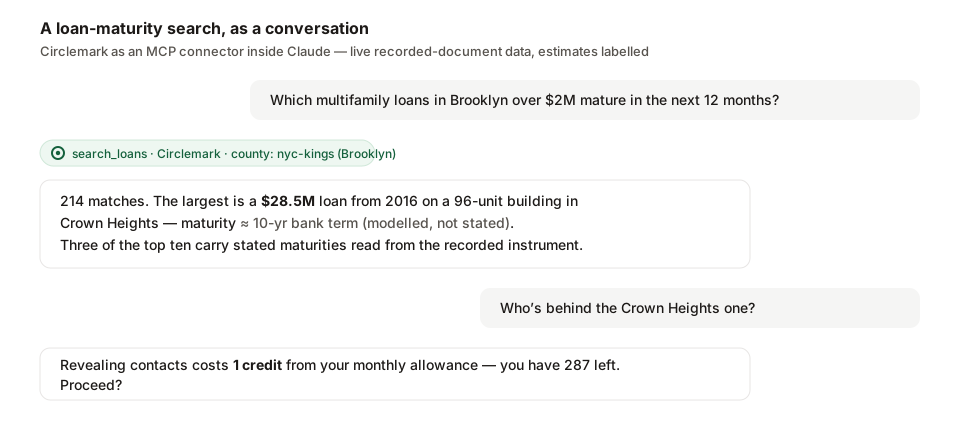 The shape of the workflow: facts come from the recorder via tool calls, the reasoning happens in the chat, and anything that costs a credit asks first.
The assistant composes what the app never could: "…and draft a first-touch email that mentions their 2016 rate," or "which of these borrowers shows up on more than one maturing loan?" — the reasoning happens in the chat, the facts come from the recorder.
Where we drew the lines
Putting a paid dataset behind a language model raises exactly the failure modes our methodology exists to prevent, so the connector enforces three rules.
A modelled maturity never travels as a fact. ACRIS has no maturity field — every NYC maturity date anywhere is stated on the recorded document, read from a securitization filing, or modelled. The connector returns each date with its basis (stated, reset for a first rate-change date read from the recorded rider, or the assumed term), and the tool description instructs the assistant to present estimates as estimates. The ≈ marker survives the trip into the chat.
Spending is explicit. Searches are metered like the web app. Anything that costs credits says so in the tool's own name and description, so the assistant asks before unlocking. Phone lookups never run unasked — a number is a separate, per-person request, and the 5-credit hold settles only if a number actually lands.
Claude never sees credentials or the database. The connection is OAuth 2.1: you sign in on circlemark.ai, approve the scopes on a consent screen, and the assistant holds a revocable token for your seat — the same identity, plan, and allowances as your login. Nothing is shared org-wide unless a workspace admin chooses to.
Why a connector beats pasting exports into a chat
You could always download a CSV and drop it into an AI chat. Three things break when you do: the data is stale the moment it's exported; the provenance is stripped (a modelled date and a stated one look identical in a spreadsheet); and the export ceiling means the model reasons over a sample, not the market. A connector inverts this — the assistant queries the live projection, page by page, with the labels attached, and a week later the same question gets this week's answer. Recorded documents change slowly; lifecycle events don't. 371,508 lifecycle events are matched into the dataset so a satisfied or consolidated loan never surfaces as a lead, in the chat or anywhere else.
The moment this is for
The maturity wall is not abstract: MBA counts 17% of all outstanding commercial and multifamily balances maturing this year, and S&P expects the wall to peak in 2027. Most of those decisions — refinance, extend, inject, sell — happen at buildings nobody writes articles about, financed by banks with no servicer disclosure, visible only in the county record. The brokers winning that market are the ones who reach the right owner first. If an assistant can shortlist the loans, name the decision-maker with a citation, and draft the outreach in one sitting, the cost of starting drops to a question.
Connect it
Takes about a minute: Settings → Connectors → Add custom connector → https://circlemark.ai/api/mcp, sign in, approve. The step-by-step — including Cowork workspaces and what each tool costs — lives at circlemark.ai/claude. The connector works with any Circlemark account, including a free seat, whose 10 reveals never expire.
New York City is live today; Dallas–Fort Worth counties are ingesting now and answer through the same tools as their recorder backfills complete.
Update, September 22, 2026. Loans on NYC one-to-four family houses (the investor house-loan segment) answer through the same tools when
residential_1_4is in the property-type filter. On that paper the event is the rate reset, not the 30-year maturity, so a row carriesmaturityBasis: "reset"with the first change date read from the rider, the next adjustment and the fixed period, and never a modelled maturity. A house loan with nothing stated says"none"and carries no date.
Frequently asked questions
- What is an MCP connector?
- The Model Context Protocol is an open standard that lets an AI assistant call tools on an external service — with your permission, under your account. A connector is an MCP server the assistant talks to. Circlemark's connector exposes loan-maturity search and owner-contact reveals to Claude, so the assistant queries the live database instead of guessing from training data.
- How do I connect Circlemark to Claude?
- In Claude (web, desktop, or a Cowork workspace): Settings → Connectors → Add custom connector → enter https://circlemark.ai/api/mcp. Claude registers itself, sends you to circlemark.ai to sign in, and asks for your consent. Setup takes about a minute; see circlemark.ai/claude for the step-by-step.
- Does Claude get access to my Circlemark account or data?
- Only what you approve. The connection uses OAuth 2.1: you sign in on circlemark.ai — never in the chat — and Claude receives a token scoped to your seat. Searches and reveals run as you, under your plan's allowances, and you can revoke the connection at any time from your account.
- What does it cost to use Circlemark inside Claude?
- The same as the web app — the connector is another door to the same account. Searches are metered like the web app: a daily fair-use limit on a paid seat, a lifetime budget on the free one. Unlocking the people behind a property costs 1 reveal credit (a free seat has 10 for the life of the seat and they never expire; a Data seat 100 a month, Pro 300), and a direct phone number is 5 credits, charged only when a number is found. The assistant is told each tool's cost up front, so it asks before spending.
- Will the assistant present an estimated maturity date as a fact?
- The data won't let it. Every maturity the connector returns is labelled: a stated date read from the recorded document, or a modelled estimate with the assumed term attached. The tool's own description instructs the assistant to present estimates as estimates — the same ≈ rule the app follows.
- Which AI assistants work with the Circlemark connector?
- MCP is an open standard. We test against Claude — claude.ai, Claude Desktop, and Cowork workspaces — which is where the connector is verified today. Other MCP-capable assistants can speak the same protocol; support for them is on the roadmap as we verify each one.
Sources
- MBA: 17 Percent of Commercial and Multifamily Mortgage Balances to Mature in 2026 (Feb 9, 2026)
- S&P Global: Commercial real estate maturity wall peaks in 2027
- Model Context Protocol — the open standard
- Anthropic: Getting started with custom connectors
- Adventures in CRE: What is MCP and why should CRE professionals pay attention?
- Inman: Rechat brings its AI operating system to Claude and ChatGPT
Check one building
Type an address and see the mortgages recorded on it — lender, amount and the maturity read from the instrument. Free, no account.
Read next
- Loan maturity leads: how CRE brokers source refinance deals before the balloon (2026)
A loan maturity lead is a commercial mortgage coming due on a property whose owner you can reach. Lead vendors sell them by the month or by the piece; the county record gives them away, with the one fact no vendor shows — whether the loan is still there. Of 130 Dallas–Fort Worth apartment loans past a stated maturity this year, 62 already carry a newer mortgage on the same lot; in New York, where few instruments print a date, it is 19 of 49. How to source the leads, which are real, and when to call.
- How to find maturing commercial loans in 2026: the three sources, the tools that search them, and a list you can pull today
Every maturing-loan list is built from the same three sources: the county recorder, securitization disclosure, and a model. This is how to search each one yourself, what each can and cannot tell you, how the tools that package them compare on price and on whether they admit which dates are guesses, and where to pull a list for New York or Texas without an account.
- Where commercial mortgage maturity data actually comes from
Every CRE maturity date in every data product traces to one of three sources: the county recorder, securitization disclosure, or somebody's model. What each one covers, what each one hides, and the questions to ask any vendor before you trust a date — with New York and Texas as the worked examples.
Circlemark Tutorials
The rest of the series — what to do on Circlemark, step by step, with the by-hand route beside it.