Loan maturity leads: how CRE brokers source refinance deals before the balloon (2026)
A loan maturity lead is a commercial mortgage coming due on a property whose owner you can reach. Lead vendors sell them by the month or by the piece; the county record gives them away, with the one fact no vendor shows — whether the loan is still there. Of 130 Dallas–Fort Worth apartment loans past a stated maturity this year, 62 already carry a newer mortgage on the same lot; in New York, where few instruments print a date, it is 19 of 49. How to source the leads, which are real, and when to call.
By Andrew Zhong, founder of Circlemark · · 15 min read · Figures as of Oct 22, 2026
A loan maturity lead is a commercial mortgage coming due, or already past due with no payoff recorded, on a property whose owner you can reach. The best ones come from the recorded instrument, not a lead list: read the maturity off the document, confirm nothing has satisfied or replaced it, then find the person behind the borrower LLC.
Skip the search. Type an address and the lookup reads the recorded instrument for you — lender, amount and maturity — free, no account. Or search every loan in your market on a free seat: no card, 10 owner reveals, 60 searches, nothing expires.
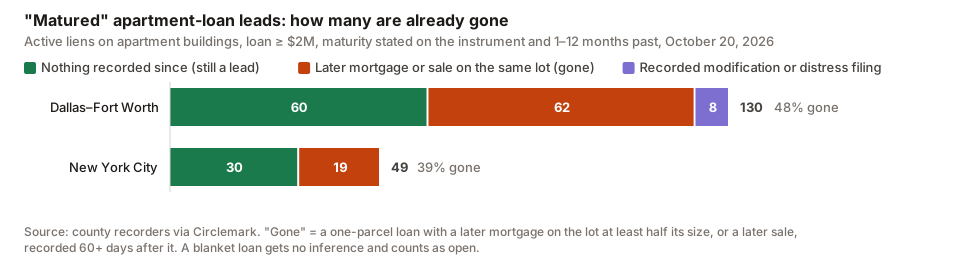
That last clause is where most lists fail, and it is measurable. On October 20, 2026, we pulled every Dallas–Fort Worth apartment loan of $2 million or more whose recorded deed of trust states a maturity that passed in the last twelve months and against which the county holds no release. There were 130. Sixty-two of them — nearly half — already carry a newer mortgage on the same lot, recorded well after the original. Those loans were refinanced; the old lender's release never reached the clerk. The same cut in New York City, where few instruments print a date at all, found 49 loans and 19 with a later lien. A lead vendor working from the maturity date alone would sell you all 179. The record, read one step further, says to call 90.
This guide is about sourcing: where maturity leads come from, what each source costs and hides, and how to tell a live lead from a dead one before you dial. If you want the longer walk through the three data sources and the tools that package them, that is the maturing-loans guide; this one assumes you have read it, or do not need to.
What a loan maturity lead is
The Mortgage Bankers Association puts $875 billion of commercial and multifamily mortgages at maturity in 2026. That is a survey of lenders, not a list of loans, and a lead is one line of the list: a loan, a date, a property, and a person. Three kinds of date make a lead, and they behave differently on the phone.
A stated maturity ahead. The instrument prints a date — "the entire indebtedness shall be due and payable on March 1, 2027" — and it has not arrived. This is the lead everyone means. The borrower has a decision to make by a date they know, and the only question is whether they have made it yet.
A maturity that passed with nothing recorded. The printed date is one to twenty-four months behind, and the county holds no satisfaction, release or superseding instrument. About a quarter of these were refinanced and the paperwork is late; most of the rest were extended by letter, which records nothing; a few are maturity defaults in a quiet workout. That cohort is its own post, and it is a refinance list by another name — the borrower bought time, not a takeout.
A rate reset on thirty-year paper. New York banks write a great deal of investor debt on thirty-year notes with a fixed rate for the first five or seven years and a reset after. The legal maturity is 2050; the refinance event is the reset, when a 3.5% coupon becomes prime plus something. The rider states the date, and the reset wave on 1–4 family investor loans is the largest refinance pipeline in the city that no maturity filter finds.
A lead with a date somebody modelled — origination plus a typical term for that kind of lender — is a fourth kind, and it is a prospect, not a lead. It belongs on the list, labelled, behind the three above.
Bought leads versus record-sourced leads
The search results for "commercial refinance leads" are owned by companies that sell them, so it is worth being precise about what is for sale.
Leads by the piece or by the month. C-Loans lists a lender on its CommercialMortgage.com marketplace for $1,000 a year per loan type and promises two to four leads a week, "less than $6.50 per lead" by its own arithmetic. The lead is a borrower who filled in a form; the order page says every lender listed for that loan type receives "a copy of every lead", with earlier buyers listed higher. SalesLeadAgent sells a pipeline of outbound targets at $399, $599 or $999 a month, flat; its pricing page does not say whether a target goes to one broker or several. Appointment-setting firms sit above both, selling the meeting rather than the name. None of these publishes where the loan data came from, how old it is, or whether anyone checked that the loan still exists.
A filter over a database. Reonomy's guide to finding commercial mortgage leads "in 60 seconds" (October 2023) describes the product honestly: a national property database with an origination-date and maturity-date filter. CRED iQ does the same over securitization servicer data; Crexi over public records and CMBS. Relip, whose refinance page is titled "Find Maturing Loans Before Anyone Else", says plainly that "county recorder data shows when a mortgage was recorded and its original term", and that is exactly the issue: the recorder shows the recording date on every instrument and the term on some of them, and the maturity on the row is modelled from those where it is not printed. None of the four says, on the row, which dates were read and which were assumed. The maturing-loans guide has the price table.
The record itself. Every mortgage and deed of trust is a public document at the county. It is free to search and slow to read, and it is the only source that covers bank, life-company, debt-fund, agency and CMBS loans alike, because every one of them was recorded. It is also the only source that can answer the question a lead list cannot: is this loan still there?
Where Circlemark sits. Brokers ask us what our role in the transaction is, and the answer is none. Circlemark is a data subscription: we do not broker, lend, take a fee on a closing or pass a lead to anyone else, and the borrower hears from you, not from us. Every row is built from the county record and says which page each field came from; the seat is $149 a month with 100 contact reveals, and the list builder is open without an account. Ask the same question of every vendor on this page, because the answer says who else will call the borrower — a marketplace earns when the lead is resold, and a lender's lead desk earns when the loan closes with that lender.
The honest comparison is not price. A bought lead costs $6.50 or $400 a month; a record-sourced lead costs an hour of a junior's time per building, or a seat on a product that reads the instruments for you. The comparison is exclusivity and staleness. A form lead goes to every lender on the page. A list lead was true when the vendor last loaded the county, which is a date none of them prints. A record-sourced lead is non-exclusive in the strict sense — the record is open to anyone — and exclusive in practice, because almost nobody reads it: the borrower at 211 East 33rd Street heard from the broker who read the maturity clause in 2025, not the one who bought a list in 2026.
Two in five "matured" leads are already gone
Here is the measurement in full, because it is the argument.
The cohort, Dallas–Fort Worth first because it is the larger one: apartment buildings by the appraisal district's classification, active liens of $2 million or more, maturity read off the recorded deed of trust rather than modelled, date between one and twelve months behind October 20, 2026. One row per loan — a facility perfected by a separate deed on each of six properties counts once. Loans whose only passed date is a rate reset are excluded; those are floating, not matured. 130 loans qualified.
For each, we asked what the clerk holds on the same lot since the loan was recorded. A later mortgage, at least half the size of the old one, recorded sixty or more days after it, is the refinance the old lender never closed out: nobody lends $40 million behind an open first lien of the same size, so the first lien is gone. 62 of the 130 carry one. 8 carry a recorded modification or distress filing. For the remaining 60, the record holds nothing at all since the maturity date — no modification, no distress filing, no release. The list of the 62 says who they are: many are agency multifamily loans originated by CBRE Capital Markets, Walker & Dunlop, Northmarq and HFF — ten-year paper that is refinanced at maturity almost by design, with the release trailing the new recording by months.
New York City, same cut, same day: 49 apartment loans, 19 with a later lien, 30 with nothing recorded since, none with a recorded modification or distress filing. The empty category is the record, not the market: the register's distress signals are an assignment to a special servicer, a judgment against the parcel or a deed-in-lieu, and a lis pendens is a court filing the register never sees, as a bank's extension letter is a document it never sees. The 49 is a small cohort for a market with more than twenty thousand active apartment loans of that size, and the reason is this post's argument in miniature. ACRIS publishes no maturity field; only some instruments print one; and the consolidation agreements most large New York refinances are recorded on almost never do (6.4%). So the 49 are the only New York apartment loans anyone can honestly call matured. Every other "matured" New York row on a vendor's list is a modelled date that has lapsed, which says the model's term was too short, not that the borrower is past due. The check works the same way there: nobody lends $11.9 million behind an open first lien of the same size, so the Dime Community Bank mortgage at 211 East 33rd Street, stated maturity February 2026, new mortgage recorded since, is gone.
Two things about those shares. First, a satisfaction search does not find it. These loans have no satisfaction on file — that is how they got into the cohort — and New York's thirty-day filing duty under RPAPL §1921 tops out at a $1,500 penalty on a loan of any size; Texas has no deadline at all for a commercial release. The old lender's paperwork is the last thing to arrive, and a list that waits for it is a list of loans paid off years ago. The later-lien check finds the refinance the day the new lender records, which is the day the lead died. Second, the share is not a New York quirk. Across the four metros we counted on October 8, with every property type and a two-year window, 758 of 3,134 past-maturity loans carried a later lien: 42% in New York, 24% in Texas. When we hand-checked our own weekly lists before building the check into the ranking, about 40% of the rows turned out to be sold or refinanced. That is the share of a bought "matured loans" list you should expect to be calling about a loan the borrower no longer has.
The same check runs forward. A loan with a stated maturity next spring and a new $20 million mortgage recorded on the lot last month is not a spring lead; it is a borrower who refinanced early, and the row on Circlemark is marked probably gone and scored down before you see it. Of the 205 New York commercial loans of $2 million or more with a stated maturity in the next twelve months, 4 already carry a later lien. Of the 921 in Dallas–Fort Worth, 113 do — one in eight, before the date has arrived.
Building the list from the county record
The full method is in the two guides this one leans on — searching ACRIS for commercial mortgages and reading the recorded instrument — so this is the order of operations and the four places a hand-built list goes wrong.
- Pull the instruments, not the index. ACRIS publishes parties, amount, document type and date and no maturity; a Texas clerk's index publishes parties and instrument number and no amount or address. The maturity is inside the scanned document or nowhere. In New York, 47% of plain mortgages print one and 6.4% of consolidation agreements do; in Texas, 41% of deeds of trust. Everything else is a modelled date, and your list should say so on the row.
- Follow the CEMA chain. A New York refinance rarely satisfies the old loan; it consolidates it. The live instrument is the consolidation agreement, and the amount, the lender and (sometimes) the maturity are on that document, not on the original mortgage the index shows first. A list built from original mortgages is a list of loans that were restated in 2019.
- Check for a satisfaction — then stop trusting it. A satisfaction (New York) or release (Texas) closes the loan. Its absence closes nothing. New York's satisfaction cites the gap note and the component notes, never the consolidation agreement your list shows, so a naive match misses the payoff; and a late or missing filing is normal, not a signal.
- Run the later-lien check. On a single-parcel loan, a later mortgage at least half the size, sixty or more days after, means the loan is gone. A later deed means it was sold and paid. On a blanket loan the check says nothing — a new mortgage on one of six lots is not a refinance of the other five — so leave blankets in and call them.
For one building rather than a market, the address lookup does the four steps for you and shows the maturity with the page it came from.
Qualifying: who is likely to need you
A list in date order is a calling order, but three facts on the row change who you call first.
Lender type sets the conversation. Bank paper from 2021 and 2022 was written at five-year terms into a market roughly three hundred basis points cheaper than today's; at maturity the borrower's problem is proceeds, and the conversation is about whether the property's income carries the new coupon. CMBS paper carries a defeasance or yield-maintenance cost until its open window, so a CMBS borrower refinances in the last three to six months or not at all. A life-company loan is usually ten-year paper with a long prepayment lockout, and the borrower you want is the one whose lockout just ended. An agency loan may be assumable, which turns a maturity lead into a sale lead. The lender on the recorded instrument tells you which of these calls you are making before you make it.
The LTV is a question, not an answer. A loan-to-value computed from the assessed value of the parcels on record is only as good as the assessment and the parcel match, and on a blanket loan the denominator is incomplete. Treat a high LTV as a reason to look, never as a reason to call with a number in your mouth; the past-maturity post has the longer caveat.
In New York, rent regulation sets the proceeds. A stabilized building's income is capped by the Rent Guidelines Board, and since 2019 the capital-improvement path to raising it is mostly closed, so a stabilized building that was 65% levered in 2019 is a refinance that will not pencil at today's rates without new equity. The number of registered stabilized units is on the Department of Finance tax bill, and we read it onto the row; on a maturity lead it tells you whether you are calling a refinance or a rescue.
Reaching the owner behind the LLC
A maturity lead with no person attached is a property, not a lead. The borrower on a commercial mortgage is almost always a single-purpose LLC, and the record that names the person behind it depends on the state.
In New York, four city records name a person: the Department of Finance's owner-of-record, the HPD registration (every building with three or more units must list a managing agent and an officer), the Department of Buildings' owner on the last permit, and the signature page of the recorded instrument itself, where a member or manager signed for the LLC. Which of them names a decision-maker rather than a registered agent, and how often each finds a phone, is measured in the New York owner guide. In Texas the appraisal district's owner of record, the deed of trust's signer and the Comptroller's officer list under Tax Code §171.203 do the same job, and the Texas guide walks each one.
The signature page is the one most brokers skip and the one that most often answers the question. HPD named two "Members" at 1791 Grand Concourse; only the signature page said which one signs. On Circlemark a contact reveal reads it for every unlocked loan and cites the page.
The timing playbook
The window is set by the borrower's own calendar, which runs backwards from the date on the instrument.
24 months out: watch. The borrower is not thinking about it and should not hear from you about it. Put the loan on a watchlist and let a recorded modification, a sale, or a later lien tell you if the situation changes early.
12 months out: the first call. The borrower has started to think about it and has not chosen a lender. This is where a rate conversation is open and a broker who already knows the loan — lender, amount, the maturity clause, the reset rider if there is one — is a relief rather than an interruption. Lead with what the record says and ask what the plan is.
6 months out: the last useful call. By now a term sheet is usually in hand, often from the incumbent. You are a second quote, which is still a role, but the conversation is about what the incumbent offered. Inside three months you are a backup, and the only loans worth a fresh call are the ones where the record shows trouble: a lis pendens, a notice of sale, a modification that extended for twelve months and is coming due again.
Past the date, nothing recorded: call for six months, then stop. A maturity that passed one to six months ago with no payoff and no later lien is a borrower who extended by letter or is negotiating one, and nobody else has called. Lead with the question, never the accusation: "the record shows a 2025 maturity and no payoff — did you extend, or are you still looking at takeout options?" Past six months the situation has settled into whatever it became and the lead is cold unless the loan is construction or bridge paper, which needs permanent financing whenever its date falls.
Bridge and construction: ignore the calendar. A two-year bridge with two one-year extension options prints a date that is only the first day it could come due. The takeout is needed regardless, and the borrower knows it from day one. These are the leads to work at any distance from the printed date.
The prefilled lists, no account needed, dates read off the instrument only:
- New York City apartment loans, stated maturity 3–12 months out
- Dallas–Fort Worth, stated maturity 3–12 months out
- Houston, stated maturity 3–12 months out
- New York City, past maturity with no payoff recorded
- Dallas–Fort Worth, past maturity with no payoff recorded
Each row says whether the date was read or modelled, and a row the record says is probably gone is marked and ranked down, so the two in five are already out of the list before it reaches you.
Frequently asked questions
- Where can I get commercial refinance leads?
- From three places. Lead vendors sell them by subscription or by the piece (C-Loans lists lenders for $1,000 a year per loan type and promises two to four leads a week; SalesLeadAgent's plans run $399 to $999 a month). Data platforms such as Reonomy, CRED iQ and Crexi sell a maturity-date filter over a national database for a few hundred to a few thousand dollars a month. And the county recorder gives the underlying instruments away: every mortgage and deed of trust is public, and in Texas the maturity is printed on page one. Circlemark's list builder returns record-sourced leads for New York City and Texas without an account.
- Are bought commercial mortgage leads exclusive?
- Usually not, and the vendor's own terms say so when you read them. C-Loans sends 'a copy of every lead' to each lender listed for that loan type, with earlier buyers listed higher. SalesLeadAgent's pricing page does not say whether a lead goes to one broker or several. A record-sourced lead is non-exclusive in a different way: anyone can read the county record, but almost nobody does, and the borrower hears from the broker who read the maturity clause months before the one who bought a list.
- What happens when a commercial loan matures?
- The balance comes due in one payment. Most commercial mortgages are balloon loans, with five, seven or ten years of payments on a longer amortisation and the balance owed at the end, so the maturity date is the day the loan has to be refinanced, sold or extended. If it is not paid, the lender can extend by letter (and usually does for a performing borrower), modify the loan, or declare a maturity default and begin foreclosure. From the county record those three look identical until something is filed: the maturity passes, and no satisfaction or release appears.
- How far ahead of maturity should I contact an owner?
- Twelve months out is the first call and six months is the last useful one. At twelve months the borrower has not chosen a lender and the rate conversation is open. At six the term sheet is usually in hand, and inside three months you are a backup quote. The exceptions run the other way: a bridge or construction loan needs a takeout whenever its date falls, and a loan already past maturity with no payoff recorded is a live conversation for about six months after the date, then settles into whatever it became.
- Can I find maturing commercial loans in Texas?
- Yes, and more easily than in New York. Texas deeds of trust state the note's maturity on the first page almost without exception, so a Texas list is mostly read dates rather than estimates; 41% of the Texas instruments we read print one, against 6.4% of New York consolidation agreements. The county clerk's index carries no address and no amount, so the lead is built from the instrument itself, and the Comptroller's officer list names the people behind the borrower LLC. Circlemark covers Dallas–Fort Worth, Houston, Austin and San Antonio.
Sources
- MBA NewsLink — Chart of the Week: CRE loan maturity volumes ($875B in 2026)
- C-Loans / CommercialMortgage.com — lead order form: $1,000 per year per loan type, two to four leads weekly (read October 19, 2026)
- SalesLeadAgent — pricing: Starter $399, Professional $599, Business $999 per month (read October 19, 2026)
- Reonomy — 'How To Find Commercial Mortgage Leads In 60 Seconds' (October 10, 2023)
- Relip — 'Refinance Leads: Find Maturing Loans Before Anyone Else' (read October 19, 2026)
- New York RPAPL §1921 — satisfaction of mortgage, 30-day duty and penalties
- Texas Finance Code §343.108 — release of lien on a home loan within 60 days (no commercial deadline)
- NYC Open Data — ACRIS Real Property Master (no maturity field)
- Circlemark — Commercial loans past their maturity date with no payoff recorded (October 8, 2026 count)
- Circlemark — methodology: stated and estimated maturities, lifecycle events, the later-lien check
Check one building
Type an address and see the mortgages recorded on it — lender, amount and the maturity read from the instrument. Free, no account.
Read next
- How to find maturing commercial loans in 2026: the three sources, the tools that search them, and a list you can pull today
Every maturing-loan list is built from the same three sources: the county recorder, securitization disclosure, and a model. This is how to search each one yourself, what each can and cannot tell you, how the tools that package them compare on price and on whether they admit which dates are guesses, and where to pull a list for New York or Texas without an account.
- Where commercial mortgage maturity data actually comes from
Every CRE maturity date in every data product traces to one of three sources: the county recorder, securitization disclosure, or somebody's model. What each one covers, what each one hides, and the questions to ask any vendor before you trust a date — with New York and Texas as the worked examples.
- Commercial loans past their maturity date with no payoff recorded: why it happens and what to do about it (2026)
In New York City, Dallas–Fort Worth, Austin and San Antonio, 3,134 commercial mortgages are past the maturity date printed on the recorded instrument and no satisfaction or release has been filed. About a quarter are refinanced loans whose release never reached the clerk. The rest are extensions nobody recorded, workouts nobody announced, and a few real maturity defaults. How to tell them apart from the county record, and what a broker should say when calling.
Guides to the public record
The rest of the series — how brokers find loans, owners and maturities in the county record.
- How to find maturing commercial loans
- Is this commercial loan in default?
- Past maturity, no payoff recorded: what it means
- Where maturity data comes from
- How NYC loan maturities are monitored
- Find the owner behind an LLC (New York)
- Find the owner behind an LLC (Texas)
- Search ACRIS for commercial mortgages
- How to read a recorded mortgage or CEMA
- How to read a blanket mortgage in ACRIS
- Who lends on NYC commercial real estate
- Rent-stabilized building loans in New York
- Who lends on Texas commercial real estate
- Why Texas files every warehouse as "commercial"
- Reonomy alternatives for loan data