Commercial loans past their maturity date with no payoff recorded: why it happens and what to do about it (2026)
In New York City, Dallas–Fort Worth, Austin and San Antonio, 3,134 commercial mortgages are past the maturity date printed on the recorded instrument and no satisfaction or release has been filed. About a quarter are refinanced loans whose release never reached the clerk. The rest are extensions nobody recorded, workouts nobody announced, and a few real maturity defaults. How to tell them apart from the county record, and what a broker should say when calling.
By Circlemark · · 14 min read · Figures as of Oct 8, 2026
Our search shows three counters: 12,035 commercial loans maturing in the next twelve months, 3,134 past a stated maturity with no payoff recorded, 1,548 in distress or foreclosure. The middle one gets the most questions, and the most misreadings. It is not a count of defaulted loans. It is a count of loans where the recorded instrument prints a maturity date that has passed — by one to twenty-four months — and the county recorder holds no satisfaction, release or superseding instrument matched to that loan. What that silence means is the subject of this post.
On October 8, 2026, the cohort across New York City, Dallas–Fort Worth, Austin and San Antonio was 3,134 loans. About a quarter of them — 758 — have a later mortgage recorded on the same lot, which in almost every case means the loan was refinanced and the old lender's release never reached the clerk. Half — 1,557 — matured twelve to twenty-four months ago. 739 matured within the last six months. Only 33 carry a recorded modification or extension, and only 4 carry a recorded distress filing. For 2,343 loans the record holds nothing at all since the maturity date passed.
Those 2,343 are the interesting ones, and nothing in a document tells you which of three very different situations each one is in.
What the record can say, and what it cannot
A county recorder knows four things about a commercial loan: that it was made (the mortgage or deed of trust), what was recorded against it afterwards (satisfactions, releases, assignments, modifications, consolidations), what happened to the collateral (deeds, lis pendens, notices of sale, trustee's deeds), and — only if the document prints it — when the loan was due. Texas deeds of trust state the maturity on page one almost without exception. New York's ACRIS publishes no maturity field at all; the date exists only inside the scanned instrument, and only on some of them. We read it where it is printed and model it from the origination date and a conventional term where it is not.
The past-maturity counter uses stated dates only. A modelled date that has passed tells you the model's term was too short — the loan was ten-year paper, not seven — or that the loan was paid off and the payoff was missed. It does not tell you the borrower is past due, and we never present it that way. The forward counter does take the model where the instrument is silent, and the landing page says so beneath the numbers. This is also why the cohort is 91% Texas: a Texas instrument almost always qualifies, while most New York loans never can.
What "no payoff recorded" can say is narrow and exact: the recorder has not been told the loan is over. Who was supposed to tell it, and whether they had to, is a matter of state law — and it is where most of the explanation lives.
Four reasons a loan sits past maturity with nothing recorded
1. It was paid off, and the release is late or never coming
A borrower refinances. The new lender records its mortgage. The old lender is paid and is supposed to record a satisfaction (New York) or release of lien (Texas). Whether that happens on time, or at all, depends on who has to do it and what happens if they don't.
New York is strict on paper. Real Property Law §275 and RPAPL §1921 require the mortgagee to present the satisfaction for recording within 30 days of payoff, with escalating penalties of $500, $1,000 and $1,500 as the delay passes 30, 60 and 90 days; a federal court has held that the clerk must receive it within 30 days, not that it be mailed on the thirtieth. But the penalty tops out at $1,500 on a loan of any size, and the bigger New York wrinkle is that most commercial borrowers never satisfy a loan at all — they consolidate it. A CEMA refinance records a gap mortgage and a consolidation agreement, and the old note lives on inside the new instrument because paying mortgage recording tax again on the old principal would cost far more than a filing fee. When a satisfaction finally does arrive, often years later, ACRIS cites the gap note and the component notes, never the consolidation agreement a list shows as the loan. We follow those citations; most pipelines do not, which is why so many New York lists are full of loans paid off in 2019.
Texas has no deadline at all for a commercial release. The 60-day rule in Finance Code §343.108 (in force since September 2023) applies to home loans only, and carries no penalty. Property Code §12.017 lets a title company record an affidavit in place of a missing release, but only for one-to-four family property or a lien whose original face amount was under $1.5 million, after notice to the lender and a 45-day wait. A $5 million deed of trust paid off at maturity has no statutory clock and no shortcut: the release gets recorded when the payoff department gets to it, which can be the following quarter or the next time someone tries to sell the property and the title company finds the lien.
The county record supplies a tell that the lender's paperwork does not: a later mortgage on the same lot. A new lender recording a lien on a single-parcel property at least half the size of the old loan, sixty or more days after it, has almost always paid the old loan off. 147 West 35th Street in Manhattan carries a 2011 Capital One mortgage with no satisfaction on file — and a $17.5 million Signature Bank mortgage recorded against the same lot in 2021. Nobody lent $17.5 million behind an open 2011 first lien; the Capital One loan is gone, and the record simply never said so. Our search flags that loan as probably gone and marks its score down accordingly. On October 8, 758 of the 3,134 past-maturity loans carried that flag — 42% of the New York cohort, 24% of the Texas one.
2. It was extended, and nobody filed anything
A bank with a performing loan at maturity and a borrower who cannot refinance at today's rates does the obvious thing: it extends. For a loan on the same terms, that is a letter agreement or an amendment to the note, and neither goes anywhere near the county clerk. A modification is recorded when the lender needs it in the chain of title — the amount increases, the collateral changes, the loan is being sold into a securitisation — and in New York a recorded modification that adds principal triggers mortgage recording tax on the new money, so lenders record when they must and extend by letter when they can. Construction and bridge loans usually carry extension options in the original note ("2+1+1"), so the printed maturity is only the first date the loan could come due; exercising the option records nothing.
This is the "extend and pretend" everyone argued about in 2026, and the argument matters for how a broker should read the cohort. Bloomberg Law declared in May that the extend-and-pretend era was ending as lenders began taking losses on more than $130 billion of distressed commercial-property debt. A Federal Reserve paper the same month (Glancy, Pretend or Amend? On Evergreening in CRE, FEDS 2026-025) found the opposite story in bank data: extensions "predominantly address temporary payment frictions", and after spring 2023 banks "increased income and principal paydown requirements for extensions", so extended loans went on to perform. Both can be true, and from the county record both look identical: an open lien, a passed date, nothing filed. In our cohort, 33 loans out of 3,134 carry a recorded modification. The other extensions — and there are certainly hundreds — are in a drawer at the bank.
3. It is in default, and nothing public has been filed yet
The third group is the one the headline number is usually taken to mean. A borrower reaches maturity without a takeout, cannot pay, and the lender begins the slow walk: a reservation-of-rights letter, a forbearance agreement, a workout negotiation, sometimes a receiver. None of it is public until the lender files — a lis pendens in New York, a notice of sale in Texas — and in New York that is often many months after the default, in Texas three weeks before the courthouse-steps auction. Texas notices are also perishable: the clerk posts them for the sale date and takes them down after it, so a loan that was in foreclosure in March and worked out in April leaves no trace at all.
The CMBS data, where servicers must report, shows how large this group has become. Trepp's September 2026 delinquency rate was 8.02%, the highest since 2020, and in August 81% of the balance that newly went delinquent was non-performing matured balloons — loans that reached maturity and stopped paying. Separately, loans past maturity but still current were 1.64% of the CMBS balance in September, which puts the all-in rate of loans past their date at 9.66%. Morningstar DBRS measured a 59.5% payoff rate on fixed-rate CMBS maturities in the second quarter and expected "more than half" of 2026's $100 billion of maturing CMBS not to repay at maturity. KBRA's September report attributed 74.9% of newly distressed balance to imminent or actual maturity default. Bank portfolios report less, but the FDIC's second-quarter profile still had non-owner-occupied CRE past-due and non-accrual at 3.08% at the largest banks, down from a 4.99% peak in 2024.
Our 4 recorded distress filings against 3,134 past-maturity loans is not evidence that the county-recorded market is healthier than CMBS. It is evidence that the recorder hears about a default last.
4. It is floating, not matured
A small group is neither extended nor defaulted nor paid off: it is thirty-year bank paper whose printed date was a first rate reset, not a maturity. Eight loans in the New York cohort match the past window on a reset date read from the recorded rider. The loan is simply floating now. The row says "rate reset", not past due, and for a broker that is its own conversation — a borrower who has just moved from a fixed rate to prime-plus has a reason to refinance that has nothing to do with maturity.
Telling them apart from the outside
No single document separates the three main cases, but the record around the loan does most of the sorting, and age does the rest.
| What the record shows since the maturity date | Most likely meaning | What to do |
|---|---|---|
| A later mortgage on the same lot, at least half the size, 60+ days after | Refinanced; release never recorded | Skip — or call the new lender's borrower about the new loan |
| A later deed on the same lot | Sold; payoff never recorded | Skip |
| A recorded modification or extension | Extended, with terms the lender wanted in the chain of title | Follow up near the new date |
| A lis pendens, notice of sale or receiver appointment | Default, foreclosure begun | Rescue capital, note sale, or wait for the trustee's deed |
| Nothing, maturity passed 1–6 months ago | Extension under negotiation or just signed; takeout still open | Call now |
| Nothing, maturity passed 6–12 months ago | Extended by letter; a takeout is the next event | Call, lead with the extension |
| Nothing, maturity passed 12–24 months ago | Long extension, or paid off and nobody filed | Low priority unless the loan is construction or bridge |
Two signals this table leaves out on purpose. An assignment of mortgage is not evidence the borrower's loan ended: in New York most standalone assignments are note sales between banks (the Signature Bank portfolio transfers of 2023–2024 above all), and the borrower goes on paying the new holder. And a blanket loan secured by several parcels gets no later-lien inference at all — a new mortgage on one lot says nothing about the other six.
A broker working the list this way drops about a quarter of it immediately (the later-lien rows), parks half of it (the 12–24-month rows), and is left with something like 700 loans across four metros whose maturity passed in the last six months and whose record is silent. That is the live list.
What to say when you call
Every one of these borrowers has a loan that needed a decision in the last two years, and most of them made one the record cannot see. The call has to respect that.
Lead with what the record shows, as a question. "Your loan with [lender] showed a 2025 maturity and the county has no payoff on file — did you extend, or are you still looking at takeout options?" The borrower who extended will say so and tell you when the extension ends, which is the date you actually want. The borrower who refinanced will say so, and you can stop. The borrower who is negotiating will usually tell you more than they meant to, because nobody else has called.
Never say "past due". The record cannot prove it, most of these borrowers are performing, and a borrower told their loan is delinquent by someone who turns out to be wrong will not take the next call. The Fed paper's finding that extended loans mostly performed is the base rate here.
Construction and bridge first. A bridge or construction loan past its printed maturity needs permanent financing whether it was extended or not; the extension only bought time to stabilise or lease up. These are the loans where the past-maturity list is a refinance list by another name.
Work the recent ones first. A maturity that passed in the last six months is a live negotiation or a fresh extension. One that passed twenty months ago has usually settled into whatever it became. The exception is the loan with a recorded modification: that row has a new date, and it should be re-filed under that date, not left in the past.
Know which conversation you are in. The extended borrower needs a takeout at the end of the extension — a refinance conversation, twelve to eighteen months early, with a borrower who already knows the current lender wants out. The borrower in a quiet workout needs rescue capital, a preferred equity piece, or a note-sale buyer — and needs it before the lender files. The paid-off borrower needs nothing from you, and the sooner the record tells you that, the less of your week they take.
The numbers, metro by metro
Counts on October 8, 2026, of commercial loans with an active lien whose recorded instrument states a maturity 1–24 months in the past and no payoff is recorded.
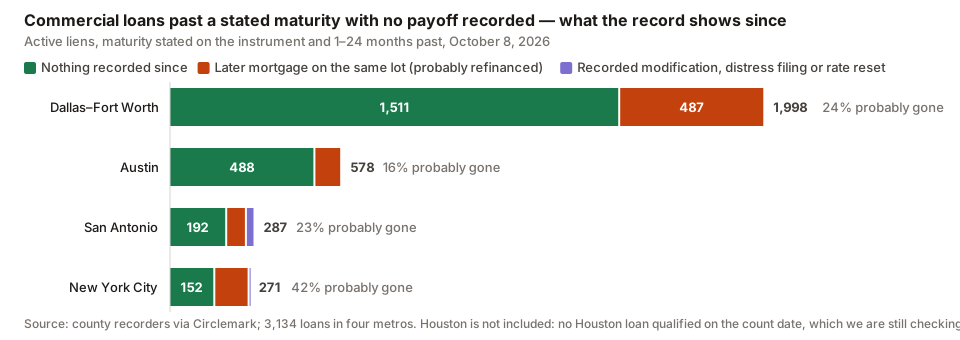
| Metro | Past maturity, no payoff recorded | Later lien on the lot (probably gone) | Recorded modification | Recorded distress | Matured in the last 6 months |
|---|---|---|---|---|---|
| Dallas–Fort Worth | 1,998 | 487 (24%) | 0 | 0 | 479 |
| Austin | 578 | 90 (16%) | 0 | 0 | 133 |
| San Antonio | 287 | 66 (23%) | 31 | 0 | 74 |
| New York City | 271 | 115 (42%) | 2 | 4 | 53 |
| Total | 3,134 | 758 (24%) | 33 | 4 | 739 |
The Texas weight is a property of the record, not the market. Nearly every Texas deed of trust prints its maturity, so nearly every lapsed Texas loan can qualify; most New York loans carry no printed date and are excluded by design, which is why New York's past-maturity count is small next to its twelve-month wall. The New York share of probably-gone loans is nearly twice Texas's partly because New York refinances consolidate rather than satisfy, so the trailing release is the rule rather than the exception.
The live lists are open to anyone: Dallas–Fort Worth, past maturity, no payoff recorded, and New York City. The rescue score on those links puts a passed stated maturity at full timing, adds recorded distress and a recorded modification, and takes points off a loan the record says is probably gone.
Method and limits
The cohort is every loan in our search with an active lien, commercial collateral (a single one-to-four family house is excluded; a portfolio of three or more is kept), and either a stated maturity or a stated first rate reset dated between 24 months and 1 month before the count date. A stated date is one read from the recorded instrument — the deed of trust's own maturity clause in Texas, the mortgage or consolidation agreement's maturity in New York, the rider's reset date on long-dated bank paper. Modelled dates never qualify. The "later lien" flag applies only to single-parcel loans: a later mortgage on the same lot at least half the size of the loan, or a later sale for at least half its amount, recorded 60 or more days after it. Assignments are deliberately not treated as the end of a loan.
Three limits. First, Texas distress is undercounted here: notices of sale are posted for the sale date and removed after it, and two of the four DFW counties record no trustee's-deed document type, so a foreclosure that completed shows as a plain deed. Second, recorded modifications are unevenly matched across Texas: every clerk's modification and extension codes are read, but San Antonio's 31 against Dallas–Fort Worth's 0 says more about how each county's instruments cite the loan they modify than about how often lenders extend, and we are checking it. Third, "no payoff recorded" is a statement about the recorder's files on the count date; a release recorded tomorrow removes the loan from the cohort at the next weekly run.
Frequently asked questions
- What is a maturity default on a commercial loan?
- A maturity default is a borrower failing to repay the full balance on the loan's maturity date, as distinct from a payment default on a monthly instalment. Most commercial mortgages are balloon loans — five, seven or ten years of payments on a 25- or 30-year schedule, with the balance due at the end — so the maturity is the one date on which the whole loan has to be refinanced, sold or extended. Trepp distinguishes a 'performing matured balloon' (past maturity, still paying) from a non-performing one; in August 2026, 81% of the CMBS balance that newly went delinquent was non-performing matured balloons.
- What happens when a commercial loan matures and is not paid off?
- Usually one of three things, and from outside the lender none of them looks different. The lender extends or modifies the loan, often by letter, with nothing filed at the county. Or the borrower refinanced or sold and the old lender's release has not reached the recorder — in Texas there is no statutory deadline for releasing a commercial lien. Or the loan is in default and the lender is negotiating a forbearance or workout before filing anything public. A lis pendens, notice of sale or trustee's deed arrives only when that negotiation fails.
- Does a loan extension get recorded in county records?
- Not necessarily. A modification or extension agreement is recorded when the lender wants it in the chain of title — typically when the amount increases, the collateral changes or the loan is securitised. In New York a recorded modification that adds principal triggers mortgage recording tax on the new money, so lenders record when they must and extend by letter when they can. A bank rolling a performing loan for twelve months on the same terms rarely files anything. Of the 3,134 loans in our past-maturity cohort on October 8, 2026, only 33 carry a recorded modification.
- How long does a lender have to record a satisfaction or release?
- It depends on the state and the collateral. New York Real Property Law §275 and RPAPL §1921 require the mortgagee to present a satisfaction for recording within 30 days of payoff, with penalties of $500, $1,000 and $1,500 as the delay passes 30, 60 and 90 days — and the courts have held that the clerk must receive it within 30 days, not that it be mailed on day 30. Texas sets a 60-day deadline only for home loans (Finance Code §343.108, since September 2023), with no penalty, and the title-company affidavit that can stand in for a missing release (Property Code §12.017) is available only for 1–4 family property or liens under $1.5 million. A $5 million Texas deed of trust paid off at maturity has no deadline and no shortcut.
- Should a broker call a borrower whose loan is past maturity with no payoff recorded?
- Yes, after sorting. Drop the loans the record says are probably gone (a later mortgage on the same lot, a later sale), start with maturities that passed within the last six months, and put construction and bridge loans first because they need a takeout whether or not they were extended. Open with a question — 'the record shows a 2025 maturity and no payoff; did you extend, or are you looking at takeout options?' — never with 'your loan is past due'. The record cannot prove that, and most of these borrowers are performing.
Sources
- MBA NewsLink — Chart of the Week: CRE loan maturity volumes ($875B in 2026)
- Trepp via CRE Daily — August 2026 CMBS delinquency: 81% of new delinquencies are non-performing matured balloons
- Trepp via YieldPro — September 2026 CMBS delinquency 8.02%; past-maturity-but-current loans 1.64% of balance
- Morningstar DBRS — US CMBS Q2 2026 maturity research (59.5% payoff rate)
- Morningstar DBRS — 2026 CMBS outlook: more than half of maturing loans will not repay at maturity
- KBRA — CMBS loan performance trends, September 2026 (74.9% of newly distressed loans are maturity defaults)
- Federal Reserve FEDS 2026-025 — Glancy, 'Pretend or Amend? On Evergreening in CRE'
- Bloomberg Law — ''Extend and Pretend' Era Ends as Real Estate Lenders Take Losses' (May 2026)
- FDIC — Quarterly Banking Profile, second quarter 2026
- New York RPAPL §1921 — satisfaction of mortgage, 30-day duty and penalties
- Riker Danzig — federal court: the clerk must receive the satisfaction within 30 days of payment
- Texas Finance Code §343.108 — release of lien on a home loan within 60 days
- Texas HB 3945 (2009) — Property Code §12.017, title-company affidavit as release of lien
- Circlemark — methodology: stated and estimated maturities, lifecycle events
Read next
- Ask Claude which CRE loans mature next year: Circlemark now provides an MCP connector
Commercial mortgage maturity data now answers questions in plain English. How we put over 100,000 NYC loans inside Claude via the Model Context Protocol, what an AI assistant can and can't do with recorded-document data, and why the connector never presents a modelled maturity as a fact.
- Where commercial mortgage maturity data actually comes from
Every CRE maturity date in every data product traces to one of three sources: the county recorder, securitization disclosure, or somebody's model. What each one covers, what each one hides, and the questions to ask any vendor before you trust a date — with New York and Texas as the worked examples.
- NYC rent-stabilized building loans: 3,269 reach their five-year mark this year, into a rate hike and a rent freeze — and who still lends on them
New York's recorded mortgages, joined for the first time to the rent-stabilized unit count on each building's Department of Finance tax bill and to the city's building class for co-ops. 24,875 active loans, $226B, sit on buildings with registered stabilized units; the largest cohort was written in 2021–22 at the bottom of the rate cycle, and 3,269 of those loans reach their five-year mark between now and October 2027 — into a Fed hike, a 5-year Treasury above 5% and a two-year rent freeze. Who lent in 2019 and who lends now, what happened to Investors Bank's co-op book, and how to read regulation off public records when no city roll records it.