NYC's 2026 maturity wall, borough by borough: $5.9B stated, $2.5B already past due
A per-borough data brief on New York City's 2026 commercial mortgage maturity wall — stated maturities only, read from the recorded instruments: 274 loans and $5.9B coming due in 12 months, 166 loans and $2.5B already matured and still open, 13 already carrying a distress filing. Every number traces to the record.
By Andrew Zhong, founder of Circlemark · · Updated · 5 min read · Figures as of Oct 24, 2026
Covered by CRE Daily · Yahoo Finance
The CRE maturity wall gets national numbers — the MBA counts $875 billion of commercial and multifamily mortgages maturing in 2026. This brief is the New York City slice of that wall, counted the hard way: loan by loan, from the recorded documents, per borough.
Everything below covers active loans of $1 million or more in the four ACRIS boroughs whose maturity date is stated — read off the scanned instrument or taken from securitization disclosure (ABS‑EE). No modelled dates, no estimates. Counts are as of September 8, 2026; the record is re-read weekly. Every number traces to a CRFN except where marked ABS‑EE.
The wall: stated maturities, next 12 months
| Borough | Loans | Volume | Median loan |
|---|---|---|---|
| Manhattan | 169 | $4,679.6M | $19.0M |
| Brooklyn | 49 | $709.9M | $3.5M |
| Queens | 28 | $252.8M | $6.2M |
| Bronx | 28 | $253.2M | $5.2M |
| New York City | 274 | $5,895.5M |
Manhattan holds 79% of the dollars, and its median coming-due loan is $19.0M against Brooklyn's $3.5M — the borough story is concentration, not just count.
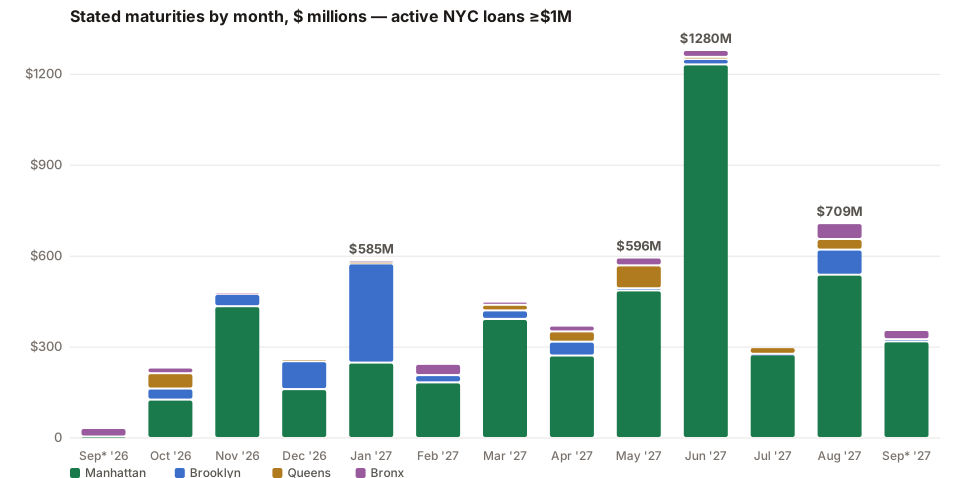
The wall is not flat. June 2027 alone carries $1.23B of Manhattan stated maturities, led by the 245 Park Avenue notes; August 2027 adds another $709M citywide.
What's coming due, by property type
| Type | Manhattan | Brooklyn | Queens | Bronx | NYC |
|---|---|---|---|---|---|
| Office | 39 · $1,903.0M | 8 · $327.0M | 4 · $66.1M | 1 · $14.3M | 52 · $2,310.3M |
| Mixed-use | 58 · $1,689.5M | 6 · $48.9M | 5 · $32.1M | 11 · $110.2M | 80 · $1,880.7M |
| Multifamily | 51 · $691.1M | 26 · $218.3M | 16 · $84.2M | 14 · $96.8M | 107 · $1,090.4M |
| Retail | 8 · $264.6M | 3 · $38.5M | — | — | 11 · $303.1M |
| Other / unclassified | 13 · $131.4M | 6 · $77.2M | 3 · $70.4M | 2 · $32.0M | 24 · $311.0M |
Office is the money: 52 loans, $2.31B — 39% of everything coming due — and $1.90B of it is Manhattan. Multifamily is the volume: 107 loans, the most of any type, spread across all four boroughs. By lender, banks hold 152 of the 274 loans ($2.30B) and debt funds 40 ($0.73B); the rest sit with life companies, CMBS trusts and other non-bank lenders. Which institutions those are, counted over three years of recordings rather than one maturity window, is its own ranking.
The layer underneath: matured, still open
These loans passed their recorded maturity date in the last 12 months and show no satisfaction or discharge — the lien is still active on the record.
| Borough | Loans | Volume |
|---|---|---|
| Manhattan | 82 | $1,563.7M |
| Brooklyn | 35 | $421.7M |
| Bronx | 25 | $257.5M |
| Queens | 24 | $236.6M |
| New York City | 166 | $2,479.4M |
Multifamily leads by count (68 loans, $492.1M); office leads by dollars (30 loans, $940.5M). Twelve of the office loans are Manhattan properties over $5M. Widen the lookback to 24 months and the layer grows to 353 loans, $6.04B — matured, nothing filed since.
Read this layer honestly. "Open on the record" is the recorder's truth, not proof of default: some of these loans were paid off or refinanced and the satisfaction was never recorded, or is still in the recording queue. That gap is part of the story — the public record both overstates and understates how much matured debt is resolved until lifecycle documents are matched loan by loan. Each of these 166 remains a live lien of record until a discharge is filed.
Distress meets the wall
Of the 274 loans coming due in the next 12 months, 13 ($480.8M) already carry a recorder-side distress signal — pre-foreclosure activity filed against the collateral before the loan even matures. Manhattan accounts for 10 of them ($370.5M). Both Brooklyn entries are pieces of the same financing on 111 Livingston Street ($96.0M). Queens has none. Notable names, from CMBS disclosure (ABS‑EE): 1384 Broadway ($88.0M, due January 2027) and 85 Broad Street ($34.0M, due June 2027).
Six loans you can check
Every figure in this brief aggregates rows like these — each traced to a recorded document.
| Property | Borough | Type | Loan | Lender | Stated maturity | CRFN |
|---|---|---|---|---|---|---|
| 123 William St | Manhattan | Office | $110.0M | Capital One | Mar 6, 2027 | 2015000136021 |
| 111 Livingston St | Brooklyn | Office | $120.0M | Deutsche Bank AG NY | Jan 6, 2027 | 2017000020814 |
| 2501 Grand Concourse | Bronx | Mixed-use | $52.5M | Bank of America | Aug 1, 2027 | 2017000293878 |
| 103-12 Roosevelt Ave | Queens | Office | $22.0M | Citi Real Estate Funding | Jul 6, 2027 | 2017000253753 |
| 79 Madison Ave | Manhattan | Office | $85.0M | Citigroup Global Markets Realty | Jan 6, 2026 · past due | 2015000460857 |
| 679 Ocean Parkway | Brooklyn | Multifamily, 59 units | $8.4M | New York Community Bank | May 31, 2026 · past due | 2020000036796 |
Methodology
- Source. NYC ACRIS (Manhattan, Brooklyn, Queens, Bronx), ingested in full and re-read weekly. Satisfactions, assignments, consolidations and modifications are matched back to the original loan by CRFN, so a satisfied or superseded loan never counts as active. Circlemark currently indexes 109,299 NYC commercial loans, 89,021 with an active lien.
- Maturity dates. ACRIS records no maturity field. Dates here are read from the scanned instrument or taken from securitization disclosure (ABS‑EE); only stated dates are counted. A further 7,445 active NYC loans ≥$1M have no stated maturity on any recorded document — term models place many inside the same window, but estimates are excluded throughout. The $5.90B is a floor.
- Unit of count. Loans, counted once each: a blanket loan recorded against several properties is one loan here.
- Floor and windows. Original principal ≥ $1,000,000. "Next 12 months" = stated maturity Sep 8, 2026 – Sep 7, 2027; "matured, still open" = stated maturity Sep 8, 2025 – Sep 7, 2026, active lien, no satisfaction or discharge recorded.
- Verification. Any row can be pulled live through Circlemark or checked against the underlying record by CRFN. Our full extraction and verification pipeline is described in how we monitor NYC commercial mortgage maturities.
CRE Daily covered this brief on September 9, 2026 ("NYC's CRE Loan Maturity Wall Tops $5.9B, Led by Manhattan"), using Circlemark's figures unchanged; Yahoo Finance syndicated its article.
Frequently asked questions
- How big is NYC's 2026 commercial mortgage maturity wall?
- Counting only maturity dates stated in a recorded document or securitization disclosure: 274 active commercial loans of $1M or more, totaling $5.90B, come due in the 12 months from September 8, 2026 — 169 of them ($4.68B) in Manhattan. That is a verified floor, not a model: a further 7,445 active NYC loans ≥$1M have no stated maturity on any recorded document and are excluded.
- What is a matured-but-open loan?
- A loan whose recorded maturity date has passed with no satisfaction or discharge on file — the lien is still active on the record. As of September 8, 2026, NYC has 166 such loans ≥$1M ($2.48B) whose stated maturity passed in the last 12 months, and 353 ($6.04B) over a 24-month lookback. Some are workouts or informal extensions; some were paid off and the satisfaction was never recorded. Either way, the record says the loan is open until a discharge is filed.
- Which borough has the most loans coming due?
- Manhattan, by both count and dollars: 169 loans, $4.68B, with a median loan of $19.0M. Brooklyn follows with 49 loans ($709.9M, median $3.5M), then Queens (28, $252.8M) and the Bronx (28, $253.2M).
- Where does the maturity date come from if ACRIS has no maturity field?
- From the scanned instrument itself — we read the stated maturity off the recorded mortgage or agreement — or from the loan's securitization disclosure (ABS-EE). Loans with no stated date anywhere are excluded from these counts rather than estimated.
Sources
- CRE Daily: NYC's CRE Loan Maturity Wall Tops $5.9B, Led by Manhattan (Sep 9, 2026) — coverage of this brief
- MBA: 17 Percent of Commercial and Multifamily Mortgage Balances to Mature in 2026 (Feb 9, 2026)
- NYC Open Data: ACRIS Real Property Master
- NYC Open Data: ACRIS Real Property References (cross-references by CRFN)
Check one building
Type an address and see the mortgages recorded on it — lender, amount and the maturity read from the instrument. Free, no account.
Searches New York City. Only the house number and street matter — leave off the unit.
Read next
- NYC's 2026 maturity wall, lender by lender: the bank with the most loans coming due is the one pulling back from New York
A data brief on the lenders behind New York City's 2026 maturity wall: 139 commercial mortgages of $5 million or more, $8.70B, whose maturity date is written into the recorded instrument and falls in the next twelve months, ranked by the institution that originated them and bucketed by lender type. One loan, the GM Building's, is a quarter of the dollars; by count the leader is Flagstar Bank, the former New York Community Bank — while it shrinks its New York book, the Fed raises rates and the city freezes stabilized rents.
- How we monitor NYC commercial mortgage maturities for brokers in 2026 (and why ACRIS makes it hard)
Where commercial mortgage maturity data actually comes from, why New York City's public records don't contain a maturity date, and how Circlemark turns recorded documents into a verified, weekly-refreshed list of loans coming due.
- Commercial loans past their maturity date with no payoff recorded: why it happens and what to do about it (2026)
In New York City, Dallas–Fort Worth, Austin and San Antonio, 3,134 commercial mortgages are past the maturity date printed on the recorded instrument and no satisfaction or release has been filed. About a quarter are refinanced loans whose release never reached the clerk. The rest are extensions nobody recorded, workouts nobody announced, and a few real maturity defaults. How to tell them apart from the county record, and what a broker should say when calling.
More on New York City
- How the New York City record is read — what is different about the market's public record, what we cover there, and the live counts.
- Loans maturing by county: Manhattan · Bronx · Brooklyn · Queens — each county's maturity windows, collateral mix and the lenders behind the loans coming due, counted from the record.
- Every New York City post
Research from the county record
The rest of the briefs — one market, one lender or one cohort, counted from the recorded instruments and dated to the pull.
- Gas station, convenience store and car wash loans
- NYC ARM resets in 2027: what the riders say
- The debt behind Austin's renters' market
- Are banks back in commercial real estate lending?
- NYC rent-stabilized building loans coming due
- Why Texas files every warehouse as "commercial"
- NYC's 2026 maturity wall, lender by lender
- NYC investor house loans and the ARM wall
- DFW's 2026 maturity wall, county by county
- A third of every NYC commercial loan list is an apartment