Reonomy alternatives for CRE loan data: why the loans go missing, stale or wrong (2026)
Brokers, lenders and investors who compared Circlemark with Reonomy, Crexi Intelligence and Capitalize.io kept describing the same four failures: loans that aren't there, loans paid off years ago still listed, maturity dates that were never in the record, and contacts for the wrong person. Each one has a mechanical cause inside the county record. Here is what it is, how to test any vendor for it, and how we handle it — including our own error rate.
By Circlemark · · 18 min read · Figures as of Sep 23, 2026
Key numbers. In onboarding calls this month, the people who signed up for Circlemark after using Reonomy, Crexi Intelligence or Capitalize.io described the same four problems, in almost the same words: loans that should be there and aren't, loans that were paid off years ago and are still listed, maturity dates that turn out to be guesses, and a phone number or email for the wrong person. Public reviews say the same thing. A Capterra reviewer in June 2026 called Reonomy's contacts "very poor. Numerous bounced emails and phone numbers that were no longer in service"; a Better Business Bureau complaint from November 2025 says the complainant's own test of Crexi Intelligence found an inaccuracy rate "of over 50% in key contact fields"; Altus Group, Reonomy's owner, wrote in October 2025 that data quality was "one of the most frequent topics of feedback" and that it had removed more than 3 million undeliverable email addresses.
None of the three vendors publishes whether a maturity date was read from the document or estimated, how quickly a repaid loan leaves the list, or an error rate. Circlemark separates the two on every row: a maturity read from the recorded instrument is shown in bold with a citation to the page, and a modelled one is shown as an estimate with the term it assumes — ≈ 5-yr — never as a bare date. And we will publish our error rate: on September 21, 2026 a rule change in our own pipeline closed 5,826 New York loans (3.7% of the active list) whose satisfaction had been recorded all along. This post explains where each of the four failures comes from, how to test any vendor for them, and what we do differently — with the numbers.
The four complaints, and where each one comes from
Every commercial-mortgage dataset in the United States is built on the same raw material: roughly 3,000 county recorders, plus securitization disclosure for the CMBS and agency slice, plus a model for everything the record leaves out (where the data comes from). Reonomy says its mortgage data comes from "public county records and a handful of public and commercial databases"; Crexi says "nationwide public records"; Capitalize.io names "mortgage records, CMBS data, and Fannie Mae, Freddie Mac and Ginnie Mae filings". So does ours. The differences are not in the source. They are in four pipeline decisions the vendors don't document, and each of the four complaints maps to one of them.
1. Missing loans
What users told us: "I know a building has a loan on it and your competitor doesn't show one." Or it shows the wrong one.
Why it happens. The recorder indexes documents, not loans, and the two disagree in ways a product has to resolve:
- The loan is a consolidation. New York's larger loans are almost never a single mortgage. They are a chain of notes folded into a consolidation agreement (
M&CONor a CEMAAGMT) that states the combined amount. A pipeline that lists each note and misses the agreement shows three small loans where there is one large one; a pipeline that dedupes by parcel and keeps the first document shows the wrong amount. We size loans at the document-set level: the consolidation wins, split notes sum, and the notes it swallowed are shown as consolidated, not active (how to read a portfolio loan in ACRIS). - The amount is not in the index. Texas county clerks index a deed of trust with parties, date and legal description and no amount. A national product that builds from the index cannot filter Texas by loan size at all unless it reads page one of the instrument. Ours does, and until it has, the amount is null rather than a placeholder.
- The loan didn't resolve to a parcel. Recorders key on legal descriptions; brokers search by address. When the lot-and-block lookup fails, the loan exists in the vendor's database and is invisible in yours. In Dallas–Fort Worth every county spells the same fact differently — Tarrant's index carries no description at all, Bexar keys everything on the New City Block — and a mismatch returns no rows rather than an error. A low resolution rate in one county is a bug, not a ceiling, and we treat it that way: unresolved loans are held as stand-in properties and retried on every county run.
- A dollar floor. Every product has one and few advertise it. Ours is $1M per loan in the commercial segment, and we say so; if the loan you are thinking of is under the floor it isn't missing, it was excluded, and the vendor should be able to tell you that.
How to test a vendor: pick five buildings you know the financing on, including one consolidation and one blanket loan, and see whether the product shows one loan at the right amount for each.
2. Loans that were paid off years ago
What users told us: the most common complaint about the two older products, and the one that costs the most. A broker who emails an owner about "your loan maturing in March" when the building was refinanced in 2023 has proven to the one person who knows that they don't have current data.
Why it happens. The county record does not have a status column. A loan is "active" until the product finds the document that ends it, and those documents cite the loan indirectly:
- In New York a satisfaction cites the notes, never the consolidation. ACRIS's satisfaction of a consolidated loan references the gap note recorded with the CEMA and the old notes it folded in — not the agreement, which is the row every product lists. A matcher that closes only the cited document leaves the agreement open forever. This is the mechanism behind our own 5,826: on our local copy, 2,627 active consolidations of $1M or more ($64.7B) had a satisfaction on their own note, and 971 of them had a new loan recorded within 45 days — the refinance was on the list next to the loan it retired. The fix (a satisfaction of any note in a filing retires every member of that filing's document set) is now in the weekly run; 20 of 20 random closures were verified in ACRIS by hand.
- In Texas the opposite error is just as easy. A facility is perfected by a separate deed of trust per property, each stating the full note amount, and released one property at a time. Close the loan on the first release and you have retired a live $40M facility because one parcel was sold.
- Foreclosures are ordinary deeds. New York records the outcome of a foreclosure as a deed whose grantor is the court-appointed referee; Tarrant and Collin counties have no trustee's-deed document type at all, so a foreclosure is a plain
DEEDtold apart by who signed it. A product that matches on document type alone keeps the foreclosed loan active. Before we detected referee's deeds by parcel, 1,516 loans on our own list sat on collateral that had already been sold at auction.
What the vendors say: Reonomy's pages do not state a refresh cadence for loan status; "refreshed weekly" is CRE Daily's description, not Reonomy's. Crexi publishes none. Capitalize.io publishes none. On the marketplace side, a Trustpilot reviewer in September 2025 wrote that Crexi "tend[s] to keep properties for sale on far beyond the actual completed transaction" — the same failure at the listing layer.
How to test a vendor: search for a loan you know was refinanced last year. If both the old loan and the new one show as active, you have found the matcher.
3. Maturity dates that were never in the record
What users told us: a maturity date on screen, a call to the owner, and the owner says the loan doesn't mature until 2029.
Why it happens. ACRIS has no maturity field. Neither does any Texas clerk's index. The date exists in exactly two places: inside the scanned instrument, if the drafting attorney put it on a recorded page, or in a model. We have read the instruments, and the share that state a maturity on their face is:
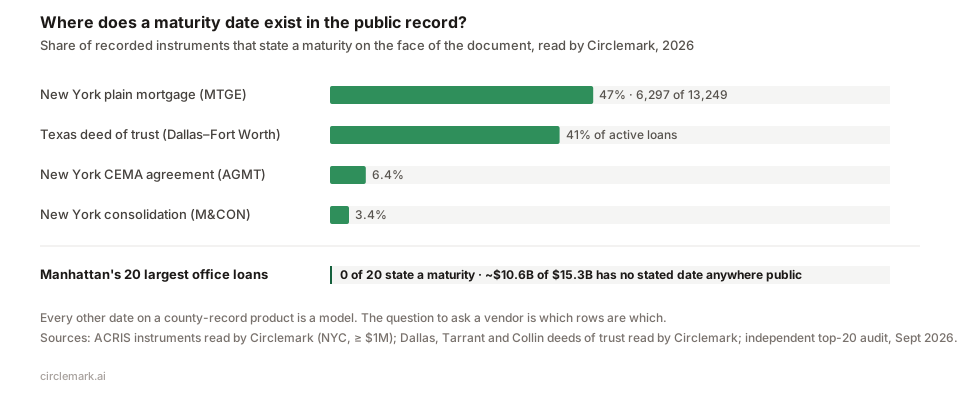
Plain New York mortgages state a maturity 47% of the time (6,297 of 13,249 read); Texas deeds of trust 41%; the consolidation agreements that carry Manhattan's largest loans 3–6%, because the amended note is an unrecorded exhibit. Not one of the twenty largest Manhattan office loans has a maturity date written into the recorded instrument — for about $10.6B of their $15.3B, no stated date exists anywhere in the public record. Any product that shows those twenty loans with a hard maturity date is showing you its model.
Modelling is fine. It is the industry's standard practice and it is how prospecting lists get built. The failure is presenting the model as the record. Reonomy's API returns a mortgage's due_date as a bare date with no field saying whether it was read or estimated; its resource guide says "the mortgage maturity date tells you when a loan is set to mature". Crexi's marketing qualifies its interest rates as "estimations" but not its maturities. Capitalize.io's guide to loan maturities never raises the question. Our own model is not exempt from error: in an independent audit of the top-20 Manhattan office loans in September 2026, all five with a disclosed securitized maturity had our estimate early, three of them by about three years (ten-year CMBS paper modelled at five or seven). What we don't do is hide that the date was modelled. Every loan on Circlemark carries one of exactly two kinds of maturity, and the row says which. A stated maturity was read from the recorded instrument: it renders in bold and cites the page it came from. A modelled maturity is shown as ≈ 5-yr (or 7, or 10), meaning "estimated, assuming a five-year term from origination", with the tooltip "term assumed, not stated on the recorded document". We keep every plausible term for that lender type rather than collapsing them to one, so a "next 12 months" filter tells you which term put the loan in the window, and a stated date, once read, replaces the whole set.
How to test a vendor: ask for the stated-versus-estimated flag on a loan. If there isn't one, every date is an estimate and you don't know which.
4. A contact for the wrong person
What users told us: the complaint that came up with all three products, and specifically with Capitalize.io. The number rings a receptionist, a former partner, a lawyer, or someone with the same name.
Why it happens. The borrower on a commercial mortgage is an LLC. The record names the LLC; contact databases index people by firm; and the person who runs the LLC usually runs it from a firm with a different name. Every wrong contact is one of four substitutions:
- The filer, not the owner. "Name and contact was for the filer of the LLC… which was a lawyer, or online LLC filing company" — a BiggerPockets user on Reonomy. The registered agent is the easiest person to find and the wrong one to call.
- The office's other tenants. Trace a person at their office address and the skip-trace returns everyone at that address. In our September bench, address-keyed lookups at an office returned zero usable numbers; at a home address, three of three.
- Same name, different person. "For years now I've been getting emails and texts about commercial real estate I don't own because I have the same name as someone else" — a Trustpilot reviewer, from the receiving end. A name-only match with no firm is how this happens, and a vendor that accepts it is choosing coverage over accuracy.
- A number that was right in 2019. Bounced emails and disconnected numbers are the most common complaint in every review set we read. Reonomy's own help center says it is "unable to verify every phone number and email address in our system"; the October 2025 clean-up removed 3 million undeliverable emails at once.
Here is what an honest first pass looks like. Eleven New York loans a broker asked about, 33 owners and officers behind them, every public source plus a business-contact lookup and a skip trace, September 2026:
| People | |
|---|---|
| A mobile number, first pass | 3 |
| A work or personal email, first pass | 8 |
| A switchboard number only | 8 |
| Nothing from any source, first pass | 16 |
| Operating firm established, of those the record named none for | 7 of 32 |
| New work emails from those firms | 4 |
| Mobiles for office-registered principals via the firm route | 5 of 10 |
| Mobiles via a home address | 3 of 3 with a home, 0 of the rest |
Sixteen of 33 principals had nothing on the first pass. A product that shows a phone number for all 33 is not verifying against the person; it is filling the column. The full method — and why findability runs opposite to authority — is in how to find the owner of a commercial property in NYC.
How to test a vendor: reveal the contacts on three buildings whose principals you already know. Count the ones that reach that person, not a person.
Is Reonomy accurate? The claims versus the reviews
Reonomy (an Altus Group business since November 2021) advertises 53M+ commercial properties, 42M+ mortgages, 30M+ owner and contact records and "verified owner contacts", sourced from "all 3,100 county assessors, Secretary of States, and census data, plus exclusive partnerships with Cotality and ICE". Pricing is listed from $400 a month on an annual plan, with monthly self-serve added in May 2026.
The reviews split the same way theBrokerList's 2020 review did: "Reonomy's property records themselves are very accurate… however, owner contact information is not always 100%." On Capterra (4.1 of 5, 33 reviews) the low scores are almost all contacts — "Ownership info is about 50/50" (April 2025), "the information is old and not accurate" (March 2023), "Over 30% of my mailings returned as no addressee or not deliverable" (BiggerPockets). CRE Daily's February 2026 roundup lists "Accuracy of data is questionable" and "Somewhat stale market insights" as cons, and its review says Reonomy "aims for about 80% accuracy" — a figure CRE Daily does not source and Reonomy does not publish.
Two things are to Altus's credit. In October 2025 it said in public that data quality was "one of the most frequent topics of feedback", that it had "corrected mortgage duplication issues" and removed the 3 million dead emails. On September 11, 2026 it announced a rebuilt contact knowledge graph with "more conservative matching and targeted validation", and warned that "some company identifiers may change" and that the verified-portfolio checkmark would be removed while it was rebuilt. That is a vendor fixing the right problem. It is also confirmation, from the vendor, that the problem was real for the four years before.
What has not changed: no stated-versus-estimated flag on maturities, no published refresh cadence for loan status, no error rate.
Crexi Intelligence review: what $2,388 a year buys
Crexi Intelligence is the data layer on top of the Crexi marketplace: 153 million+ property records, 46 million+ "verified" sales and lease comps, and a monthly allowance of ownership-contact credits, listed on Capterra at $249 per user per month or $2,388 a year (reviewers report $263–$272 a month on twelve-month contracts). Its owner-contact data is supplied by a third party; BatchData publishes the case study. Crexi's own pitch for the loan side is to "identify refinance candidates by searching loan maturity dates, lender information, and interest rate estimations, then immediately access verified ownership contact details".
The marketplace is well liked — Trustpilot's 4.6 over 3,200 reviews is overwhelmingly listings and support. The Intelligence reviews are different. On G2 a review titled "'Intelligence' not very intelligent" says a filtered search returns forty properties of which "only 2 or 3 actually fit the filters… mobile home parks for apartment buildings, vacant land", and — the one loan-specific complaint we found anywhere — that "the software lacks the ability to differentiate between an arms-length transaction and a second mortgage or refi, so the mortgage valuations are dicey as well". A Trustpilot reviewer who bought it to "search mortgage data and find potential deals" wrote that they would be lucky "if 1 of 100 contacts answered" and called it "a $6,000 mistake". The November 2025 BBB complaint alleges an internal test found "a severe and systemic inaccuracy rate of over 50% in key contact fields (owner names, phone numbers)" after a sales representative had called the data "highly accurate". A counter-example from April 2026: one reviewer tested Crexi against Reonomy and ProspectNow and found its skip tracing reached "the right contact simpler and better than any other".
Crexi publishes no methodology for owner contacts, no refresh cadence for loan records, and no labelling of maturities as recorded or estimated. The word doing the work on its pages is "verified", and nothing says by whom or how.
Capitalize.io: a lender database with loan data attached
Capitalize.io (founded 2024, $4M seed in July 2025) is a different product from the other two. Its front page counts 100K+ lenders, 650K+ lender contacts, 2M+ sponsors profiled and "$2 billion+ of deals sourced and closed"; the loan records — 12 million+ mortgages, per a July 2026 profile — are built from mortgage records, CMBS data and agency filings and are there to match a borrower to a lender who has done that deal. Reported pricing is $399 a month for a solo seat and $149 a seat for teams, with outreach infrastructure billed separately.
It is too new to have a review-site footprint: no G2, Capterra or Trustpilot listing, no forum threads. The only accuracy evidence is the company's own August 2025 claim to be "seven times more accurate at identifying relevant contact information than conventional databases" — which CRE Daily's write-up rendered as seven times more accurate at "borrower-lender matches", the same number attached to two different things, with no comparator, sample or method named either time. The wrong-contact reports we have about it are from our own onboarding calls, not from public reviews, and its coverage claim — "complete, real-time coverage of every securitized commercial mortgage" — is the right claim for the CMBS slice and says nothing about the bank loans that are most of the market.
Is Reonomy shutting down?
No. Altus still sells Reonomy under its own name, added self-serve plans in May 2026 and shipped a rebuilt contact graph in September 2026. Reonomy data feeds Altus's ARGUS Intelligence product but the two are listed separately, and Reonomy was not part of the appraisal and development-advisory businesses Altus sold to Newmark in 2026. If a search sent you here for that question, the answer is that the product is alive and mid-rebuild.
Six questions to ask any vendor
- Is this maturity date read from the document or estimated, and which is which on screen? If there is no flag, every date is an estimate.
- How does a paid-off loan leave the list? Ask specifically about a consolidation whose satisfaction cites the old notes (New York) and a facility released one property at a time (Texas).
- Is a blanket or multi-property loan counted once? One financing recorded against five parcels is one debt, and a Texas facility states the full amount on every recording.
- Is the contact tied to the person or to the LLC? Ask what happens when the record names only an LLC and a registered agent.
- What is the refresh cadence for loan status, as opposed to listings, and where is it written down?
- What is your error rate, and when did you last publish one?
The vendor that answers all six may still be wrong about a loan. It will at least be wrong in a way you can see.
How Circlemark compares
We cover New York City and Texas (Dallas–Fort Worth and San Antonio, with more Texas counties loading) — not the country — and everything below applies only there. We currently track 162,790 commercial loans across those markets, 19,978 of them active and maturing within twelve months, and 26,113 with a maturity read from the recorded instrument.
| Reonomy | Crexi Intelligence | Capitalize.io | Circlemark | |
|---|---|---|---|---|
| Coverage | National | National | National; securitized loans emphasised | NYC + Texas metros only |
| Loan source | County records + commercial databases | Public records + CMBS | Mortgage records, CMBS, agency filings | County recorder, instrument read; ABS-EE / agency for the securitized slice |
| Maturity labelled stated vs estimated | No | No | No | Yes, on every row: a stated date in bold with a page citation; a modelled date as ≈ 5-yr, "term assumed, not stated on the recorded document" |
| Loan-status refresh | Not published | Not published | Not published | Weekly per county; five guards (satisfied, superseded, modified, foreclosed, distressed) |
| Multi-property loans | Not documented | Not documented | Not documented | One loan, parcel count shown; Texas facilities collapsed to one recording |
| Owner contacts | "Verified", ranked by reliability; contact graph rebuilt Sep 2026 | Third-party contact data; "verified" | Lender contacts first | Public-record people with source and tier per name; work email on unlock; a phone charged only when a number lands |
| Published error rate | No ("about 80%" is CRE Daily's figure) | No | No ("7× more accurate", unsourced) | Yes, in this post and the methodology: 5,826 (3.7%) stale loans found and closed Sep 21, 2026 |
| Listed price | From $400/mo (annual) | $249/user/mo or $2,388/yr | Solo $399/mo, Teams $149/seat (reported) | $299/mo |
The thing to take from the table is not the last column. It is that the three "No"s in the middle rows are the four complaints. A product cannot show you which dates it made up, retire a loan whose satisfaction cites a different document, or reach a person the record only names by LLC, unless someone made those three pipeline decisions on purpose — and if they did, they would say so.
What Circlemark does not do
- Two states. If your market is not New York City or Texas, none of the above helps you, and we will say so rather than sell you a nearby one.
- Most maturities are still modelled. Reading the instrument gets a stated date on about half of plain mortgages and almost no consolidations. The rest carry a labelled estimate, and our estimate has a measured early bias on securitized paper.
- Lis pendens lives with the courts, not the recorder, and we don't have it yet.
- Sixteen of 33 principals had no reachable contact on the first pass in our own bench. We show that as nothing rather than a number for someone else.
- The 5,826 were ours. They were on the list for months before the rule caught them. The next class of stale loan — a satisfaction that cites a note too small to have been ingested — is known and is being repaired now.
Every loan on Circlemark shows where each field came from and when it was last checked, on the web or inside Claude. If you have used one of the products above and can name the building where it was wrong, we would like to know whether we are right about it — that is how the four sections above were written.
Frequently asked questions
- Is Reonomy accurate?
- Reonomy's property records come from assessors and recorders and are generally sound; the complaints in public reviews cluster on owner contacts — bounced emails, disconnected numbers, and the LLC's filing agent listed as the owner. Altus, Reonomy's parent, wrote in October 2025 that data quality was one of the most frequent topics of customer feedback and that it had removed more than 3 million undeliverable email addresses. Neither Reonomy nor its parent publishes an accuracy rate; CRE Daily's 'about 80%' figure is reported, not sourced.
- Is Reonomy shutting down?
- No. Altus Group bought Reonomy in November 2021 and still sells it under the Reonomy name, with self-serve monthly plans added in May 2026 and a rebuilt contact graph announced on September 11, 2026. It feeds data into Altus's ARGUS Intelligence but was not folded into it, and it was not part of the businesses Altus sold to Newmark in 2026.
- Is Crexi Intelligence worth it?
- It depends on the job. At $249 per user per month (or $2,388 a year) it bundles nationwide property records, comps and owner-contact credits with the marketplace. Reviewers on G2, Trustpilot and the BBB describe poor filter precision, stale ownership contacts and mortgage records that do not distinguish a refinance from a second lien. Crexi publishes no refresh cadence for loan data and does not label maturity dates as recorded or estimated.
- What is Capitalize.io and is its loan data accurate?
- Capitalize.io is a lender-matching platform: its headline assets are a searchable lender database, lender contacts and sponsor profiles, with loan records drawn from mortgage records, CMBS data and agency filings. It is too new to have a public review footprint, so the only accuracy evidence is the company's own 'seven times more accurate' claim, which names no comparator or sample. Users we onboarded reported wrong contacts, not wrong loans.
- Why do CRE data platforms show loans that were already paid off?
- Because the county record retires a loan indirectly. In New York a satisfaction cites the notes a consolidation folded in, never the consolidation agreement the product lists, so the agreement stays 'active' unless the matcher follows the citation. In Texas a facility is recorded once per property and released one property at a time, so the opposite mistake — closing the whole loan on the first release — is just as easy. Both are pipeline choices, and no vendor publishes which one it made.
- Why is the maturity date wrong on so many commercial loans?
- Most county recorders have no maturity field. The date is either read off the scanned instrument, which states one on about 47% of plain New York mortgages, 41% of Texas deeds of trust and almost no New York consolidation agreements, or it is modelled from the origination date and a typical term. A product that shows a single hard date for every loan is presenting the model as the record.
- What should I ask a CRE data vendor before I trust its maturity dates?
- Six things: whether each date is read from the document or estimated, and which is which on screen; how a paid-off or consolidated loan leaves the list and how quickly; whether a blanket or multi-property loan is counted once; whether a contact is tied to the person or only to the LLC; what the refresh cadence is for loan status, not just listings; and whether they will tell you their own error rate.
Sources
- Altus Group: Reonomy — Data quality improvements (Oct 31, 2025)
- Altus Group: Reonomy — A stronger foundation for company and contact intelligence (Sep 11, 2026)
- Altus Group: Reonomy self-serve pricing (May 27, 2026)
- Altus Group acquires Reonomy (Nov 11, 2021)
- Reonomy API reference — mortgage fields (due_date)
- Reonomy help center: What do I do if some of the ownership information listed is incorrect?
- Capterra: Reonomy reviews
- CRE Daily: Reonomy review (updated Nov 24, 2025)
- CRE Daily: Crexi review (updated Feb 2, 2026)
- CRE Daily: Best commercial real estate data sources for 2026 (Feb 18, 2026)
- Capterra: Crexi PRO pricing and reviews
- G2: Crexi reviews
- Trustpilot: Crexi reviews
- Better Business Bureau: Crexi complaints
- BatchData: Crexi case study (owner-contact data sourcing)
- BiggerPockets: Reonomy — need review? (2018–2022)
- BiggerPockets: CoStar vs Reonomy vs Crexi vs others
- Wall Street Oasis: Crexi Intelligence subscription — what's the catch?
- Capitalize.io
- GlobeNewswire: Capitalize launches AI agents for CRE financing (Aug 14, 2025)
- AI for CRE Collective: Inside Capitalize.io (Jul 2, 2026)
- The Real Deal: AI proptech startup Capitalize.io raises seed funding (Jul 21, 2025)
- NYC Open Data: ACRIS Real Property Master
Read next
- Ask Claude which CRE loans mature next year: Circlemark now provides an MCP connector
Commercial mortgage maturity data now answers questions in plain English. How we put over 100,000 NYC loans inside Claude via the Model Context Protocol, what an AI assistant can and can't do with recorded-document data, and why the connector never presents a modelled maturity as a fact.
- Where commercial mortgage maturity data actually comes from
Every CRE maturity date in every data product traces to one of three sources: the county recorder, securitization disclosure, or somebody's model. What each one covers, what each one hides, and the questions to ask any vendor before you trust a date — with New York and Texas as the worked examples.
- How we monitor NYC commercial mortgage maturities for brokers in 2026 (and why ACRIS makes it hard)
Where commercial mortgage maturity data actually comes from, why New York City's public records don't contain a maturity date, and how Circlemark turns recorded documents into a verified, weekly-refreshed list of loans coming due.