How to find home builders' construction loans in public records: search by who the borrower is (2026)
Every loan-prospecting tool filters by collateral — asset class, amount, maturity. A lender who wants custom home builders needs the opposite question answered: who is the borrower? Here is where that answer lives in the public record, how much of it there is, and a step-by-step worked in Dallas–Fort Worth — 1,456 active builder loans, 1,194 of them project-sized, a builders' roster matched against the record, the maturity and lender off the deed — with what carries over to New York and to markets we do not cover.
By Andrew Zhong, founder of Circlemark · · Updated · 14 min read · Figures as of Oct 22, 2026
Every loan-prospecting tool lets you filter by what the collateral is — multifamily, office, land; $1M to $5M; maturing in twelve months. A lender with capital for custom home builders needs the other question answered: who is the borrower? That answer is in the public record — most fully in Texas, where the state publishes each entity's line of business — and this walks through reading it for the 1,456 active builder loans in Dallas–Fort Worth, then says what carries over to other markets.
The lenders who asked for this are private and hard-money shops with a specific appetite: a builder with entitled lots who needs vertical construction capital, or a land loan coming due that a bank will not roll. Their existing tools let them pick "land" and "$2M–$10M" and "maturing in 2026", which returns a REIT's parking lot next to a builder's subdivision. The email goes to both, and the reply rate shows it. The collateral filters are not wrong; they are answering a different question.
What the record can say about who the borrower is turns out to be more than people expect, with limits that matter, so this post does four things: shows where the answer comes from and how much of it exists, walks through the search step by step in Dallas–Fort Worth, says what changes outside Texas, and says plainly where it stops.
Where "who the borrower is" lives in the public record
Every recorded mortgage or deed of trust names its borrower — the mortgagor in New York, the grantor in Texas. Two public sources say what that entity does, and one of them exists only in Texas.
The Comptroller's register (Texas). Every taxable entity in Texas files a franchise-tax account, and the account carries the NAICS code the entity gave the state for its line of business. The Comptroller releases the register on request: 3,454,403 entities in the extract we loaded, 3,279,392 of them active (October 9, 2026). NAICS 236115, 236116 and 236117 are residential building construction — the custom builder, the production builder, the for-sale builder. 237210 is land subdivision. 2362 and 238 are commercial builders and the trades. The code is the entity's own statement to the state, so we call a type read from it registered.
The entity's name. "Impression Homes LLC" says what it is. So do "Lone Star Roofing" and "First Baptist Church of Frisco". A word in the name is a weaker reading than a filing, so we call that type estimated, and the interface marks it with ≈ the way it marks an estimated maturity. The readers are deliberately narrow: HOMES, BUILDERS and CUSTOM for builders, CONSTRUCTION and CONTRACTING for contractors, LAND DEVELOPMENT for developers. Words every LLC carries — DEVELOPMENT, HOLDINGS, PROPERTIES, INVESTMENTS, CAPITAL — say nothing and are not read. A registered code always beats a name reading.
How much of the record this covers, for active Dallas–Fort Worth loans of $1 million and up on October 9, 2026:
| Loan rows | Share | |
|---|---|---|
| Active rows | 69,095 | |
| Borrower type from the Comptroller register | 12,222 | 18% |
| Borrower type from the name only | 6,226 | 9% |
| No type — a single-asset LLC named after a street or a project | 50,647 | 73% |
The 73% is the honest ceiling of a borrower-type filter, and it is structural: "Golden Ranch Lot 12 LLC" has filed nothing that says who stands behind it, and its name says nothing either. That is what the third step below, your own roster, is for.
For home builders specifically, the two reads together tag 5,394 active rows in Dallas–Fort Worth, 1,362 of them from the register. A builder's facility is recorded against every lot it covers, so those rows are 1,456 distinct loans.
262 of them are $50 million or more, and most are not what a construction lender is looking for: they are national builders' corporate debt, recorded against the lots that secure it — K. Hovnanian's secured notes with Wilmington Trust as collateral agent, revolving lines to Ashton Woods and LGI Homes from Wells Fargo and Texas Capital Bank. 182 of the 262 were recorded before 2020; they are probably refinanced since, and stay on the active list until a release is matched to them. The project-sized loans are the other 1,194, on 3,694 rows (October 11, 2026):
| Lender type | Under $50M | $50M and over |
|---|---|---|
| Bank | 848 | 227 |
| Unclassified lender | 188 | 34 |
| Debt fund / private | 135 | 0 |
| Life company | 12 | 1 |
| Agency | 7 | 0 |
| Credit union | 3 | 0 |
| Residential lender | 1 | 0 |
| All | 1,194 | 262 |
By county, the same loans under $50 million:
| County | Builder loans under $50M | Due within 12 months | Maturity stated on the deed | Stated, due within 24 months | On vacant land |
|---|---|---|---|---|---|
| Dallas | 497 | 57 | 172 | 43 | 40% |
| Denton | 383 | 50 | 104 | 27 | 26% |
| Collin | 240 | 39 | 57 | 16 | 17% |
| Tarrant | 204 | 21 | 61 | 12 | 29% |
| Dallas–Fort Worth | 1,194 | 143 | 363 | 89 | 33% |
A facility drawn on lots in two counties counts in both, so the counties add up to more than the metro line. "Due within 12 months" takes the deed's date where it states one and our estimate where it does not; the next two columns are the deed alone. Three in ten of these loans state their maturity; the rest carry an estimate, marked ≈. "On vacant land" is the appraisal district's own vacant-lot or acreage code on at least one of the loan's parcels, which on a roll a year old includes lots with a house now going up. Dallas leans most to lot paper; in Collin most builder loans sit on parcels the roll already shows improved.
The register is Texas-wide, so Houston, Austin and San Antonio carry registered types too; how each Dallas–Fort Worth county's record is read is on the Dallas–Fort Worth market page. The next section covers what changes elsewhere.
Step 1 — filter by borrower type
On Search, set the metro to Dallas–Fort Worth and open Borrower type. Pick Home builder; add Land developer if lot paper is in scope. Everything else works as before: county, maturity window, loan size, lender type. Set a ceiling on Loan size — $50M, or your own credit box — or the national builders' corporate lines fill the top of the list. The hover text on the control says which read is in play for the metro you have chosen.
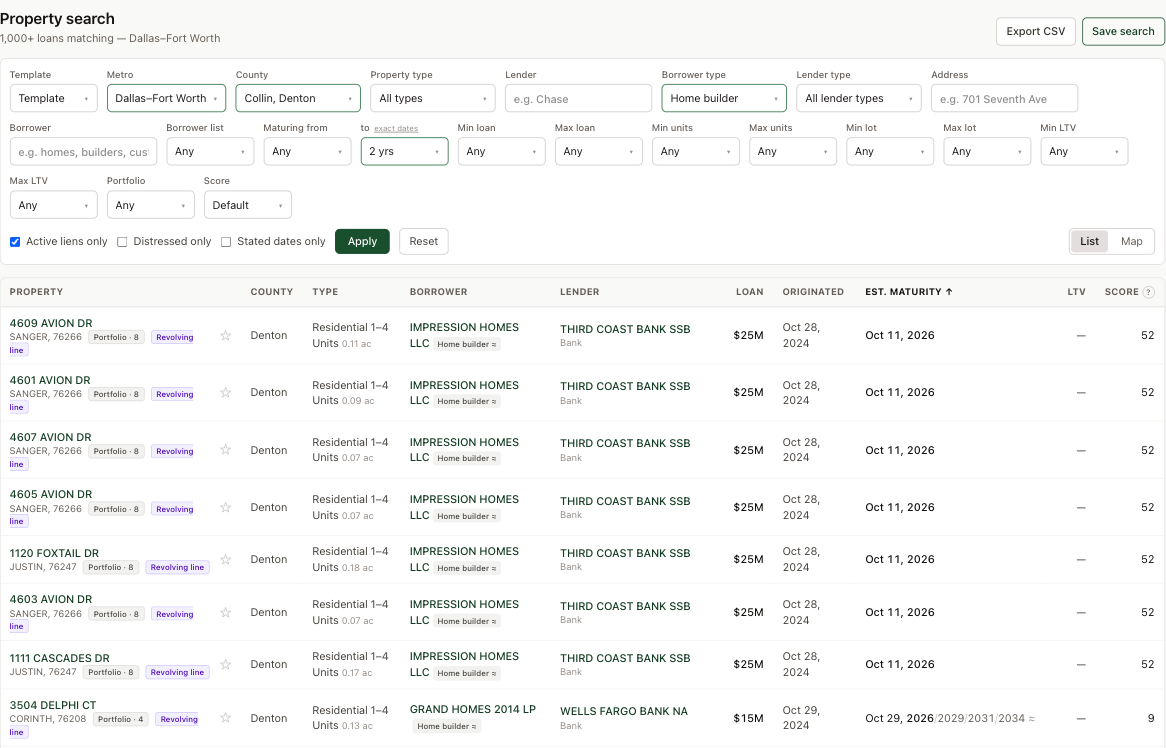 Collin and Denton, home builders, maturing within two years. The chip beside each borrower says "Home builder"; the ≈ says it was read from the name, not the register. A revolving line is recorded against every lot it draws on, which is why one $25M facility fills eight rows.
Two things to read on the results. A builder's revolving line shows the line's full amount on every lot, not that lot's share; the badge says so, and the amount should never be summed across rows. And the ≈ is doing work: a row with it is a builder because its name says so, which is right most of the time and wrong for "Nursing Homes" and "Mobile Homes" often enough that those are excluded by rule.
Step 2 — or search the name directly
The Borrower box takes keywords, comma-separated, any of them: homes, builders, custom returns every loan whose borrower or owner of record carries one of those words. It is cruder than the type filter and catches a few things the filter leaves out — a builder whose entity is a person's name, found through the appraisal district's owner of record. Use it when you know the words a target market uses for itself.
Step 3 — upload your own roster
This is the step that reaches the 73%. A builders' association directory, a CRM export, the firms your desk already knows: under Saved → Borrower lists → Upload a list, drop in a CSV or an Excel workbook with a Company column and, if you have one, a Contact column. City and ZIP columns help. The form shows what it read before you save.
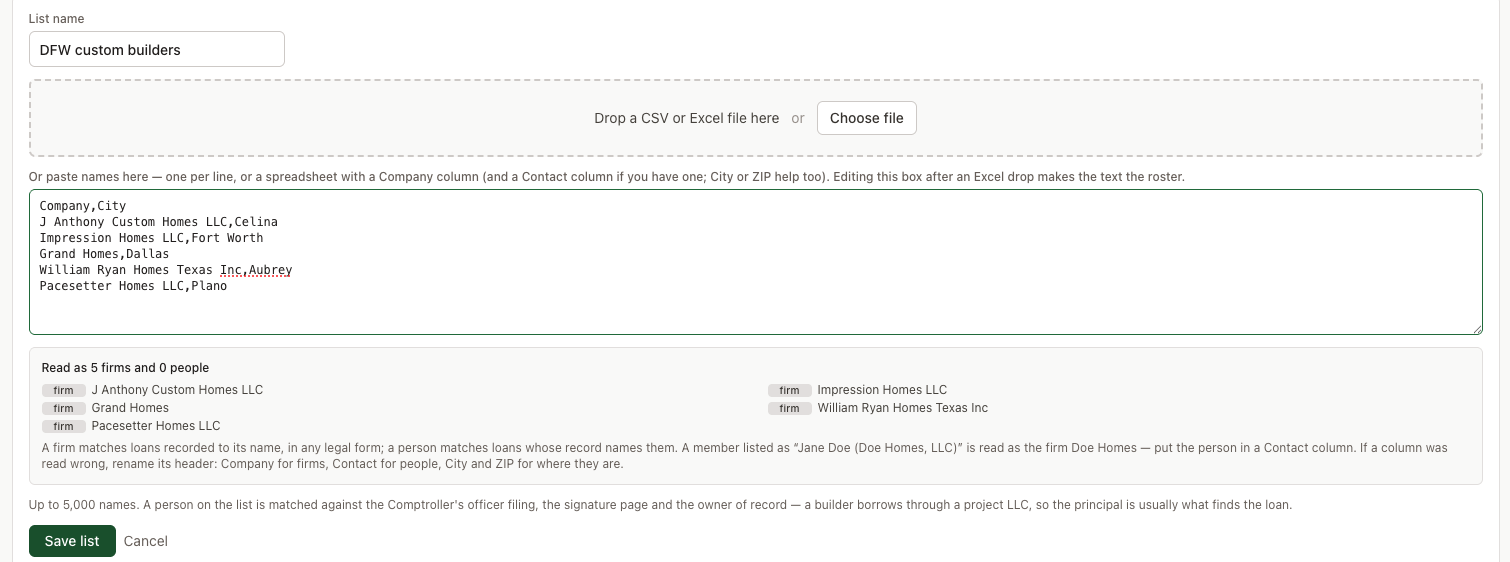 The preview is the check: every line is labelled firm or person before anything is saved, so a misread column shows here rather than in a match count later.
Matching works two ways, and the second is the one that matters for builders. A firm matches loans recorded to its name in any legal form — "Alco Homes, LLC", "ALCO HOMES L.L.C." and "Alco Homes" are one key. A person matches loans whose public record names them: the officers the Comptroller holds for the borrowing entity, the person who signed the deed, the appraisal district's owner of record. A builder borrows through a project LLC that no directory lists; the principal's name on that LLC's officer filing or signature page is what ties the roster to the loan. A person placed by city or zip on the roster must share the place of the record naming them, which is what keeps a common name from matching a stranger: the first test of a 712-person Dallas roster matched thirty New York loans through same-named housing contacts before that rule, and none after.
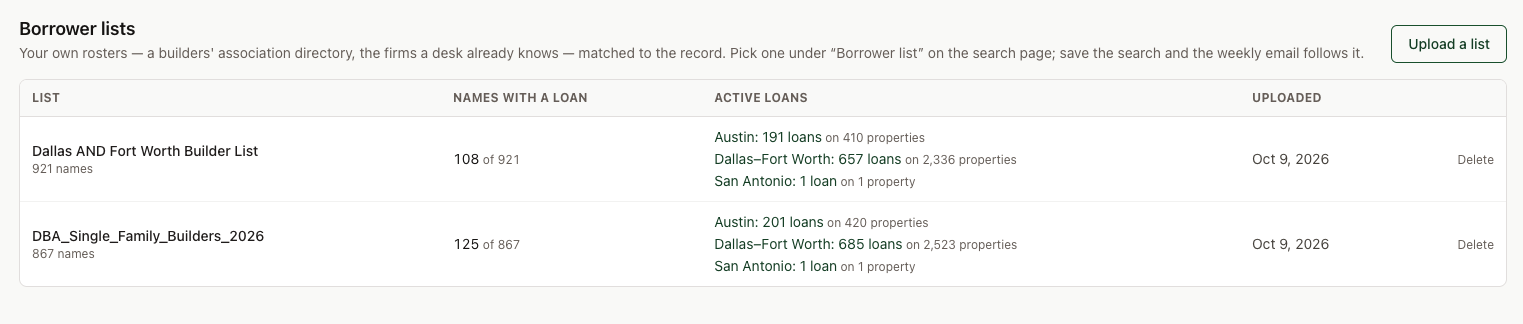 Two real rosters from a Dallas lender, uploaded October 9, 2026: the Dallas Builders Association's 2026 single-family directory and a Dallas–Fort Worth member list. Each row links to the search.
The numbers on those rows are the honest answer to "did my list land". The DBA directory's 867 names, firms and contacts together, reach 685 active Dallas–Fort Worth loans. 125 names have a loan on record; the other 742 are firms that borrow under $1 million, borrow nothing, or borrow through an LLC whose officers have not yet reached the Comptroller's file — the register names officers for 63% of active entities and almost none formed since 2025. Pick the list under Borrower list on the search page, combine it with a maturity window, save the search, and the weekly email reports every new loan recorded to a name on it.
Step 4 — read the maturity and the lender off the deed
Open any row. The card leads with what the recorded instrument states.
 A $1M loan from a private lender on a Dallas lot, recorded September 2026 and due in about a year. The maturity is stated on the deed; the rate band is a convention for this lender type, marked ≈, because the deed does not restate the note's rate.
Three in ten builder deeds state the maturity date outright, and a two-year builder loan from a private lender is the clearest refinance event the record offers: the date is a fact, the lender's rate class is known, and the next lender's pitch window is the twelve months before it. What the deed does not give you is the rate itself. Of the 1,456 active builder loans in Dallas–Fort Worth, 61 carry a stated rate, and none of those is from a debt fund. The honest proxy is the lender: filter Lender type to debt fund and you have the builders paying private-money rates.
Below the card are the people on record for the loan, each citing its source — the Comptroller's officers, the signer of the instrument, the owner of record — and a Reveal spends one credit to put an email beside the decision-maker. Mobile numbers are a separate, priced click.
Step 5 — keep it running
Save the search. The weekly email runs it after the week's recordings are in and reports new loans entering the criteria and status changes on loans you have seen. The same filters, including the roster, are available through the Claude connector: ask for "builder loans in Collin County maturing within eighteen months on my DBA list" and the answer comes back with every date labelled stated or estimated.
Who this is for
Lenders. Private and hard-money lenders with a builder appetite are the obvious case, and the reason this exists. Bank construction desks have the same question from the other side: which builders in the footprint are borrowing from a competitor, and when does that paper mature.
Debt brokers. A broker placing lot loans and vertical construction can run the same search and arrive before the builder calls anyone. The roster step matters most here: a broker's list is the association roster plus everyone they have ever closed with.
Investors and developers. Land buyers and lot developers use the Land developer and Home builder types in reverse — which builders are active in a submarket, who finances them, what they paid — and equity partners use the roster to watch the debt of the firms they back. The watch is the same; the reason differs.
What the other tools say they do
We read the published material of the platforms a Dallas lender named to us, on October 9, 2026, and recorded what each describes.
| Platform | What its published material describes | A borrower-type filter from a state register? |
|---|---|---|
| Capitalize | A searchable database of loans, lenders and contacts built from county records, with maturing-loan and refinance leads; filters on loan type, asset class and amount | Not described |
| Forecasa | Private-lending market intelligence: lender and borrower activity, borrower profiles, segmentation by fix-and-flip, bridge, DSCR and construction, watchlists, an MCP connector | Borrower profiles are described; their source is not |
| Reonomy, CoStar | Property-first databases with a loan record per property, owner contact, portfolio filters | Not described |
That is what the material says, not what the products do on a given day; filter sets change, and a demo answers the question faster than a web page. The question to ask any of them is the same one this post answers for Circlemark: when the filter says "home builder", where did that answer come from, and what share of loans can it reach?
Outside Texas
The method carries over; one of the two sources does not.
New York City. The Department of State registers an entity's officers but not its line of business, so every New York borrower type is a name reading, marked ≈, and the Borrower type menu leaves out the three types only a register can produce (investor, real estate services, other operating business). The roster works as it does in Texas, through different records: a person on your list is matched against the officers on the building's HPD registration, the owner on its DOB permit filings, the signer on the recorded mortgage and the owner of record — the four sources in our guide to finding the owner behind an NYC LLC.
Markets we do not cover yet. The steps work by hand anywhere a county recorder indexes its records by party name, which most do:
- Start from a roster, not the recorder: the local builders' association directory, your CRM, the permit office's list of active residential contractors.
- Search each firm as grantor or mortgagor in the county's official-records portal. You will find the loans recorded in the firm's own name and miss the project LLCs.
- Find the project LLCs through the principals. The state's business registry names an LLC's organizer or registered agent, sometimes its managers; search those names as grantor too, and read the signature page of anything you find.
- Read the maturity off the instrument. A deed of trust usually states it on the first page; a mortgage in a state like New York often does not, and then any date you see elsewhere is an estimate.
That is the work the filters above save; it is a few hours a firm, which is why the roster has to be short to do it by hand.
Where it stops
- Three in four Dallas–Fort Worth borrowers carry no type, because a single-asset LLC says nothing about itself and has filed nothing that does. The roster reaches those through their principals; nothing else does.
- Loans under $1 million are not in the product, and much starter-home lot paper sits there. A builder you know who is missing is usually missing for that reason.
- The newest LLCs have no officers on file yet. The Comptroller's officer rows cover 63% of active entities and almost none formed since 2025, which is exactly the single-asset borrower profile. A roster's people cannot reach a 2025 project LLC until the next officer filing cycle lands.
- Outside Texas there is no register. Every New York borrower type is a name reading; the roster still works through the people on record.
- Rates are not on the deed, with the 4% exception above.
Everything a row shows says which of these applies to it: a chip with ≈ is a name reading, a date with ≈ is a model, a blank is the record saying nothing. Start with Dallas–Fort Worth home builders maturing within two years, no account needed, and upload your roster when you have one.
Frequently asked questions
- How do I find which home builders have construction loans?
- Search the county's recorded mortgages and deeds of trust by who the borrower is rather than by the collateral. Every recorded instrument names its borrower; a builder's own name usually says what it is; and in Texas the Comptroller's franchise-tax register adds the line of business the entity filed (NAICS 2361 is residential building construction). Most builders borrow through project LLCs, so the third route is a builders' roster matched through the principals named on the LLC's filings and the deed's signature page. On Circlemark the Borrower type filter and borrower lists do these reads in Dallas–Fort Worth, San Antonio, Austin and New York City, and mark which read they used.
- Can I search commercial loan records by borrower type?
- Only where a public register records the borrower's line of business, which in our markets means Texas. The Comptroller publishes every active taxable entity's NAICS code; New York's Department of State registers officers but no industry. Circlemark reads the Texas register for a registered borrower type and falls back to a word in the borrower's name, marked as an estimate, everywhere.
- Do loan prospecting platforms like Capitalize or Reonomy filter by borrower type?
- Their published material describes filters on loan type, asset class, amount, lender and maturity, and contact enrichment on the result; none that we could find on October 9, 2026 describes a filter on the borrower's line of business read from a state register. Forecasa describes borrower profiles for fix-and-flip, bridge, DSCR and construction loans. Ask any vendor where a borrower-type filter gets its answer from before relying on it.
- How many home builders in Dallas–Fort Worth have active loans on record?
- 1,456 active loans of $1 million or more have a borrower tagged as a home builder, counted October 11, 2026. 262 of them are $50 million or more, mostly national builders' corporate notes and credit lines recorded against their lots. The 1,194 below that are the project loans: 848 from banks, 135 from debt funds and private lenders, 188 from lenders we have not classified. A builder's facility is recorded once per lot, so those 1,194 loans sit on 3,694 property rows.
- Can I upload my own list of builders and match it to loans?
- Yes. Under Saved, upload a CSV or Excel file with a Company column and, if you have one, a Contact column. Firms match loans recorded to their name in any legal form; people match loans whose record names them — the Comptroller's officer filing, the signature page, the owner of record — which is how a builder borrowing through a project LLC gets found. One Dallas Builders Association directory of 867 names matched 685 active loans in Dallas–Fort Worth.
- Does the recorded deed show the interest rate on a builder's loan?
- Rarely. Texas deeds of trust secure the note but seldom restate its rate: 61 of the 1,456 active builder loans in Dallas–Fort Worth carry a stated rate, and none from a debt fund. The honest proxy for a high-rate loan is the lender: a builder borrowing from a private lender is paying private-money rates, and Lender type filters for that.
Sources
- Texas Comptroller of Public Accounts — Franchise tax account status and Public Information Reports (open records)
- US Census Bureau — North American Industry Classification System (NAICS 2361, residential building construction)
- Collin County Clerk — Official Public Records search
- Dallas Builders Association — member directory
- CREtech — Capitalize launches AI platform to unlock $3 trillion in maturing CRE debt (July 2025)
- Forecasa — solutions for lenders
Check one building
Type an address and see the mortgages recorded on it — lender, amount and the maturity read from the instrument. Free, no account.
Read next
- Gas station, convenience store and car wash loans in New York and Dallas–Fort Worth: 864 on the record, who lends on them, and when they come due
A data brief on the debt behind fuel retail in two markets: the 864 active mortgages of $1 million or more recorded against gas stations, convenience stores and car washes in New York City and Dallas–Fort Worth, how each county's own records identify the use (DOF building classes G3–G5 and GW, the Dallas and Collin appraisal rolls, the businesses on file in Tarrant and Denton), which lenders wrote them, and what the instruments say about when they come due.
- How to use the Circlemark search: every filter, column and mark, from the maturity window to the Monday email
A walkthrough of the signed-in search page for New York City and Texas: how the maturity window reads a stated date against an estimate, what each property-type, lender and borrower control matches, the New York-only co-op and rent-regulation filters, how to read a row's badges and the score, the map, and what Save search, Export CSV and the watchlist do on each plan — with the guide behind each control linked where the record itself is the question.
- NYC ARM resets in 2027: what the riders say the rate becomes
ICE counts 186,020 adjustable-rate mortgages resetting nationally in 2027. In New York City the recorded Fixed/Adjustable Rate Riders say what those loans re-set to: the initial rate, the index, the margin and the caps on 5,563 active $1M+ loans with a stated first rate change — 384 of them in 2027 and 361 in 2028. The margins, the cap forms that decide the first year, and the 1,346 riders that still name one-year LIBOR.
Circlemark Tutorials
The rest of the series — what to do on Circlemark, step by step, with the by-hand route beside it.