Gas station, convenience store and car wash loans in New York and Dallas–Fort Worth: 864 on the record, who lends on them, and when they come due
A data brief on the debt behind fuel retail in two markets: the 864 active mortgages of $1 million or more recorded against gas stations, convenience stores and car washes in New York City and Dallas–Fort Worth, how each county's own records identify the use (DOF building classes G3–G5 and GW, the Dallas and Collin appraisal rolls, the businesses on file in Tarrant and Denton), which lenders wrote them, and what the instruments say about when they come due.
By Andrew Zhong, founder of Circlemark · · 19 min read · Figures as of Oct 22, 2026
7-Eleven's parent disclosed in April that it would close 645 North American stores in its 2026 fiscal year. Zips Car Wash went into Chapter 11 in February 2025 citing competition, rising rates and nearly $654 million of funded debt, after a build-out that had opened more than 900 express tunnels a year at its 2022 peak. Every one of those sites sits on a parcel with a recorded mortgage, and until this month no public dataset could pick those parcels out.
Now the county record can. Across New York City and Dallas–Fort Worth, 864 active mortgages of $1 million or more are recorded against gas stations, convenience stores and car washes, written by 345 different lenders. 810 of them are single-site loans under $25 million, $2.68B of original principal (153 in New York, 657 in Dallas–Fort Worth). The other 54 are chain-level facilities of $25 million and up, perfected across as many as 21 sites under one instrument; this post counts them and never adds them to a total. What follows is what the instruments say: how each county's own records identify the use, who wrote the loans, and when they come due.
Counts are as of October 24, 2026. "Gas station", "convenience store" and "car wash" mean what the county's assessor filed on the parcel, not our guess, except in Tarrant and Denton counties, where the appraisal district publishes no building class and the use is estimated from the businesses on record at the address and marked ≈ (187 of the 864). "Lender" means the institution named on the recorded instrument, which is the originator and not necessarily today's holder.
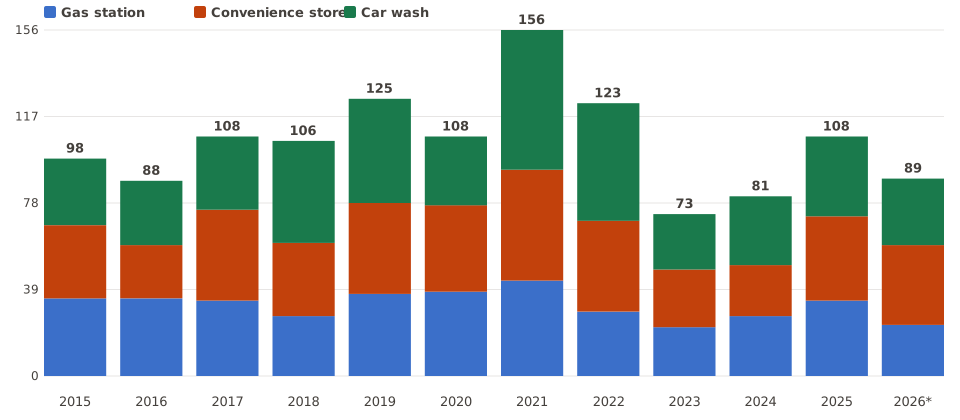
Recorded instruments by year and sub-type, both markets, whatever the loan's status today ( 2026 to Oct 24, 2026).*
How a county record says "gas station"
There is no national dataset of gas stations with mortgages, because the two halves live in different offices. The recorder files the mortgage against a lot. The assessor files the use. The join is a parcel number, and the use is written in each county's own vocabulary.
| County | What the roll says | What we read it as |
|---|---|---|
| New York City (all five boroughs) | DOF building class G3 gas station with retail store, G4 gas station with service / auto repair, G5 gas station only; GW car wash or lubritorium facility | Gas station / car wash, recorded |
| Dallas | DCAD building description: "MINI-MART/GAS SERVICE STATION", "SERVICE STATION", "CONVENIENCE STORE", "CAR WASH" | Gas station, convenience store or car wash, recorded |
| Collin | Collin CAD use code CS (convenience store), split by the trade name on the roll — a QuikTrip or an Exxon is a gas station, a Josephine Market is a store; FSCW / SSCW full- and self-service car wash | Recorded |
| Tarrant, Denton | Nothing finer than the state class F1 "commercial". The business personal property accounts filed at the address — a fuel brand's account names a gas station, a car wash operator's a car wash | Estimated, shown ≈ |
| Harris, Travis, Bexar | The state class only, or codes the district does not publish a key for | No sub-type yet |
Two traps in that table are worth a paragraph each.
PLUTO files gas stations under "transportation". New York's land-use field (landuse 07, "transportation and utility") holds the G classes, parking garages included, and landuse 05, "commercial and office", holds the K store classes. A dataset that types a parcel from land use alone calls every one-story store an office and every gas station a utility. Until October 22 ours did too: 2,500 K1 one-story stores were "office" and the G3–G5 stations were "transportation". We now read the building class ahead of the land use, so a store is retail and a station is a gas station. One class is easy to misread: GU is not a car wash. The Department of Finance's list says "car sales or rental lots without showroom"; GW is the car wash class.
Texas has one code for everything commercial. We wrote about this in October: the Comptroller's F1 class covers a Buc-ee's and a nail salon alike, and only two of the four DFW districts publish a second field that splits it. In Dallas and Collin the split is the district's own; in Tarrant and Denton it is ours, read from who renders equipment at the address, and it says so wherever it appears.
What is on the record
| Market | Sub-type | Active loans | Principal, loans under $25M | Median loan | Facilities ($25M+) | Estimated types | Median lot | Median year built | Lenders |
|---|---|---|---|---|---|---|---|---|---|
| Dallas–Fort Worth | Car wash | 254 | $804.8M | $3.0M | 18 | 81 (≈) | 1.03 ac | 2007 | 131 |
| Dallas–Fort Worth | Convenience store | 298 | $902.0M | $2.3M | 15 | 53 (≈) | 0.87 ac | 2001 | 155 |
| Dallas–Fort Worth | Gas station | 156 | $430.3M | $2.1M | 18 | 53 (≈) | 0.91 ac | 1998 | 102 |
| New York City | Car wash | 34 | $87.6M | $2.1M | 1 | — | 11,250 sq ft | 1964 | 27 |
| New York City | Gas station | 122 | $459.8M | $2.9M | 2 | — | 12,008.5 sq ft | 1964 | 46 |
| All | 864 | $2.68B | $2.5M | 54 | 187 | 345 |
Active mortgages of $1 million or more, one row per loan; a facility perfected by several recordings counts once. Lot size and year built are the assessor's, for the lead parcel.
The median loan is $2.5M, and 81% of the book is under $5 million: this is a sector of single-site operators and small portfolios, financed one deed at a time. The 54 instruments of $25 million and up are a different animal. 35 of them are recorded against more than one parcel, up to 21 sites, and they are a fuel distributor's or a car wash platform's credit facility perfected site by site, written by Wells Fargo Bank, MidCap Financial Trust and Regions Bank among others; 19 are on car washes, 20 on gas stations, 15 on convenience stores. A facility states its whole commitment on every deed, and the commitment is the chain's, not the corner lot's, so the $8.57B they show on paper stays out of every total here.
| Lender | Type | Facilities | Sites under them | Stated principal |
|---|---|---|---|---|
| Wells Fargo Bank | Bank | 9 | 28 | $945.2M |
| MidCap Financial Trust | Debt fund / private | 4 | 6 | $800.0M |
| Regions Bank | Bank | 4 | 5 | $502.5M |
| CB Corporate Finance | Debt fund / private | 3 | 3 | $450.0M |
| Centennial Bank | Bank | 3 | 12 | $84.0M |
| Bank of America | Bank | 2 | 23 | $2.79B |
| WhiteHorse Capital Origination | Debt fund / private | 2 | 12 | $370.0M |
| Capital One | Bank | 2 | 7 | $92.2M |
| Citibank | Bank | 2 | 4 | $79.0M |
| Citizens Bank | Bank | 2 | 9 | $64.7M |
The lenders behind the $25M+ instruments, with the number of sites recorded under them. Stated principal is what each deed says it secures, which for a revolver is the facility, not a drawn balance.
The single-site book looks like this:
| Market | Sub-type | Address | Lender | Type | Amount | Recorded | Matures | Parcels |
|---|---|---|---|---|---|---|---|---|
| Dallas–Fort Worth | Car wash ≈ | 1900 W UNIVERSITY DR, Denton | Bankwell Bank | Bank | $23.5M | May 18, 2026 | Jun 1, 2028 | 1 |
| Dallas–Fort Worth | Car wash | 3505 W NORTHWEST HWY, Dallas | Centennial Bank | Bank | $17.0M | Dec 28, 2021 | Dec 31, 2026 | 2 |
| Dallas–Fort Worth | Convenience store ≈ | 101 LAKE PARK RD, Lewisville | Walker & Dunlop | Agency | $24.9M | Aug 1, 2018 | Aug 1, 2028 | 2 |
| Dallas–Fort Worth | Gas station | 500 S HAMPTON RD, Dallas | American First National Bank | Bank | $21.3M | May 13, 2025 | ≈ May 13, 2030 | 1 |
| Dallas–Fort Worth | Gas station | 710 W PLEASANT RUN RD, Lancaster | Stearns Bank | Bank | $13.5M | Dec 29, 2023 | ≈ Dec 29, 2028 | 1 |
| New York City | Car wash | 49 PENNSYLVANIA AVENUE, Brooklyn | Bank of Hope | Bank | $6.6M | Dec 16, 2025 | ≈ Dec 16, 2030 | 3 |
| New York City | Car wash | 2591 ATLANTIC AVENUE, Brooklyn | Provident Bank | Bank | $6.2M | Jul 15, 2026 | ≈ Jul 15, 2031 | 1 |
| New York City | Gas station | 94-36 MERRICK BOULEVARD, Jamaica | AuguStar Life Insurance Company | Life company | $16.5M | Sep 12, 2025 | ≈ Sep 12, 2035 | 10 |
| New York City | Gas station | 3116 FT HAMILTON PARKWAY, Brooklyn | Citizens Bank | Bank | $11.5M | Sep 21, 2023 | ≈ Sep 21, 2028 | 8 |
| New York City | Gas station | 72-02 ROOSEVELT AVENUE, Jackson Heights | Ponce Bank | Bank | $10.0M | Mar 8, 2022 | ≈ Mar 8, 2027 | 4 |
Open loans under $25 million, among the largest per market and sub-type, whose maturity is still ahead. "Open" means no release is matched and no later instrument is recorded on the lead parcel. A maturity marked ≈ is modelled from the recording date and a typical term; an unmarked one is stated on the instrument.
The New York lots are small and old: a median 11,250 square feet under a car wash and a median build year of 1964 under a gas station. That is also what a Brooklyn or Queens station is worth to a lender today: a corner lot on an avenue, which is why several of the largest "gas station" loans in the city are development loans on sites where the pumps are the current use and not the future one. Manhattan's stations have been closing for twenty years. In Dallas–Fort Worth the median gas-station parcel is 0.91 acres and a car wash sits on 1.03; the collateral is the business.
| County | Gas stations | Convenience stores | Car washes | Basis |
|---|---|---|---|---|
| Manhattan | 7 ($37.0M) | — | — | DOF building class |
| Bronx | 26 ($87.8M) | — | 7 ($12.5M) | DOF building class |
| Brooklyn | 36 ($116.2M) | — | 16 ($44.5M) | DOF building class |
| Queens | 53 ($218.8M) | — | 11 ($30.5M) | DOF building class |
| Dallas | 57 ($156.1M) | 230 ($652.8M) | 98 ($317.4M) | DCAD building description |
| Tarrant | 34 ($100.0M) | 28 ($102.4M) | 52 ($161.8M) | estimated from the businesses on record (≈) |
| Collin | 42 ($112.8M) | 10 ($36.3M) | 62 ($200.2M) | Collin CAD use code + DBA |
| Denton | 23 ($61.5M) | 30 ($110.4M) | 42 ($125.4M) | estimated from the businesses on record (≈) |
Who lends on them
| Lender type | Loans | Share | Lenders |
|---|---|---|---|
| Bank | 703 | 81% | 224 |
| Other / unclassified | 99 | 11% | 78 |
| Debt fund / private | 38 | 4% | 27 |
| Credit union | 12 | 1% | 10 |
| Life company | 9 | 1% | 7 |
| Public / subsidy | 2 | 0% | 2 |
| Agency | 1 | 0% | 1 |
Active fuel-retail loans in both markets by the originator's type. Lender types are derived from the recorded name; "other" is a lender the record does not resolve to an institution, often a private party or a seller.
Fuel retail is bank paper to a degree ordinary retail is not. In New York, banks wrote 87% of the gas-station and car-wash loans against 79% of all retail; CMBS conduits, which wrote 2% of the city's retail loans, wrote 0% of these. Dallas–Fort Worth reads the same way: 80% bank-written against 73% for retail at large. A conduit needs a tenant with a lease; a gas station's income is the operator's, and the environmental file is the operator's too, so this is relationship lending, and the names at the top of the tables are the banks that do that work, several of them among the most active SBA 7(a) lenders in the country. Which of their loans carry the guarantee, the deed does not say.
| Bank | CMBS conduit | Debt fund | Life company | |
|---|---|---|---|---|
| New York City — gas, c-store, car wash | 87% | 0% | 4% | 1% |
| New York City — all retail | 79% | 2% | 5% | 2% |
| Dallas–Fort Worth — gas, c-store, car wash | 80% | 0% | 5% | 1% |
| Dallas–Fort Worth — all retail | 73% | 1% | 4% | 4% |
New York City
| # | Originating lender | Type | Loans | Gas | C-store | Car wash | Median loan | Last closing |
|---|---|---|---|---|---|---|---|---|
| 1 | Bank of Hope | Bank | 18 | 15 | 0 | 3 | $2.2M | Mar 27, 2026 |
| 2 | Citizens Bank | Bank | 12 | 12 | 0 | 0 | $2.9M | Sep 21, 2023 |
| 3 | M&T Bank | Bank | 10 | 10 | 0 | 0 | $3.7M | Dec 23, 2025 |
| 4 | Valley National Bank | Bank | 10 | 9 | 0 | 1 | $3.9M | Jun 17, 2026 |
| 5 | TD Bank | Bank | 9 | 9 | 0 | 0 | $2.7M | Jul 24, 2026 |
| 6 | NewBank | Bank | 6 | 6 | 0 | 0 | $3.8M | Jun 26, 2026 |
| 7 | Dime Community Bank | Bank | 5 | 5 | 0 | 0 | $4.4M | May 30, 2023 |
| 8 | Alma Bank | Bank | 5 | 4 | 0 | 1 | $2.7M | May 29, 2025 |
| 9 | People's United Bank (now M&T)¹ | Bank | 4 | 4 | 0 | 0 | $3.0M | Jul 15, 2021 |
| 10 | Signature Bank (now Flagstar)¹ | Bank | 4 | 3 | 0 | 1 | $3.1M | Jun 27, 2022 |
| 11 | SB One Bank (now Provident)¹ | Bank | 4 | 1 | 0 | 3 | $2.3M | Dec 19, 2019 |
| 12 | Capital One | Bank | 3 | 3 | 0 | 0 | $4.7M | Jan 5, 2022 |
Dallas–Fort Worth
| # | Originating lender | Type | Loans | Gas | C-store | Car wash | Median loan | Last closing |
|---|---|---|---|---|---|---|---|---|
| 1 | SouthState Bank | Bank | 28 | 5 | 15 | 8 | $2.1M | Aug 31, 2026 |
| 2 | Metro City Bank | Bank | 27 | 0 | 0 | 27 | $4.2M | Sep 10, 2026 |
| 3 | Wells Fargo Bank | Bank | 21 | 7 | 11 | 3 | $12.5M | Dec 28, 2023 |
| 4 | Commonwealth Business Bank | Bank | 17 | 3 | 10 | 4 | $2.4M | Jan 21, 2026 |
| 5 | First IC Bank | Bank | 15 | 8 | 7 | 0 | $1.6M | Dec 22, 2022 |
| 6 | Simmons Bank | Bank | 14 | 0 | 3 | 11 | $4.0M | Aug 10, 2026 |
| 7 | First United Bank | Bank | 12 | 1 | 7 | 4 | $2.3M | May 29, 2026 |
| 8 | Southwestern National Bank | Bank | 12 | 4 | 8 | 0 | $1.2M | Apr 22, 2026 |
| 9 | American First National Bank | Bank | 10 | 4 | 5 | 1 | $2.1M | Jun 30, 2026 |
| 10 | Celtic Bank | Bank | 9 | 1 | 1 | 7 | $2.5M | Apr 28, 2026 |
| 11 | Golden Bank | Bank | 9 | 1 | 8 | 0 | $1.5M | Mar 20, 2025 |
| 12 | Bank of America | Bank | 8 | 3 | 4 | 1 | $2.5M | Nov 3, 2025 |
Originators ranked by active loans, all three sub-types; "last closing" is the most recent recording in the market. ¹ A successor name is a fact about the record, footnoted, never merged: the deed names the bank that existed on the day.
When they come due
A New York mortgage states no maturity in ACRIS; the date lives on the instrument, and in this cohort we have read it for 2, so the New York column below is modelled and marked ≈ throughout. A Texas deed of trust states it on page one, and our read has it for 42% of the Dallas–Fort Worth loans; the rest are estimates. Both columns count the single-site loans under $25 million.
| Year due | NYC — stated on the instrument | NYC — stated or modelled (≈) | DFW — stated on the instrument | DFW — stated or modelled (≈) |
|---|---|---|---|---|
| 2026 | 0 ($0.0M) | 13 ($39.2M) | 12 ($42.2M) | 47 ($117.3M) |
| 2027 | 0 ($0.0M) | 11 ($43.2M) | 6 ($18.7M) | 38 ($127.2M) |
| 2028 | 0 ($0.0M) | 18 ($71.6M) | 7 ($63.2M) | 29 ($154.7M) |
| 2029 | 0 ($0.0M) | 13 ($51.7M) | 15 ($62.3M) | 32 ($102.8M) |
| 2030 | 0 ($0.0M) | 12 ($41.8M) | 19 ($58.3M) | 44 ($141.6M) |
Open fuel-retail loans by the year they come due: the stated date where the instrument has one, otherwise an estimate from the recording date and a typical term for that lender type, marked ≈. Loans with a release or a later instrument on the parcel are excluded.
On the record as stated, 8 loans ($34.0M) mature between Oct 24, 2026 and Oct 24, 2027, and 14 ($92.6M) by Oct 24, 2028. With the estimates included, 94 loans ($389.5M) fall in the next 24 months. 15 loans are past a stated maturity with no release recorded: open on the record, which usually means an extension or a payoff the county has not yet matched, and is not read as anything more.
The car wash vintage is the one to watch. 141 car wash instruments were recorded in 2021, 2022 and 2023, the years the express tunnels were built. 86 of them are still active single-site loans under $25 million, $307.2M of principal, and 64 of the vintage have no release and no later instrument on the parcel. Bank construction and mini-perm paper from those years comes up for its first reset or maturity in 2026–2028, in a sector where new express openings have fallen by two-fifths since 2022 and the average SBA 7(a) car wash loan has shrunk by a third.
| Market | Sub-type | Address | Lender | Type | Amount | Recorded | Matures | Parcels |
|---|---|---|---|---|---|---|---|---|
| Dallas–Fort Worth | Car wash | 3505 W NORTHWEST HWY, Dallas | Centennial Bank | Bank | $17.0M | Dec 28, 2021 | Dec 31, 2026 | 2 |
| Dallas–Fort Worth | Car wash ≈ | 2501 WILLIAM D TATE AVE, Grapevine | Ally Bank | Bank | $8.5M | Dec 14, 2022 | Aug 15, 2027 | 5 |
| Dallas–Fort Worth | Convenience store | 1401 E BELT LINE RD, Richardson | Bank OZK | Bank | $2.2M | Apr 8, 2022 | Apr 8, 2027 | 1 |
| Dallas–Fort Worth | Gas station | 104 E SANER AVE, Dallas | Texas Bank & Trust | Bank | $1.9M | Aug 10, 2022 | Aug 10, 2027 | 1 |
| Dallas–Fort Worth | Gas station | 619 W DAVIS ST, Dallas | Spectra Bank | Bank | $1.3M | Dec 7, 2021 | Nov 7, 2026 | 1 |
| Dallas–Fort Worth | Gas station | 301 LEGACY DR, Plano | American National Bank of Texas | Bank | $1.1M | Jun 26, 2015 | Jul 1, 2027 | 1 |
The largest loans under $25 million with a stated maturity in the next 12 months, by market.
The operators
A sub-type says what the building is. The borrower and the owner of record say who runs it, and in fuel retail the operator's name is often on the deed. 120 of the 864 active loans (14%) carry a fuel brand, a chain name or the word petroleum, fuel, oil or car wash in the borrower or the owner of record:
| Name in the borrower or owner of record | Active loans | NYC | DFW | Open on the record |
|---|---|---|---|---|
| Petroleum / Fuel / Oil in the name | 56 | 15 | 41 | 37 |
| Car wash in the name | 39 | 0 | 39 | 24 |
| Getty / Bolla | 13 | 12 | 1 | 12 |
| RaceTrac | 8 | 0 | 8 | 5 |
| BP | 4 | 0 | 4 | 2 |
| 7-Eleven | 4 | 0 | 4 | 3 |
| Buc-ee's | 2 | 0 | 2 | 1 |
| Sunoco | 2 | 0 | 2 | 1 |
| Murphy | 1 | 0 | 1 | 1 |
Whole-word matches on the borrower (mortgagor) and the assessor's owner of record; a loan can count under more than one name. "Shell" matches Shell, not an owner named Shelley.
The brands that own their real estate — 7-Eleven, QuikTrip, RaceTrac, Buc-ee's — rarely mortgage it, so their counts are low by design. The names that recur are the regional operators and distributors who own dozens of sites and finance them: in New York the Bolla and Getty entities, in Texas the family fuel companies whose names end in Petroleum or Oil.
How to run it yourself
On the search page, the Retail sub-type filter (every control, step by step) sits beside Property type and takes Gas station, Convenience store and Car wash, in any combination; a market, a county, a loan-size band and a maturity window narrow it from there. The link form is /search?metroId=dfw&propertySubtype=gas_station,convenience_store, which a saved search or an email can carry. The borrower box takes a comma-separated list and matches any name, whole word, against both the borrower and the owner of record, so the brand list above is a second net on top of the sub-type. Through the connector, search_loans takes propertySubtype with the same three values and returns each row's sub-type and whether it is the district's or an estimate.
Each result links to the property record, which cites the instrument, the assessor's class it was typed from and, where the maturity is read, the page it was read from.
Method and caveats
- One row per loan. A facility perfected by several recordings counts once, on the widest; the other recordings are marked consolidated and excluded. Corporate credit facilities already confirmed as such are excluded.
- $25 million and up is counted, never summed. Those instruments are chain-level facilities whose stated amount is the commitment, not the site; every dollar figure in this post is the single-site book under $25 million.
- $1 million and up, the recorder's amount or the amount read off the instrument. Most single-site SBA loans are below it; this is the larger end of the sector.
- The use is the county's, except in Tarrant and Denton. There the estimate is right about four times in five on a hand check and is never quoted as the district's classification.
- A gas station parcel is not always a gas station loan. In New York especially, the instrument may finance what replaces the station. The sub-type is what the assessor filed on the recording day's roll.
- Houston, Austin and San Antonio are not here. Their rolls give us the state class only (Harris, Montgomery, Travis) or codes without a published key (Bexar), so no sub-type is written. Their loans are in the search under Retail or Commercial.
- Originator, not holder. The record names the institution that closed the loan. First Republic's loans are First Republic's on the deed and JPMorgan Chase's in life.
- No SBA flag. A guarantee is not recorded against the property.
Every count in this post is reproducible from the recorded instruments, and each one is cited on the property record it comes from.
Frequently asked questions
- How many gas stations and car washes have a commercial mortgage in New York City?
- 156 active mortgages of $1 million or more are recorded against parcels the Department of Finance classes as a gas station (G3, G4, G5) or a car wash (GW) as of October 24, 2026; 153 of them are single-site loans under $25 million, $547.3M of original principal. New York has no convenience-store class — a bodega is a K-class store — so that sub-type exists only in Texas. Loans under $1 million and parcels without an active lien are not counted.
- Who lends on gas stations and car washes?
- Banks, overwhelmingly: 81% of the 864 active loans across both markets, from 224 different banks. CMBS conduits, which write a meaningful share of ordinary retail, wrote 0%. In New York the top originators by count are Bank of Hope, Citizens Bank and M&T Bank; in Dallas–Fort Worth SouthState Bank, Metro City Bank and Wells Fargo Bank. Every name is the originator on the recorded instrument, not the current holder.
- How do I find car wash or gas station owners whose loans are maturing?
- Filter the county record by the use the county itself filed, then by maturity. On Circlemark the Retail sub-type filter takes Gas station, Convenience store and Car wash, and the maturity window takes the date the instrument states or, where it states none, a marked estimate. The borrower box adds operator names as a second net: 7-Eleven, QuikTrip, RaceTrac, Bolla and the rest match whole words in the borrower and the owner of record.
- What are NYC building classes G3, G4, G5, GU and GW?
- The Department of Finance's classes for automotive lots: G3 is a gas station with a retail store, G4 a gas station with service or auto repair, G5 a gas station only, with or without a small kiosk, GW a car wash or lubritorium facility. GU is a car sales or rental lot without a showroom — not a car wash. G1, G6 and G7 are parking. PLUTO files most G classes under land use 07 'transportation', which is why gas stations do not appear under 'retail' in a land-use query.
- How does Texas identify a gas station or car wash in the appraisal roll?
- The state class does not: F1 is every commercial parcel. Dallas CAD publishes a building description in words ('MINI-MART/GAS SERVICE STATION', 'CAR WASH'); Collin CAD publishes use codes — CS for a convenience store, which we split into gas station or store by the trade name on the roll, and FSCW / SSCW for full- and self-service car washes. Tarrant and Denton publish nothing finer than F1, so there the use is estimated from the businesses that render equipment at the address and marked ≈. Harris, Travis and Bexar rolls give us no usable class yet, so Houston, Austin and San Antonio have no sub-type.
- Are SBA loans in the data?
- They are in it but not marked. An SBA 7(a) or 504 loan on a gas station is recorded by the bank or the certified development company that made it, under its own name, and the guarantee does not appear on the mortgage or deed of trust. The lender names in the tables include the banks that do most of the sector's SBA lending; which of their loans are guaranteed cannot be read from the record.
- Where does the data come from?
- The county recorders (ACRIS in New York City; the Dallas, Tarrant, Collin and Denton county clerks), read in full since 2015 and weekly since; the recorded instruments themselves where an amount or maturity had to be read off the page; and the property use from each county's own assessor: the Department of Finance's building class in New York, the Dallas and Collin appraisal districts' codes, and the business personal property accounts of the Tarrant and Denton districts for the estimated types. Every figure is a count of recorded instruments; none is modelled except the maturity estimates, which are marked.
Sources
- NYC Department of Finance: Building Classification Codes
- FOX 5 New York: 7-Eleven plans to close 645 stores during 2026 fiscal year (April 2026)
- Law360: Zips Car Wash Hits Ch. 11 With Plan To Trim $279M Debt (February 2025)
- MMCG Invest: The US Car Wash Industry in 2026 — the gold rush meets its ceiling
- Texas Comptroller: Property Classification Guide (96-313)
- Circlemark: Why every warehouse in Denton and Tarrant County is filed as 'commercial' (Oct 2026)
- Circlemark: Who lends on Texas commercial real estate (Oct 2026)
- Circlemark: NYC commercial mortgage lenders (2026)
Check one building
Type an address and see the mortgages recorded on it — lender, amount and the maturity read from the instrument. Free, no account.
Read next
- How to use the Circlemark search: every filter, column and mark, from the maturity window to the Monday email
A walkthrough of the signed-in search page for New York City and Texas: how the maturity window reads a stated date against an estimate, what each property-type, lender and borrower control matches, the New York-only co-op and rent-regulation filters, how to read a row's badges and the score, the map, and what Save search, Export CSV and the watchlist do on each plan — with the guide behind each control linked where the record itself is the question.
- NYC ARM resets in 2027: what the riders say the rate becomes
ICE counts 186,020 adjustable-rate mortgages resetting nationally in 2027. In New York City the recorded Fixed/Adjustable Rate Riders say what those loans re-set to: the initial rate, the index, the margin and the caps on 5,563 active $1M+ loans with a stated first rate change — 384 of them in 2027 and 361 in 2028. The margins, the cap forms that decide the first year, and the 1,346 riders that still name one-year LIBOR.
- Are banks back in commercial real estate lending? What the county record says (2026)
The Mortgage Bankers Association says bank lending on commercial real estate rose 61% in a year. That is a survey. We counted every commercial mortgage of $1 million or more recorded in New York City and six Texas counties since January 2024 and typed each lender. Banks' share of closings rose from 57% to 63% in New York between the second quarters of 2025 and 2026, and from 61% to 66% in Texas. Bank closings grew by a third and a quarter while the whole market grew 21% and 16%. One bank is most of the New York move. The Texas gain went to Texas banks while two out-of-state banks in the middle of mergers halved.
Research from the county record
The rest of the briefs — one market, one lender or one cohort, counted from the recorded instruments and dated to the pull.
- NYC ARM resets in 2027: what the riders say
- The debt behind Austin's renters' market
- Are banks back in commercial real estate lending?
- NYC rent-stabilized building loans coming due
- Why Texas files every warehouse as "commercial"
- NYC's 2026 maturity wall, lender by lender
- NYC investor house loans and the ARM wall
- DFW's 2026 maturity wall, county by county
- NYC's 2026 maturity wall, borough by borough
- A third of every NYC commercial loan list is an apartment