Are banks back in commercial real estate lending? What the county record says (2026)
The Mortgage Bankers Association says bank lending on commercial real estate rose 61% in a year. That is a survey. We counted every commercial mortgage of $1 million or more recorded in New York City and six Texas counties since January 2024 and typed each lender. Banks' share of closings rose from 57% to 63% in New York between the second quarters of 2025 and 2026, and from 61% to 66% in Texas. Bank closings grew by a third and a quarter while the whole market grew 21% and 16%. One bank is most of the New York move. The Texas gain went to Texas banks while two out-of-state banks in the middle of mergers halved.
By Andrew Zhong, founder of Circlemark · · 8 min read · Figures as of Oct 22, 2026
The Mortgage Bankers Association's second-quarter survey says banks lent 61% more on commercial real estate than a year earlier, and the trade press has been running "banks are back" since spring. Every source for that claim is a survey of lenders or a bank's own balance sheet. The county record is the other witness: every commercial mortgage is recorded, the lender is named on it, and the recording is dated. So on October 22, 2026, we counted every commercial mortgage of $1 million or more recorded in New York City and in Dallas, Tarrant, Collin, Denton, Bexar and Travis counties since January 2024, one row per loan, and typed each lender.
Banks are back on the record too, and the record says where the money came from.
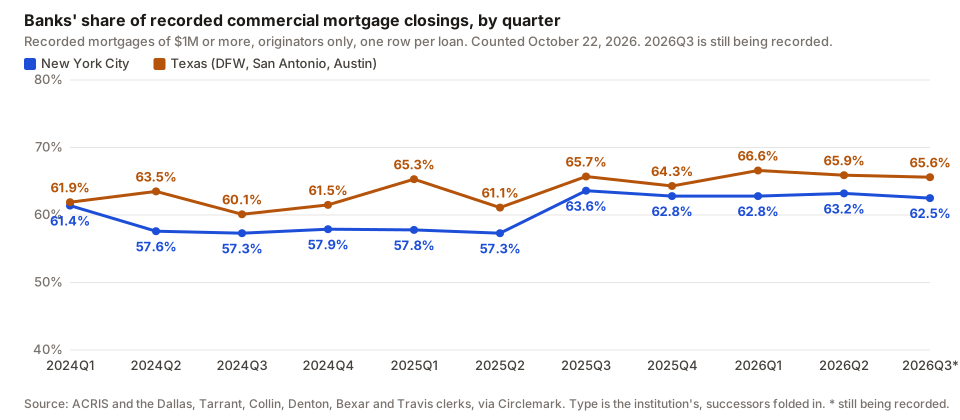
Two in three closings, up from fewer than three in five
Between the second quarter of 2025 and the second quarter of 2026, the last quarter fully recorded in both markets:
| 2025 Q2 | 2026 Q2 | Change | |
|---|---|---|---|
| New York City | |||
| Commercial mortgages recorded | 1,336 | 1,615 | +21% |
| By banks | 766 | 1,020 | +33% |
| Banks' share, by count | 57.3% | 63.2% | +5.9 pts |
| Banks' share, by dollars | 47% | 52% | |
| Texas (DFW, San Antonio, Austin) | |||
| Deeds of trust recorded | 1,482 | 1,714 | +16% |
| By banks | 906 | 1,129 | +25% |
| Banks' share, by count | 61.1% | 65.9% | +4.8 pts |
| Banks' share, by dollars | 56% | 63% |
By dollars the bank figures rose 56% in New York and 59% in Texas, close to the MBA's 61%, and that closeness is partly luck: dollar shares swing on a handful of large loans each quarter, which is why the chart and the rest of this piece count closings.
The move is not a one-quarter blip. New York's bank share ran between 57% and 61% for six quarters, stepped to 63.6% in the third quarter of 2025 and has held between 62% and 64% since. Texas was already higher and drifted up: 61.7% of closings across 2024, 64.1% across 2025, 66% so far in 2026, with Dallas–Fort Worth at 66.6% and San Antonio at 69.5% in the second quarter against Austin's 59.7%.
Who gave up the share? In New York, agency lenders fell from 3.7% of closings to 1.4%, life companies from 4.3% to 2.7%, and the lenders the record cannot type (an individual, a family LLC, a seller carrying paper) from 13.4% to 10.8%. Debt funds did not give anything up: 13.0% to 15.0%. In Texas the picture is flatter, with debt funds steady near 9%, agency lenders down from 3.0% to 2.2%, and the untyped group still 18%. CMBS is under 2% of closings by count in both markets; conduit loans are few and large, and by dollars they were 4.6% and 5.7% of New York's two quarters.
New York: one bank is most of the move
New York's banks recorded 1,908 commercial mortgages in the first half of 2026 against 1,362 in the first half of 2025. JPMorgan Chase went from 247 to 475, and accounts for 228 of the 546 added, 42% of the whole bank increase. Through October 22 it has 650 recorded closings this year, about $7.9 billion, nearly eight times the next bank. The NYC lender ranking put Chase at one in nine of the city's commercial mortgages over three years; in 2026 it is closer to one in six.
The rest of the rise is a row of banks that were small in New York two years ago, several from across the Hudson:
| Bank | 1H 2025 | 1H 2026 |
|---|---|---|
| JPMorgan Chase | 247 | 475 |
| Customers Bank | 27 | 60 |
| Valley National Bank | 25 | 53 |
| Peapack Private Bank & Trust | 12 | 41 |
| ConnectOne Bank | 3 | 32 |
| Webster Bank | 33 | 50 |
| Ponce Bank | 26 | 41 |
| Wells Fargo | 28 | 42 |
| Bank Hapoalim | 4 | 17 |
| BNY Mellon | 3 | 15 |
| U.S. Bank | 3 | 14 |
Webster's 50 closings carried $810 million against $210 million the year before; Ponce's 41, $730 million against $310 million. Both are lending bigger as well as more often.
The banks that recorded fewer: East West Bank, 33 to 13; Ridgewood Savings, 35 to 21; Metropolitan Commercial Bank, 22 to 9; Spencer Savings, 14 to 4; Morgan Stanley Bank, 12 to 5; Citibank, 11 to 7. Citizens (41 to 40) and National Cooperative Bank (43 to 43) held still.
Flagstar, the former New York Community Bank, is the one lender we set aside. Its record shows 100 instruments in the trailing year, and 77 of them were recorded on March 31, 2026: consolidation agreements over small Brooklyn and Bronx apartment buildings, every one restating older New York Community Bank notes. That is a legacy book being re-papered on one day, not 77 loans made, and counting it would have made Flagstar the second most active bank in the city for a quarter. Without that day it recorded 23 in a year, which is the pulling-back our maturity-wall brief described.
Texas: the Texas banks took it, and the merging banks gave it up
Texas's bank closings rose from 1,766 in the first half of 2025 to 2,095 in the first half of 2026, and the gain went to banks headquartered in the state:
| Bank | 1H 2025 | 1H 2026 |
|---|---|---|
| Frost Bank | 65 | 94 |
| SouthState (the former Independent Bank) | 56 | 82 |
| First United Bank | 57 | 73 |
| PlainsCapital Bank | 47 | 63 |
| Southside Bank | 17 | 30 |
| American Bank of Commerce | 13 | 25 |
| PNC Bank | 8 | 18 |
| Origin Bank | 8 | 18 |
| Fifth Third Bank | 11 | 20 |
SouthState's 82 carried $1.01 billion against $450 million; PNC's 18 carried $1.04 billion against $100 million, the one out-of-state bank on the list lending bigger as well as more often.
The two largest falls are mergers in progress. Veritex Community Bank and Cadence Bank, now both Huntington, recorded 103 deeds of trust in the six counties in the first half of 2025; Huntington recorded 47 in the first half of 2026, with the Cadence merger closing on February 1. Comerica, merged into Fifth Third on the same day, went from 32 to 8, and Fifth Third itself from 11 to 20: 43 closings between them a year ago, 28 now. Regions fell from 33 to 25, First Financial from 17 to 9, Washington Federal from 10 to 2, Bank of America from 36 to 29 and Texas Capital from 16 to 11.
The most active lenders of 2026 so far, all types, are Frost (161 closings, $1.0 billion), SouthState (132, $1.6 billion), Prosperity (101), First United (96) and PlainsCapital (92), then Construction Loan Services, the builder lender, at 73. Wells Fargo (61) and JPMorgan Chase (51) are far down the count and far up the dollars, at $6.9 billion and $7.3 billion. The Texas lender ranking explains why no lender owns Texas the way Chase owns New York.
What the record cannot say
A recorded instrument is a closing, not a dollar of new credit. In New York most refinances are consolidation agreements that restate old notes with some new money, and the record does not separate the two; in Texas a facility secured by several properties records a deed of trust on each, which we collapse to one. The MBA survey counts originations in dollars from the lenders who answer it. The two measures agree on direction and should not be expected to agree on size.
The $1 million floor leaves out the small loans that community banks make most of, so the bank share of all commercial lending is higher than printed here. The untyped group, 11% of New York's closings and 18% of Texas's, is mostly individuals and single-purpose lending LLCs, some of which are private lenders in all but name; a reader who moved them to the debt-fund line would roughly double it in Texas. The third quarter of 2026 is still being recorded in New York (ACRIS indexes weeks late) and the fourth everywhere, so the chart ends at a quarter marked partial. Houston is excluded until its backfill completes in November. And a successor bank takes its predecessor's closings, which is right for Huntington and wrong in one direction for OceanFirst: its count rose from 29 to 52 because Flushing Bank's closings carry its name since June 1, while it sold $1.3 billion of New York multifamily loans on June 29.
Who to call
The lender that closed three deals like yours in your county this year is the one to call, and the county pages list them: Manhattan, Brooklyn, Queens, the Bronx, Dallas County, Tarrant, Collin, Denton, Bexar, Travis and Harris, each lender dated to its last closing there, by property type and loan size. The county index lists them all. With a free seat, the lender search takes a county, a property type and a loan size and returns every institution with three or more comparable closings, with its desks and the people on record.
Frequently asked questions
- Are banks lending on commercial real estate again in 2026?
- Yes, and more than the rest of the market. In New York City, banks recorded 1,020 commercial mortgages of $1 million or more in the second quarter of 2026 against 766 a year earlier, a 33% rise, while all lenders together rose 21%. In Dallas–Fort Worth, San Antonio and Austin, banks went from 906 to 1,129, up 25%, against 16% for the market. Banks' share of closings rose from 57% to 63% in New York and from 61% to 66% in Texas. The figures are counts of recorded instruments, not the dollar originations the Mortgage Bankers Association surveys, and they point the same way.
- Which banks are the most active commercial real estate lenders in New York City in 2026?
- By recorded closings of $1 million or more, JPMorgan Chase by a wide margin: 650 in 2026 through October 22, about $7.9 billion, nearly eight times the next bank. Then Cathay Bank (87), Customers Bank (82), Valley National (73), Peapack Private (71), Webster (66), National Cooperative Bank (64), Citizens (60), Ponce (58), Wells Fargo (56, but $7.3 billion) and TD (55). The fastest risers from the first half of 2025 to the first half of 2026 were Chase (247 to 475), Customers (27 to 60), Peapack (12 to 41), ConnectOne (3 to 32) and Valley (25 to 53).
- Which banks are the most active commercial real estate lenders in Texas in 2026?
- In Dallas–Fort Worth, San Antonio and Austin, counting recorded deeds of trust of $1 million or more in 2026 through October 22: Frost Bank (161), SouthState (132, the former Independent Bank), Prosperity (101), First United (96), PlainsCapital (92), then Wells Fargo (61, $6.9 billion), Huntington (60, which absorbed Veritex and Cadence), JPMorgan Chase (51, $7.3 billion), American National Bank of Texas and Bank of America (50 each). Frost, SouthState, First United, PlainsCapital and Southside all rose between the first halves of 2025 and 2026; the three banks now called Huntington fell from 103 closings to 47, and Comerica, merged into Fifth Third on February 1, 2026, from 32 to 8.
- What share of commercial mortgages do banks make?
- On the county record, about two in three. Banks made 63% of New York City's recorded commercial mortgages of $1 million or more in the second quarter of 2026 by count (52% by dollars), and 66% in the six Texas counties we read (63% by dollars). Debt funds and private lenders were 15% in New York and 9% in Texas, agency lenders under 3% in both, CMBS under 2% by count. Between 11% (New York) and 18% (Texas) of closings are by a lender the record does not let us type: an individual, a family LLC, a seller carrying paper. The Mortgage Bankers Association puts banks at under 40% of commercial real estate debt outstanding nationally, which measures dollars held, not loans made; the two are not in conflict.
- How are these figures counted?
- One row per recorded mortgage or deed of trust, $1 million or more, dated by the instrument, in the five boroughs and in Dallas, Tarrant, Collin, Denton, Bexar and Travis counties. Only the lender that originated the loan counts; trustees, MERS and agents do not. Every spelling of an institution is folded into one name, and a bank's successor takes its predecessor's loans, so Veritex and Cadence count as Huntington. Each institution is typed once, by the type its spellings carry most often. A loan on one to four houses is left out unless it blankets three or more. A lender that recorded ten or more instruments on one day, amounting to a quarter of its trailing year, is set aside for that day: Flagstar recorded 77 consolidation agreements over its legacy New York Community Bank loans on March 31, 2026, which is a book being re-papered, not new lending. Houston is excluded until its backfill completes.
Sources
- MBA — Commercial/Multifamily Borrowing Increased 16% in the Second Quarter of 2026 (August 2026): depositories +61% year over year, CMBS +68%, GSEs −17%, life companies −27%; office +47%, retail +61%, multifamily +8%
- CRE Daily — Big Banks Resume CRE Lending as Deal Activity Surges (Q2 2026 balance sheets: PNC +15%, Truist +25%)
- National Mortgage News — Banks are again vying for CRE loans as fears subside
- Federal Reserve FEDS Notes — Monitoring high credit growth: the link between local deposits and CRE lending (May 1, 2026)
- Fifth Third Bancorp — Form 8-K: closing of the Comerica merger, February 1, 2026
- Huntington Bancshares — exhibit 99.1: completion of the Cadence Bank merger, February 1, 2026
- OceanFirst Financial — completes sale of $1.3 billion of New York City multifamily loans (June 29, 2026); Flushing Bank acquired June 1, 2026
- Circlemark — Who lends on NYC commercial real estate: the 25 most active lenders (2026)
- Circlemark — Who lends on Texas commercial real estate: the 25 most active lenders (2026)
- Circlemark — methodology: lender identity, lender type, corporate successors
Check one building
Type an address and see the mortgages recorded on it — lender, amount and the maturity read from the instrument. Free, no account.
Read next
- Who lends on NYC commercial real estate: the 25 most active lenders (2026)
The lenders behind 14,656 NYC commercial mortgages recorded in the last three years, ranked by what they funded, by borough and property type.
- Who lends on Texas commercial real estate: the 25 most active lenders in Dallas–Fort Worth, San Antonio and Austin (2026)
The lenders behind 15,985 commercial mortgages recorded in Dallas–Fort Worth, San Antonio and Austin over the last three years, ranked by what they funded, by county, property type and loan size — and why no lender owns Texas the way one owns New York.
- NYC's 2026 maturity wall, lender by lender: the bank with the most loans coming due is the one pulling back from New York
A data brief on the lenders behind New York City's 2026 maturity wall: 139 commercial mortgages of $5 million or more, $8.70B, whose maturity date is written into the recorded instrument and falls in the next twelve months, ranked by the institution that originated them and bucketed by lender type. One loan, the GM Building's, is a quarter of the dollars; by count the leader is Flagstar Bank, the former New York Community Bank — while it shrinks its New York book, the Fed raises rates and the city freezes stabilized rents.
Research from the county record
The rest of the briefs — one market, one lender or one cohort, counted from the recorded instruments and dated to the pull.
- Gas station, convenience store and car wash loans
- NYC ARM resets in 2027: what the riders say
- The debt behind Austin's renters' market
- NYC rent-stabilized building loans coming due
- Why Texas files every warehouse as "commercial"
- NYC's 2026 maturity wall, lender by lender
- NYC investor house loans and the ARM wall
- DFW's 2026 maturity wall, county by county
- NYC's 2026 maturity wall, borough by borough
- A third of every NYC commercial loan list is an apartment