How to find maturing commercial loans in 2026: the three sources, the tools that search them, and a list you can pull today
Every maturing-loan list is built from the same three sources: the county recorder, securitization disclosure, and a model. This is how to search each one yourself, what each can and cannot tell you, how the tools that package them compare on price and on whether they admit which dates are guesses, and where to pull a list for New York or Texas without an account.
By Andrew Zhong, founder of Circlemark · · Updated · 11 min read · Figures as of Oct 22, 2026
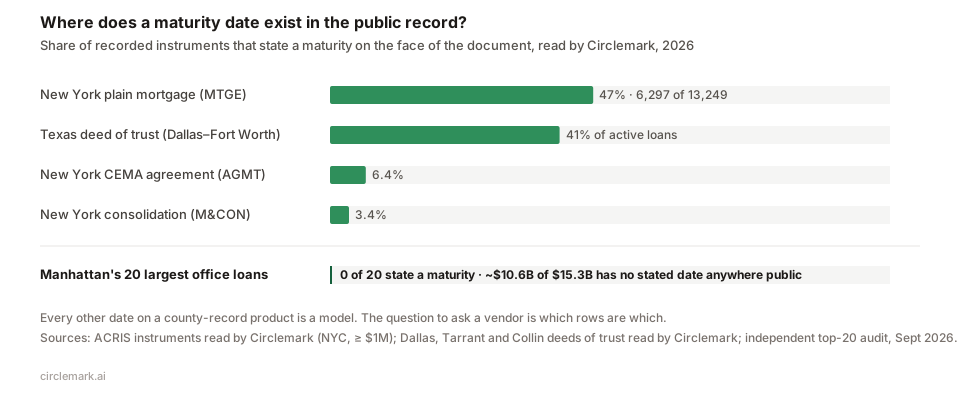
A commercial loan's maturity date is printed on the recorded instrument less than half the time: in our markets, 41% of Texas deeds of trust state it (on page 1, in the note-description clause) and 47% of plain New York mortgages do (in the "Maturity Date" definition or the payment clause), but only 6.4% of New York consolidation agreements, which is the instrument most large Manhattan loans sit under. Where the instrument is silent, the date exists in the securitization filing if the loan was sold into a CMBS or agency deal, and otherwise in nobody's records at all: every product that shows you a date then made it up from the origination date and a typical term. Adding five, seven or ten years to the origination date is an estimate, not a lookup, and should be labelled as one. Finding maturing loans means reading the instrument first, attaching the securitization filing second, and knowing when you are looking at a guess.
Skip the search. Type an address and the lookup reads the recorded instrument for you — lender, amount and maturity — free, no account. Or search every loan in your market on a free seat: no card, 10 owner reveals, 60 searches, nothing expires.
The short version. Pick a market and a window (three to twelve months out is the refinance window; past maturity is a different conversation). Pull the recorded mortgages and deeds of trust from the county recorder, read the maturity off the instrument where it prints one, attach the securitization disclosure where the loan was securitized, and label everything else an estimate. Then sort the list by whether the date is stated, drop the loans the record says were refinanced, and call the rest in date order. The tools below do some or all of that for you; the table says which, at what price, and whether they tell you which dates are guesses.
Across New York City, Dallas–Fort Worth, Houston, Austin and San Antonio, 13,112 active commercial loans have a maturity in the next twelve months on the best date available, 37,210 loans in the corpus carry a maturity read from the recorded instrument, and 3,689 are past a stated maturity with no payoff on file. Those counts update weekly and the date beneath the headline says when they were last pulled. If you only want the list, it is at the end and needs no account.
Source 1: the county recorder
Every mortgage and deed of trust is recorded with the county, which makes the recorder the only source that covers bank, life-company, debt-fund, agency and CMBS loans alike. It is also the only source that is incomplete on the one field you want.
Whether the maturity is printed depends on the state and the instrument. Texas deeds of trust state the note's maturity on the first page almost without exception. New York is the opposite: ACRIS, the city's recorder, publishes parties, amount, document type and date and no maturity field, so the date exists only inside the scanned instrument and only when the lender's form included it. When we read the instruments in our markets, 41% of Texas deeds of trust and 47% of plain New York mortgages stated a maturity; 6.4% of New York consolidation agreements and 3.4% of consolidated mortgages did, and none of the twenty largest Manhattan office loans states its maturity anywhere public. The biggest loans are the least documented.
How to search it by hand. In New York, ACRIS document search by party name or by borough-block-lot lists every recorded document against a parcel; filter to MTGE, AGMT and M&CON, open the latest, and read the maturity clause if there is one. In Texas, each county clerk's portal (Dallas, Tarrant, Collin, Denton and Bexar are all on the same GovOS system, Travis on its own) searches by grantor, grantee, instrument number or date range; the index carries no address and no amount, so you search by borrower name or legal description and open page one for the amount and the date. Harris County's portal is free with a login. The step-by-step version of that search for one building — which document to open, where the maturity clause sits on a New York mortgage and on a Texas deed of trust, and how to tell whether the loan is still open — is in the single-address walkthrough.
What the record does not tell you. It has no status column. A loan is open until a satisfaction (New York) or release (Texas) is recorded, and those cite the loan indirectly: a New York satisfaction names the gap and component notes, never the consolidation agreement a list shows; a Texas facility is released one property at a time. A later mortgage on the same lot is the most reliable sign the old one was refinanced, and a quarter of the loans past a stated maturity in our markets carry one. If you build a list by hand, check each loan for a later lien before calling.
Source 2: securitization and agency disclosure
If the loan was sold into a CMBS trust, a CRE CLO or a Freddie Mac K-deal, or insured by HUD, its exact maturity, balance, rate and payment status are public: Form ABS-EE on EDGAR for CMBS (Schedule AL, one row per loan, updated monthly), Annex A of the offering circular and the monthly servicer report for Freddie Mac, HUD's multifamily database for FHA-insured loans. This is the data behind every CMBS delinquency statistic, and it is perfect for the loans it covers.
It covers a thin slice. The securitized and agency share of commercial mortgage debt is the share that servicers report on; the bank, life-company and debt-fund loans that make up the rest never appear in any CMBS tracker. A list built from disclosure alone is a list of the loans everyone else can already see. Its value is in cross-checking: when a recorded loan matches a disclosed one by address, amount and date, the disclosed maturity replaces the estimate. Circlemark attaches ABS-EE, Freddie Mac and HUD rows to the recorded instrument this way, and the row says so.
Source 3: the model, and how to keep it honest
For the loans neither source dates, the only option is an estimate: origination date plus the conventional term for that kind of lender. Five years for a bank, seven to ten for CMBS depending on vintage, ten for a life company, two to three for a bridge lender. The estimate is as good as the convention, and the convention is wrong often enough to matter: when we audited Manhattan's twenty largest office loans against their securitization filings, three of the modelled dates were about three years early.
Two rules make a modelled date usable. It must be labelled, on the row, as an estimate, so the reader can prioritise the stated ones and discount the rest. And it must never drive a dollar figure: the counts we publish in dollars use stated dates only, because a forward estimate is a guess about the future and a lapsed estimate says only that the model's term was too short. Any product that shows one maturity-date column with no flag is showing you a mix of read and guessed dates and letting you find out which on the phone.
The tools, compared
Six products sell or give away some version of the three sources. The table records what each one's own published material says, with the date it was read; "not stated" means the vendor does not publish it, not that it does not do it. Ask.
| Maturity source | Stated vs estimated flagged on the row | Markets | Published price | Free way in | |
|---|---|---|---|---|---|
| CRED iQ | CMBS, SASB, CRE CLO and agency servicer data; county records added, depth varies by county (CRE Daily review, Sep 25, 2026) | Not stated; securitized dates are servicer-reported | National | Solo $625/mo, Starter $1,250/mo, Professional $3,850/mo, billed annually (CRE Daily, Sep 25, 2026) | Demo |
| Crexi Intelligence | Public records and CMBS | No | National | $249/user/mo or $2,388/yr (Capterra) | Crexi listings are free; Intelligence is not |
| Reonomy (Altus Group) | County records and commercial databases | No | National | Sold online since May 2026; amounts not on the pricing page; from $400/mo per user reported by directories | Not stated |
| CoStar | Not stated for bank loans; CMBS servicer data integrated 2021 | No | National | Not published | No |
| CRE Engage | Not stated (site read Oct 2026); 50-state owner lookup with credit-metered contacts and "recorded loan maturity coverage" research pages | Not stated | National | Not visible on the site | Trial without a card |
| Circlemark | County recorder, instrument read; ABS-EE, Freddie Mac and HUD disclosure attached to the recorded loan | Yes: stated dates in bold with a page citation; estimates marked ≈ with the assumed term | New York City, Dallas–Fort Worth, Houston (instruments still being read), Austin, San Antonio | $149/seat/mo for the data with 100 contact reveals, $299 with 300 and outreach (pricing) | List builder, no account; free seat with 10 contact reveals |
The column that separates the products is the third one. Every vendor on the list has a maturity-date field; one says on the row which dates it read and which it assumed. If the vendor you are considering is not on the table, the six questions to ask it are the same.
Working the list
A maturing-loan list is a calling order, and the order matters more than the length.
- Stated dates first. A borrower whose deed of trust says March 2027 has a March 2027 problem. A borrower with an estimated date has a problem some time in a two-year band.
- Drop the refinanced. A later mortgage on the same lot, at least half the size, recorded sixty or more days after the loan, means the loan you are looking at is almost certainly gone and the release is late. Skip it, or call the new lender's borrower about the new loan.
- Three to twelve months out is the refinance window. Inside three months the borrower has usually chosen a lender; past twelve, nothing is urgent yet. Bridge and construction loans are the exception: they need a takeout whenever the printed date falls, extended or not.
- Lender type sets the conversation. A bank's five-year paper written in 2021 or 2022 reprices into today's rates; CMBS paper has a defeasance or yield-maintenance cost until its open window; an agency loan may be assumable. The lender on the record tells you which call you are making.
- Past maturity is its own list. A loan past a stated maturity with no payoff recorded is usually extended, refinanced with a late release, or in a quiet workout, and the record cannot say which. How to sort those and what to say.
How those five rules play out on the phone — bought leads against record-sourced ones, how many "matured" leads are already refinanced, and the 24 / 12 / 6-month calling order — is the loan-maturity-leads guide.
Pull a list today
For New York City and Texas the list builder is open without an account. Three things to set and one to read:
- Market and counties. One metro at a time; leave the counties on All to see the whole market first.
- Maturing from / to. The window in months from today. Three to twelve is the refinance conversation; zero to three is late to the table.
- Anything that narrows your book — property type, lender type, loan size, LTV, units. Stated dates only is the checkbox worth knowing about: it drops every modelled date and leaves the loans whose maturity was read off a document.
- Then read the maturity column, not just the date. A date in plain type was read from the instrument. A ≈ is modelled, and where it shows two or three dates it is showing the plausible terms for that kind of lender rather than pretending to one.
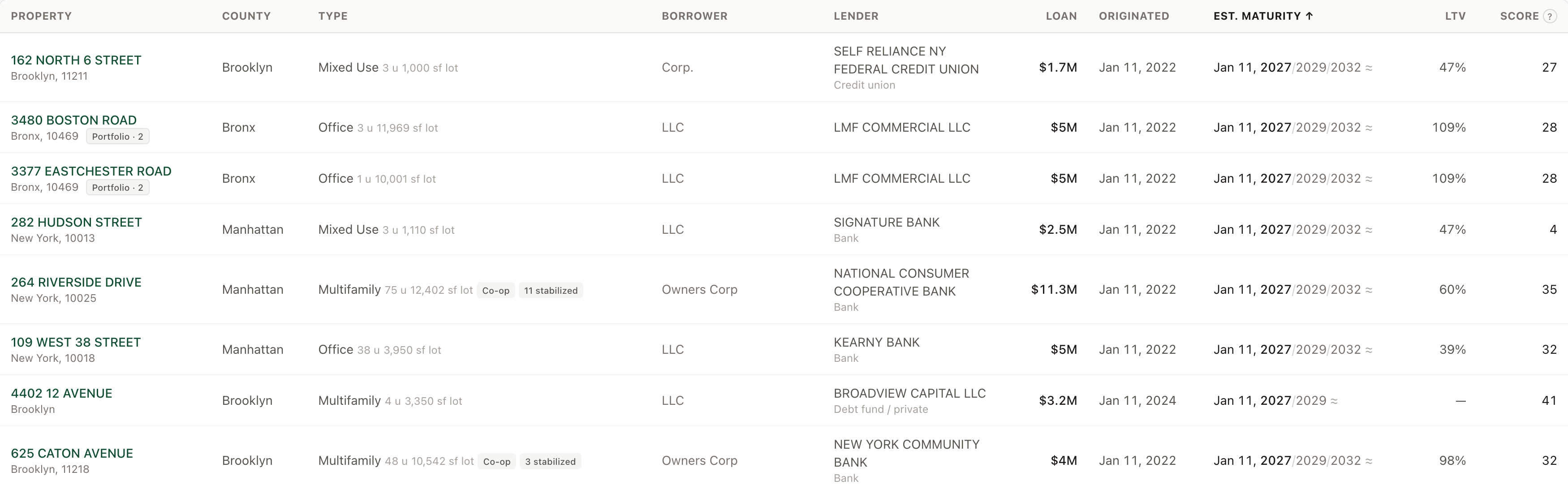
That screenshot is the honest state of a New York maturity window: every date in it is modelled, because the instrument that refinances a New York loan is a consolidation agreement and those almost never state a maturity. In Texas, where two deeds of trust in five print the date, the same window comes back with far more of the column read rather than assumed. Either way the list says which it is, per row.
The prefilled links:
- New York City, maturing in 3–12 months
- Dallas–Fort Worth, maturing in 3–12 months
- Houston, maturing in 3–12 months
- Austin, maturing in 3–12 months
- San Antonio, maturing in 3–12 months
Signed in, the same window is the first control on the search page, and the rest — property type, lender, borrower, the map, a saved search that emails what changed — are walked through control by control in the search tutorial.
Each county's own page gives the maturity windows, the collateral mix and the ten lenders with the most loans coming due, counted from the record: Manhattan, Brooklyn, Queens, the Bronx, Dallas County, Tarrant County, Collin County, Denton County, Harris County, Travis County, Bexar County.
If your market is not one of these, the method above still works by hand, and where the data comes from explains what each source will and will not tell you about it.
Frequently asked questions
- How do I find every commercial loan maturing in my market?
- Work the three sources in order for the market and window you want, then label what each date is. Pull the recorded mortgages and deeds of trust from the county recorder and read the maturity off the instrument where it prints one; attach the securitization disclosure where the loan was securitized; treat whatever is left as modelled and mark it as an estimate. Three to twelve months out is the refinance window, and a later mortgage on the same lot usually means the loan you are looking at is already gone. To check a single building rather than a whole market, see the walkthrough on looking up a commercial mortgage maturity by address.
- What share of commercial mortgages state a maturity date on the recorded document?
- Fewer than half, and it varies by state and by instrument. The recorder files the mortgage or deed of trust; whether the maturity appears depends on the state's drafting habits and the lender's. In our markets, 41% of Texas deeds of trust and 47% of plain New York mortgages state one, 6.4% of New York consolidation agreements do, and none of Manhattan's twenty largest office loans states its maturity anywhere in the public record (counted September 22, 2026).
- Where can I get a list of maturing commercial loans for free?
- For New York City and Texas, Circlemark's list builder is open without an account: pick a market and a maturity window and it returns the loans with lender, borrower, amount and the maturity labelled stated or estimated, with a daily cap per visitor. Nationally, EDGAR's ABS-EE filings are free and exact but cover only securitized loans. County recorder portals are free to search by hand but index documents, not loans, and most carry no maturity field.
- What is the CRE maturity wall in 2026?
- The Mortgage Bankers Association estimates $875 billion of commercial and multifamily mortgages mature in 2026, down from the $957 billion originally scheduled for 2025 after a record year of extensions. The figure is a survey of lenders, not a list of loans; finding the loans behind it in a given market is what the rest of this guide is about.
- How accurate are estimated commercial loan maturity dates?
- An estimate is the origination date plus a conventional term for that lender type (five years for a bank, ten for CMBS and life companies), so it is as good as the convention. When we audited the twenty largest Manhattan office loans against securitization filings, three of the modelled dates were about three years early. That is why every estimated date on Circlemark is marked as one and why the counts we publish in dollars use stated dates only.
- Does Reonomy or CoStar show commercial loan maturity dates?
- Both show a maturity-date field. Neither says, on the row, whether the date was read from the recorded instrument or estimated from the origination date, and neither publishes how quickly a repaid loan leaves the list. Ask any vendor those two questions before paying; the comparison table in this guide records what each one's published material says, with dates.
Sources
- MBA NewsLink — Chart of the Week: CRE loan maturity volumes ($875B in 2026)
- Colliers via Bisnow — loan extensions hit a record $384B in 2025
- SEC — Form ABS-EE and Schedule AL asset-level disclosure for CMBS
- NYC Open Data — ACRIS Real Property Master (no maturity field)
- Dallas County Clerk — official public records search (GovOS)
- CRE Daily — CRED iQ 2026 review (pricing and coverage; updated September 25, 2026)
- CRE Daily — Reonomy 2026 review
- Altus Group — Reonomy pricing: subscribe online (May 2026)
- Capterra — Crexi PRO pricing and reviews
- CoStar — Loans product page (read October 2, 2026)
- CRE Engage — homepage and research pages (read October 2026)
- Circlemark — Reonomy alternatives for CRE loan data: the four failures and a vendor table
- Circlemark — methodology: stated and estimated maturities, lifecycle events, data notes
Check one building
Type an address and see the mortgages recorded on it — lender, amount and the maturity read from the instrument. Free, no account.
Read next
- Loan maturity leads: how CRE brokers source refinance deals before the balloon (2026)
A loan maturity lead is a commercial mortgage coming due on a property whose owner you can reach. Lead vendors sell them by the month or by the piece; the county record gives them away, with the one fact no vendor shows — whether the loan is still there. Of 130 Dallas–Fort Worth apartment loans past a stated maturity this year, 62 already carry a newer mortgage on the same lot; in New York, where few instruments print a date, it is 19 of 49. How to source the leads, which are real, and when to call.
- Where commercial mortgage maturity data actually comes from
Every CRE maturity date in every data product traces to one of three sources: the county recorder, securitization disclosure, or somebody's model. What each one covers, what each one hides, and the questions to ask any vendor before you trust a date — with New York and Texas as the worked examples.
- Reonomy alternatives for CRE loan data: why the loans go missing, stale or wrong (2026)
Brokers, lenders and investors who compared Circlemark with Reonomy, Crexi Intelligence and Capitalize.io kept describing the same four failures: loans that aren't there, loans paid off years ago still listed, maturity dates that were never in the record, and contacts for the wrong person. Each one has a mechanical cause inside the county record. Here is what it is, how to test any vendor for it, and how we handle it — including what we found wrong in our own list, and when.
Guides to the public record
The rest of the series — how brokers find loans, owners and maturities in the county record.
- Loan maturity leads: sourcing refinance deals before the balloon
- Is this commercial loan in default?
- Past maturity, no payoff recorded: what it means
- Where maturity data comes from
- How NYC loan maturities are monitored
- Find the owner behind an LLC (New York)
- Find the owner behind an LLC (Texas)
- Search ACRIS for commercial mortgages
- How to read a recorded mortgage or CEMA
- How to read a blanket mortgage in ACRIS
- Who lends on NYC commercial real estate
- Rent-stabilized building loans in New York
- Who lends on Texas commercial real estate
- Why Texas files every warehouse as "commercial"
- Reonomy alternatives for loan data