Look up when a commercial mortgage matures, by address (2026): one search, and the ACRIS and county-clerk steps behind it
Type an address into the free maturity lookup and read every active recorded mortgage on the building: lender, amount, the maturity read from the document or an estimate marked ≈, a blanket loan counted once. Then the by-hand method it is running for you — New York City's ACRIS and the Texas county clerks step by step, where the date sits on the page, what to do when the document states none, and how to tell whether the loan is still open.
By Andrew Zhong, founder of Circlemark · · Updated · 12 min read · Figures as of Oct 22, 2026
You have an address. You want to know when the mortgage on it comes due, how much it is for and who holds it. The county recorder has the mortgage and will give up the lender, the borrower, the amount and the recording date in a few clicks; it will not give up the maturity, in any county, because no recorder indexes one. The date is printed inside the scanned instrument, when the lender's form printed it at all. This walks through the one search that does the whole job for New York City and the five Texas metros — type the address, read the result — and then the by-hand method it is running for you, so you know what each mark on the result means and what to do in a county it does not cover.
This is a tutorial for one building. If you want every maturing loan in a market, that is a different search and its own guide.
Step 1 — type the address
Open the maturity lookup, pick the market and type the house number and street. Only the number and the street are matched: the number exactly, the street loosely, so leave off the unit, the city and the ZIP, and write a Queens number with its hyphen (42-31, not 4231). Five lookups a day are free without an account.
Here is 11 Seaman Avenue in Inwood, a 72-unit multifamily, as the lookup returns it.
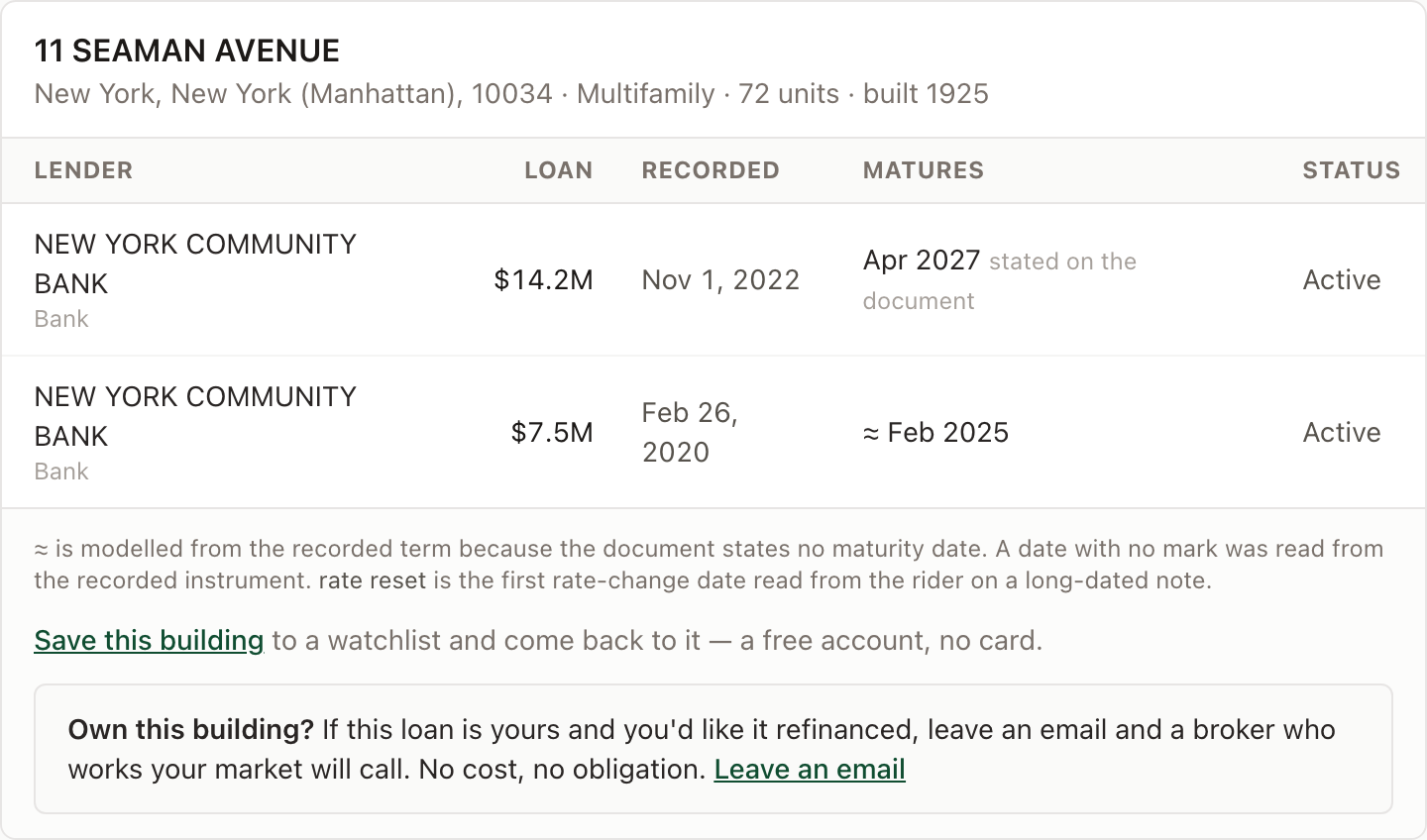 Two active loans on one building, two kinds of date. The 2022 agreement's April 2027 was read off the recorded document and says so. The 2020 agreement states no maturity, so its date is an estimate from the recorded term and carries the ≈.
Every active recorded mortgage on the property is a row: the lender and its type, the amount, the recording date, the maturity and the status. What is not a row is as deliberate as what is. ACRIS lists New York Community Bank consolidation agreements against this lot from 2003, 2011, 2014, 2020 and 2022, and read one at a time they look like five open loans. The cross-references say two: the 2022 agreement consolidates one lineage, the 2020 agreement consolidates the 2014, 2011 and 2003 filings into itself, and the earlier three are retired by the citations rather than by any satisfaction. The lookup retires a loan the county shows as satisfied, released or folded into a later consolidation before the result is shown, and says under the table how many it retired. What remains is what the record still treats as open.
Step 2 — read the mark beside the date
A maturity column with one kind of date in it is hiding something, because the public record holds a date for only about half the loans in New York and two in five in Texas. The lookup marks each date three ways:
- A date with no mark was read from the recorded instrument. The row says stated on the document.
- ≈ a date is an estimate from the recorded term, because the document states none: the origination date plus the conventional term for that kind of lender. It is a working estimate, never the note's date.
- rate reset is the first rate-change date read from the rider on a long-dated note. A 25- or 30-year bank note on a New York multifamily building resets at year five, seven or ten, and on that paper the reset is the refinancing event, not the maturity.
The 2020 loan at 11 Seaman shows what the ≈ is for. Its estimate, February 2025, has already passed. That tells you the assumed five-year term was wrong for this note, not that the loan is late: there is no release and no later lien, and the record holds no date to replace the estimate with. A stated date that has passed is a different thing, and the next building shows one.
Step 3 — a Texas result: one loan, several buildings
710 East Centerville Road in Garland, a retail property, shows the two things a Texas result adds.
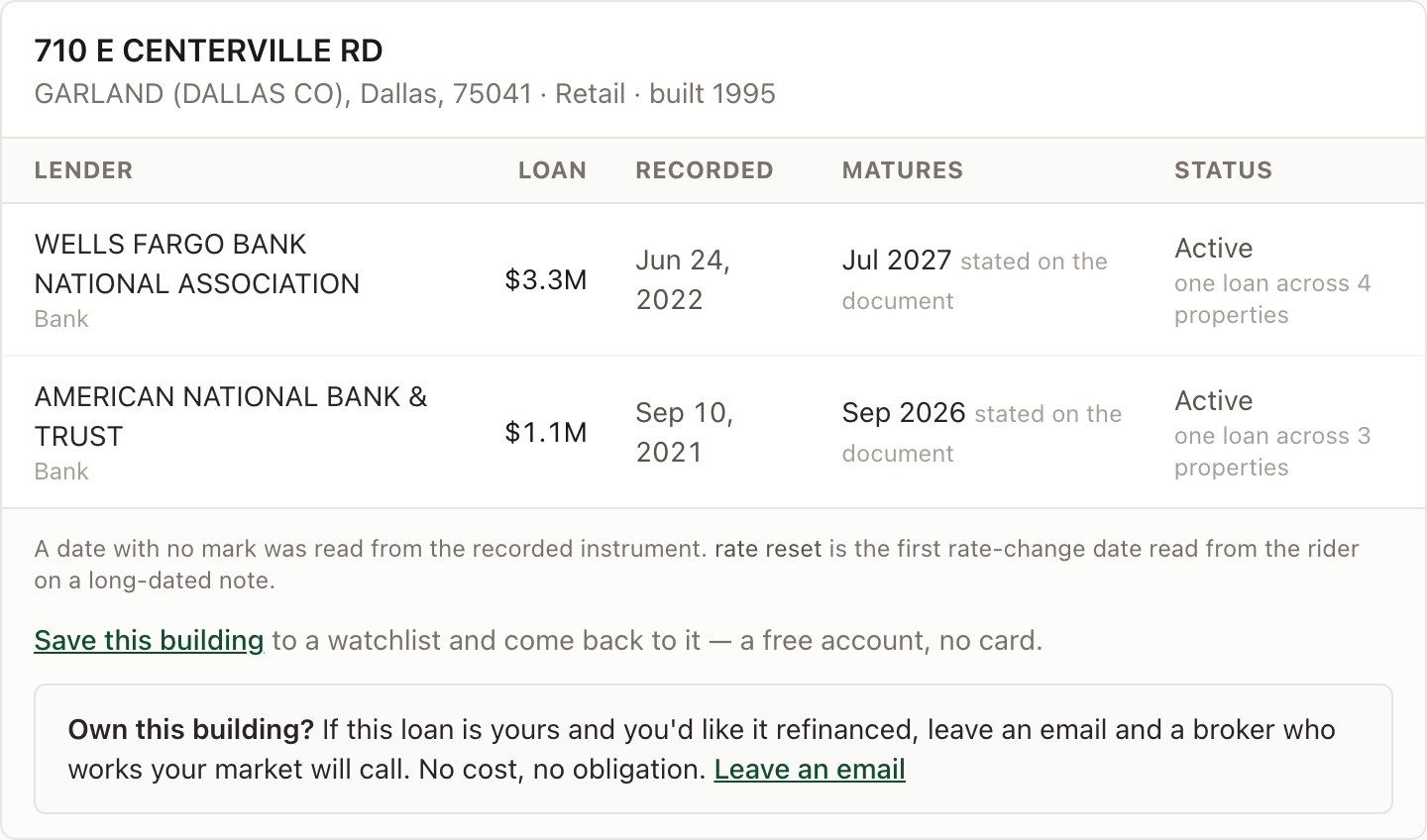 A blanket deed of trust is listed once per building and labelled one loan across four properties: read parcel by parcel it would be $13 million of debt, read as the record intends it is one $3.25 million loan. The smaller lien's stated September 2026 has passed with no release on file.
One loan across N properties. A Texas facility is perfected by a separate deed of trust on each property it covers, and every recording states the full note. The Wells Fargo loan here, $3,250,000 recorded June 24, 2022 and maturing July 1, 2027 on page one, is recorded against four retail properties. Read parcel by parcel, as a vendor database or a county search will show it, that is $13 million of debt; the lookup lists it once per building, labels it, and never sums it. The label matters the other way too: a release of one member frees that property and does not close the facility.
A stated date that has passed. The second lien, American National Bank & Trust for $1.1 million, recorded September 2021 and due September 2026, is still active on the record with no release filed. Texas sets no deadline for releasing a commercial lien, so the record cannot distinguish a late release from an extension or a loan in trouble. What a lapsed maturity with no payoff usually means is its own question; the lookup's job is to show the date as stated and the status as recorded, not to guess between the three.
The easy case is there too, one search away: 13660 Montfort Drive in Dallas, a 224-unit multifamily, carries one deed of trust to Morgan Stanley Bank for $14,625,000, recorded July 3, 2017, maturity July 1, 2027 stated on page one. Ten years of paper with the date printed.
Step 4 — keep it, or open the record
Under every result is Save this building, which puts it on a watchlist with a free account: no card, 10 owner reveals, 60 searches, and nothing expires. The result does not show who owns the building, who signed the mortgage or how to reach them. Those are the signed-in product: the loan record with the maturity clause linked to the page of the scan it was read from, the people the public record names behind the borrower, each cited to the filing that names them, and the full search, with every maturing loan in a market on one list (walked through control by control). How to read the instrument itself, page by page, is the companion guide.
If you own the building and the loan is yours, the same result has one line for that: leave an email and a broker who works your market will call. Nothing else happens with the address.
What the lookup just did, by hand
The rest of this piece is the method behind the result, so you can check it, and run it yourself in a county the lookup does not cover.
What the record holds for one building
A recorded mortgage or deed of trust is public. Its index entry carries four facts you can trust: the lender and borrower as named on the document, the amount, the document and recording dates, and the parcel. What the index never carries is the term. Whether the maturity appears depends on the state's drafting habits and the lender's form.
In our markets, measured from 13,249 New York instruments read in September 2026 and the Texas deeds of trust read since: a plain New York mortgage states its maturity about 47% of the time, a Texas deed of trust about 41%, a New York CEMA consolidation agreement 6.4%, a consolidated mortgage 3.4%. The biggest loans are the least documented: not one of Manhattan's twenty largest office loans states a maturity anywhere in the public record. Across every metro we cover, 37,210 loans carry a maturity read from the recorded instrument; the rest, in our product and everyone else's, carry an estimate.
So the question "when does this mortgage mature?" has three honest answers: the date on the document, the date in a securitization filing if the loan was sold into a CMBS or agency deal, or an estimate, and a good lookup tells you which one you are looking at.
New York City: ACRIS, step by step
ACRIS is the city register for Manhattan, Brooklyn, Queens and the Bronx. Staten Island has its own county clerk and is not in ACRIS.
- Open Document Search and search by address. Enter the house number, the street and the borough. ACRIS resolves the address to a tax lot (borough, block and lot) and lists every document recorded against it. If the address is ambiguous, search by BBL instead; the lot number is on the Department of Finance property page.
- Filter to the mortgage types.
MTGEis a plain mortgage.AGMTandM&CONare consolidation agreements, the instrument of a New York refinance: the new money is a small gap mortgage, and the agreement consolidates it with the earlier notes into one loan. A New York refinance is recorded as a set, and the agreement is the row that carries the loan. - Open the most recent one and read the first two pages. A plain mortgage that states its maturity does so near the amount, in a clause of the form "which sum is to be paid on April 1, 2027". A consolidation agreement almost never does, because the consolidated note is an exhibit that is not recorded. If there is no date, there is no date; the public record does not hold it.
- Check the later documents against the same lot. A
SAT(satisfaction) retires a loan. Read what it cites: a satisfaction of a consolidated loan names the gap note and the old notes, never the agreement you are looking at, so the agreement is retired when any note of its filing is. A laterAGMTorM&CONthat cites the loan supersedes it without a satisfaction. ADEEDto a new owner usually means a new lender too.
Run on 11 Seaman Avenue, that is the search in Step 1: five agreements against the lot, two of them open, the 2022 one stating April 1, 2027 on its face for $14,233,047 and the 2020 one, $7,500,000, stating nothing. The full ACRIS guide covers searching by borrower and by lender as well.
Texas: the county clerk, step by step
Dallas, Tarrant, Collin, Denton and Bexar counties run the same GovOS public-search portal. Harris County (Houston) has its own, and Travis County (Austin) a third. None of them indexes an address.
- Search by the grantor or the legal description. The grantor on a deed of trust is the borrower, usually an LLC named for the property; the grantee is the trustee or the lender. If you have only the address, the appraisal district's page for the property gives you the owner's name and the legal description (subdivision, block and lot, or survey abstract and acreage), and either one searches the clerk's index.
- Filter to deeds of trust. The instrument type is
DTorDEED OF TRUST. The index entry shows the parties, the instrument number and the recording date, and nothing else: no amount, no maturity. - Open the instrument and read the first page. A Texas deed of trust states the note's principal twice on page one, in words and in numerals ("...AND NO/100 DOLLARS ($14,625,000.00)"). When the maturity is stated it sits in the same clause: "finally due and payable on July 1, 2027". When it is not, the deed refers to the promissory note, which is not recorded, and the public record holds no date.
- Check for a release. A
RELorRELEASE OF LIENagainst the same instrument number retires the loan. Texas sets no deadline for releasing a commercial lien, so a refinanced loan can stay open on the record for years. A later deed of trust on the same lot from a different lender is the more reliable sign that the earlier one is gone.
Run on 710 East Centerville Road, this is where the by-hand search misleads: the Wells Fargo deed of trust turns up four times, once per property, each stating the full $3,250,000, and nothing in the index says they are one loan. The borrower, the instrument date and the stated amount agree across the four, which is how the lookup knows.
When the document states no date
For roughly half the loans in New York and three in five in Texas, the steps above end at a document with no maturity on it. There are two places left to look.
If the loan was securitized, the exact maturity is in the trust's disclosure: Form ABS-EE on EDGAR for conduit CMBS, Annex A of the offering circular for a Freddie Mac K-deal, HUD's multifamily database for an FHA-insured loan. It covers a thin slice of the market and nothing bank-held, and matching a disclosed loan to a recorded one takes the address, the amount and the origination month together.
Otherwise the date is an estimate: the origination date plus the conventional term for that kind of lender. Five years for a bank, seven to ten for CMBS, ten for a life company, two or three for a bridge lender. The estimate is as good as the convention, and the convention is wrong often enough that an estimate should never be read as the date; that is the ≈ in Step 2. Any tool that shows one maturity column with no mark on the row is showing you a mix of read and guessed dates and not saying which is which. Where every maturity date in every product comes from covers the three sources in full.
If your county is not covered
The method is the same everywhere; only the portal changes. Find the recorder's online search (most counties have one, many on the same GovOS system as Dallas), search by the owner's name or the legal description from the assessor, open the most recent mortgage or deed of trust, read the first pages for the maturity clause, and check for a satisfaction, a release or a later mortgage. Budget twenty minutes a building, and expect to come away with no date about half the time. That is not a failure of the search. It is what the public record holds.
Frequently asked questions
- How do I find the maturity date of the mortgage on a building I don't own?
- For New York City, Dallas–Fort Worth, Houston, Austin and San Antonio, type the address into Circlemark's free maturity lookup: it lists every active recorded mortgage on the building with the lender, the amount and the maturity, marked read-from-the-document or estimated. By hand, open the recorded instrument. The county recorder's index gives you the lender, the borrower, the amount and the recording date, but no maturity; the date, when it exists, is printed inside the scanned mortgage or deed of trust. In New York City search ACRIS by address, open the latest MTGE, AGMT or M&CON and read the note's maturity clause. In Texas search the county clerk's portal by the borrower's name or the legal description, open the deed of trust and read the first page.
- Does ACRIS show a mortgage's maturity date?
- No. ACRIS indexes the document type, the amount, the document and recording dates and the parties. The maturity date exists only inside the scanned instrument and only when the lender's form printed it: about 47% of plain New York mortgages state one, 6.4% of CEMA consolidation agreements and 3.4% of consolidated mortgages (13,249 instruments read, September 2026). For the rest, every maturity date in every product is an estimate from the origination date and a typical term.
- Where is the maturity date on a Texas deed of trust?
- On the first page, when the lender's form prints it, beside the note amount: a clause such as 'finally due and payable on July 1, 2027'. Roughly two deeds of trust in five state a defined maturity date; the rest refer to the promissory note, which is not recorded. The county clerk's index itself carries neither the amount nor the maturity, so the deed of trust has to be opened.
- How do I know whether a recorded commercial mortgage has been paid off?
- Look for a later document against the same parcel. In New York a satisfaction of mortgage retires the loan, but it cites the notes a consolidation folded in rather than the consolidation agreement itself, and a later consolidation supersedes the earlier one without any satisfaction. In Texas a release of lien does it, one property at a time, with no deadline for commercial liens. A later mortgage on the same lot from a different lender is the most reliable sign the earlier one was refinanced and the release is late.
- What does the free lookup show, and what does it not?
- Every active recorded mortgage on the address you type, in New York City, Dallas–Fort Worth, Houston, Austin and San Antonio: lender, amount, recording date, the maturity read from the document or an estimate marked ≈, a stated rate-reset date where the rider has one, and whether the loan is one lien across several buildings. It does not show who owns the building or anyone's contact details; those are in the signed-in product. Five lookups a day without an account.
- Why does the lookup list two or three loans on one building?
- Because the record does. A building can carry two lineages of debt refinanced on different schedules, a senior loan and a subordinate one, or a loan whose release was never filed. The lookup retires every loan the county shows as satisfied, released or folded into a later consolidation and says how many it retired; what remains is what the record still treats as open.
Sources
- NYC Department of Finance — ACRIS document search
- NYC Open Data — ACRIS Real Property Master (document type, amount, dates, parties; no maturity field)
- NYC Open Data — ACRIS Real Property References (satisfactions and consolidations cite the instruments they act on)
- Dallas County Clerk — official public records search (GovOS)
- Harris County Clerk — real property records search
- Circlemark — Commercial mortgage maturity lookup by address
- Circlemark — methodology: provenance tiers, stated and estimated maturities, lifecycle events
- Circlemark — How we monitor NYC commercial mortgage maturities (the share of instruments that state a date)
Check one building
Type an address and see the mortgages recorded on it — lender, amount and the maturity read from the instrument. Free, no account.
Read next
- Gas station, convenience store and car wash loans in New York and Dallas–Fort Worth: 864 on the record, who lends on them, and when they come due
A data brief on the debt behind fuel retail in two markets: the 864 active mortgages of $1 million or more recorded against gas stations, convenience stores and car washes in New York City and Dallas–Fort Worth, how each county's own records identify the use (DOF building classes G3–G5 and GW, the Dallas and Collin appraisal rolls, the businesses on file in Tarrant and Denton), which lenders wrote them, and what the instruments say about when they come due.
- How to use the Circlemark search: every filter, column and mark, from the maturity window to the Monday email
A walkthrough of the signed-in search page for New York City and Texas: how the maturity window reads a stated date against an estimate, what each property-type, lender and borrower control matches, the New York-only co-op and rent-regulation filters, how to read a row's badges and the score, the map, and what Save search, Export CSV and the watchlist do on each plan — with the guide behind each control linked where the record itself is the question.
- NYC ARM resets in 2027: what the riders say the rate becomes
ICE counts 186,020 adjustable-rate mortgages resetting nationally in 2027. In New York City the recorded Fixed/Adjustable Rate Riders say what those loans re-set to: the initial rate, the index, the margin and the caps on 5,563 active $1M+ loans with a stated first rate change — 384 of them in 2027 and 361 in 2028. The margins, the cap forms that decide the first year, and the 1,346 riders that still name one-year LIBOR.
Circlemark Tutorials
The rest of the series — what to do on Circlemark, step by step, with the by-hand route beside it.