Who lends on Texas commercial real estate: the 25 most active lenders in Dallas–Fort Worth, San Antonio and Austin (2026)
The lenders behind 15,985 commercial mortgages recorded in Dallas–Fort Worth, San Antonio and Austin over the last three years, ranked by what they funded, by county, property type and loan size — and why no lender owns Texas the way one owns New York.
By Andrew Zhong, founder of Circlemark · · Updated · 15 min read · Figures as of Oct 22, 2026
No lender owns Texas. The 25 most active commercial real estate lenders in Dallas–Fort Worth, San Antonio and Austin made about one loan in four, and the biggest of them, Frost Bank, made fewer than three in a hundred. Counted from 15,985 commercial mortgages recorded in six counties over the last three years, each attributed to the institution that lent the money.
Skip the search. Type an address and the lookup reads the recorded instrument for you — lender, amount and maturity — free, no account. Or search every loan in your market on a free seat: no card, 10 owner reveals, 60 searches, nothing expires.
A broker working a market they do not know asks two questions in the same order: what is maturing, and who lends here. The second usually gets answered with a list of banks ranked by assets, or a directory of every institution with a lending licence, or a colleague's memory. None of those is the question.
So we counted it, the way we counted New York: not who could lend on a Texas building, but who did. One row per recorded deed of trust, commercial property only, from the county clerks of Dallas, Tarrant, Collin, Denton, Bexar and Travis counties.
The 25 most active commercial real estate lenders in Texas
The five most active, by loans recorded: Frost Bank (442), Huntington National Bank (350, almost all of it recorded under the Veritex Community Bank and Cadence Bank names it bought), SouthState Bank (314, most of it recorded as the Independent Bank it absorbed), First United Bank (308) and PlainsCapital Bank (274). Three of the five are Texas banks and the other two bought one. The first national bank, Bank of America, is seventh.
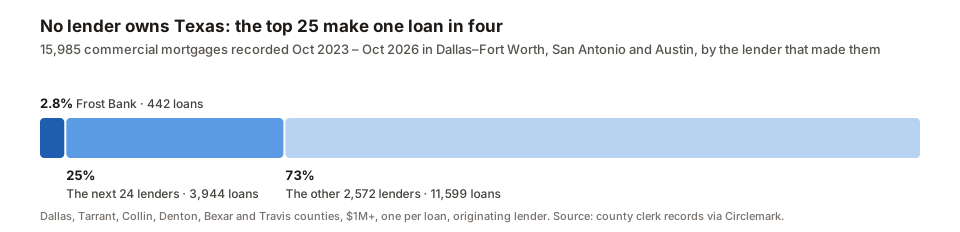 The top 25 made one loan in four. In New York City the top 25 make four in ten, and one bank makes one in nine.
| # | Lender | Type | Loans | Median | Middle half | Most active in | Last recorded |
|---|---|---|---|---|---|---|---|
| 1 | Frost Bank | Bank | 442 | $2.5m | $1.5–6.2m | Bexar | Sep 2026 |
| 2 | Huntington National Bank¹ | Bank | 350 | $2.3m | $1.5–5.7m | Dallas | Sep 2026 |
| 3 | SouthState Bank² | Bank | 314 | $3.4m | $2.0–10.0m | Collin | Oct 2026 |
| 4 | First United Bank | Bank | 308 | $2.7m | $1.5–6.3m | Collin | Sep 2026 |
| 5 | PlainsCapital Bank | Bank | 274 | $3.0m | $1.8–5.4m | Tarrant | Sep 2026 |
| 6 | Prosperity Bank | Bank | 244 | $2.1m | $1.4–4.8m | Travis | Oct 2026 |
| 7 | Bank of America | Bank | 214 | $3.9m | $1.8–19.3m | Dallas | Sep 2026 |
| 8 | Wells Fargo Bank | Bank | 198 | $25.6m | $8.6–168.7m | Dallas | Sep 2026 |
| 9 | Comerica Bank | Bank | 168 | $3.0m | $1.7–8.1m | Dallas | Jul 2026 |
| 10 | JPMorgan Chase Bank | Bank | 162 | $4.0m | $1.5–40.2m | Dallas | Sep 2026 |
| 11 | Regions Bank | Bank | 154 | $10.5m | $2.6–41.0m | Dallas | Oct 2026 |
| 12 | Construction Loan Services | Non-bank | 152 | $1.8m | $1.4–2.9m | Dallas | Oct 2026 |
| 13 | American National Bank of Texas | Bank | 143 | $2.8m | $1.7–5.3m | Dallas | Sep 2026 |
| 14 | International Bank of Commerce | Bank | 128 | $7.3m | $2.3–39.6m | Travis | Sep 2026 |
| 15 | Simmons Bank | Bank | 123 | $4.1m | $2.3–7.3m | Dallas | Sep 2026 |
| 16 | First Financial Bank | Bank | 110 | $2.3m | $1.3–4.0m | Tarrant | Oct 2026 |
| 17 | Third Coast Bank | Bank | 110 | $20.0m | $10.0–25.0m | Denton | Oct 2026 |
| 18 | Pinnacle Bank | Bank | 108 | $2.3m | $1.5–4.5m | Tarrant | Sep 2026 |
| 19 | Broadway National Bank | Bank | 106 | $2.1m | $1.3–4.0m | Bexar | Oct 2026 |
| 20 | Loan Ranger Capital Investments | Debt fund | 105 | $1.8m | $1.4–2.5m | Travis | Aug 2026 |
| 21 | Southside Bank | Bank | 103 | $5.5m | $2.0–25.8m | Travis | Sep 2026 |
| 22 | First-Citizens Bank & Trust | Bank | 102 | $2.2m | $1.3–3.8m | Travis | Oct 2026 |
| 23 | Berkadia Commercial Mortgage | Agency | 101 | $20.4m | $9.4–43.7m | Tarrant | Sep 2026 |
| 24 | BOKF (Bank of Texas) | Bank | 84 | $4.5m | $1.9–21.3m | Dallas | Oct 2026 |
| 25 | Texas Bank & Trust | Bank | 83 | $2.6m | $1.6–4.6m | Dallas | Oct 2026 |
Deeds of trust recorded against parcels in Dallas, Tarrant, Collin, Denton, Bexar and Travis counties in the three years to October 14, 2026, $1 million and up, one row per loan, originating lenders only, one-to-four family houses excluded. "Middle half" is the 25th to 75th percentile of loan amounts. "Most active in" is the county with the most of that lender's loans. ¹ Recorded as Veritex Community Bank and Cadence Bank, which Huntington acquired in October 2025 and February 2026. ² Includes Independent Bank of McKinney, which merged into SouthState on January 1, 2025 and is still recorded under its own name.
Three names need a word. Construction Loan Services, twelfth with 152 loans, is not a bank and not a commercial lender in the office-and-retail sense: it lends to home builders against lots and townhome sites, at $1.4 to $2.9 million a loan, and the record is full of lenders like it. Third Coast Bank, a Humble bank that is seventeenth by count, is the largest Texas lender by typical loan after Wells Fargo: a $20 million median, mostly in Denton County. And Huntington did not lend under its own name in Texas until recently; its 350 loans are Veritex's and Cadence's, counted as one institution because that is who a broker calls now.
If you are a broker rather than a borrower, the next question is which of these lenders' loans come due first: DFW's 2026 maturity wall, county by county counts the loans whose maturity is written into the recorded instrument.
Texas is not New York: no lender owns the market
The same count over the same three years in New York City gives a different shape. There, JPMorgan Chase made one commercial mortgage in nine on its own and the top 25 made four in ten. In Texas the most active lender made one in 36, and the top 25 made one in four.
| Texas (six counties) | New York City (four boroughs) | |
|---|---|---|
| Commercial mortgages recorded, three years | 15,985 | 14,112 |
| Institutions that recorded one | 2,597 | 2,055 |
| Share made by the most active lender | 2.8% (Frost) | 12.0% (Chase) |
| Share made by the top 25 | 27.4% | 41.4% |
Part of that is geography: six counties and three metros against one city. Most of it is the lenders. Texas commercial lending runs through dozens of regional and community banks — Frost, First United, PlainsCapital, Prosperity, American National Bank of Texas, First Financial, Broadway, Pinnacle, Southside, Texas Bank & Trust — each strongest in a few counties, with the national banks filling in behind. Banks made 63% of the loans we can type; debt funds and private lenders 9%, agency lenders 4%, life companies 3%, credit unions 2%, CMBS conduits under 1%, and 18% came from institutions the record does not type.
For a broker the consequence is practical. In New York a shortlist for a $3 million refinance writes itself. In Texas it depends on the county, and the right names in Fort Worth are not the right names in Austin.
Volume vs. loan size: two different rankings
Fourteen of the 25 have a median loan under $3 million: the Texas banks, plus First-Citizens, Loan Ranger and Construction Loan Services. That is the strip-centre, small-industrial and lot-loan business, done at volume. It is a different market from the one Wells Fargo is in at a $25.6 million median, with a middle half that runs to $168.7 million, or Berkadia at $20.4 million, or Third Coast Bank at $20 million.
- Under $3 million. Frost, Huntington (as Veritex and Cadence), First United, PlainsCapital, Prosperity, Comerica, American National Bank of Texas, First Financial, Pinnacle, Broadway National, First-Citizens, Texas Bank & Trust, Loan Ranger, Construction Loan Services.
- $3–8 million. Bank of America, SouthState, JPMorgan Chase, Simmons, International Bank of Commerce, Southside, BOKF. The mid-market, where the national banks' medians sit, with middle halves that stretch far above.
- Over $8 million. Regions, Third Coast, Berkadia, Wells Fargo. Larger balance-sheet, agency and syndicated execution.
A $2 million loan on a strip centre and a $40 million loan on an apartment complex have few lenders in common. A list that does not say what size it is about is not much use.
Multifamily, industrial, office and retail lenders in Texas (and land)
| Property type | Loans | Top five lenders by loans |
|---|---|---|
| Land | 3,052 | SouthState² (111), Construction Loan Services (110), Huntington¹ (87), First United (80), Prosperity (60) |
| Multifamily | 1,581 | Berkadia (72), JLL Real Estate Capital (55), CBRE Capital Markets (53), Walker & Dunlop (45), Regions (44) |
| Retail | 1,285 | SouthState² (42), Comerica (28), PlainsCapital (28), Frost (27), First United (26) |
| Industrial | 1,182 | Frost (47), Huntington¹ (36), Wells Fargo (30), JPMorgan Chase (28), Bank of America (26) |
| Office | 747 | Frost (34), Bank of America (27), Huntington¹ (19), First United (15), American National Bank of Texas (14) |
| Lodging | 196 | State Bank of Texas (10), Global One Bank (8), Bank of Hope (5), American National Bank & Trust (5), First United (5) |
Property type is the appraisal district's own classification, so this table counts Dallas, Collin, Bexar and Travis counties only: Denton and Tarrant publish no building class, and the types we estimate there are not counted here.
Two things stand out against New York. Land is the largest category — more loans than multifamily and office together — because Texas is still being built, and a deed of trust on a tract or a platted site is how builders and developers finance it. And multifamily belongs to the agency lenders: Berkadia, JLL, CBRE and Walker & Dunlop, all Fannie Mae and Freddie Mac sellers, hold the first four places, and the first bank, Regions, is fifth. In New York the biggest multifamily lender is a bank by a distance. A broker with a stabilised apartment deal in Texas is talking to an agency desk; one with a strip centre is talking to a Texas bank.
Hard money and private lenders in Texas build houses
Searches for "hard money lenders in Texas" are common, and the record answers them with a surprise: the most active non-bank lenders in these six counties are not bridge lenders on office buildings. They lend to home builders and house investors.
| Lender | Loans | Median | Most active in |
|---|---|---|---|
| Loan Ranger Capital Investments | 105 | $1.8m | Travis |
| HouseMax Funding | 49 | $1.8m | Travis |
| Avondale Private Lending | 26 | $1.8m | Dallas |
| Builder Circle Finance | 23 | $2.2m | Travis |
| Stallion Texas Real Estate Fund | 22 | $1.8m | Dallas |
Debt funds and private lenders, same loans and window as above. Agency desks, SBA development companies and public housing finance corporations typed as private lenders in the record are left out.
Every one of them has a median near $2 million and a book of lots, spec homes and small townhome sites. Add Construction Loan Services from the main table and the picture is consistent: Texas's private lending market, as the clerks record it, is construction finance for residential builders. The New York private lenders — S3, Broadview, Derby Copeland — have no Texas equivalent at this scale in the record.
Top lenders by county: Dallas, Fort Worth, San Antonio, Austin, Collin and Denton
The state-wide ranking hides lenders that are large in one county and absent from the rest, and in Texas that is most of them.
| County | Loans | Lenders | Most active (loans here / loans in all six counties) |
|---|---|---|---|
| Dallas | 4,387 | 1,112 | Construction Loan Services 111/152, Huntington¹ 95/350, Frost 75/442, SouthState² 65/314 |
| Tarrant (Fort Worth) | 3,165 | 900 | Frost 119/442, PlainsCapital 85/274, Huntington¹ 74/350, First Financial 65/110 |
| Bexar (San Antonio) | 2,222 | 658 | Frost 141/442, Broadway National 71/106, Texas Partners Bank 53/64, Bank of America 48/214 |
| Travis (Austin) | 2,205 | 616 | Horizon Bank 76/80, Prosperity 65/244, Loan Ranger 61/105, International Bank of Commerce 54/128 |
| Collin | 2,160 | 642 | SouthState² 84/314, First United 81/308, Huntington¹ 62/350, Prosperity 42/244 |
| Denton | 1,844 | 576 | SouthState² 64/314, First United 62/308, Huntington¹ 51/350, Frost 40/442 |
- San Antonio is Frost's home and it shows: 141 of its 442 loans are in Bexar County, more than in any other. Broadway National Bank and Texas Partners Bank lend almost nowhere else.
- Austin has a local bank nobody outside it would list: Horizon Bank made 76 of its 80 Texas loans in Travis County. Loan Ranger, the builder lender, is third.
- Fort Worth is Frost, PlainsCapital and First Financial, and Pinnacle Bank, a Fort Worth bank, did 62 of its 108 loans there.
- Dallas is the one county where the top name is a builder lender.
- Collin and Denton, the northern suburbs, belong to SouthState through the McKinney-based Independent Bank it absorbed, and to First United Bank, a Durant, Oklahoma bank with its branches along the Texas side of the Red River.
Each county now has its own page, kept current from the weekly clerk runs: the most active lenders in Dallas County, Tarrant County, Collin County, Denton County, Bexar County and Travis County, by property type and loan size, each row dated to the lender's last closing there. Harris County, Houston, which this post's six counties do not include, has a page too; the county index lists them all.
Purchase or refinance: what the appraisal roll adds
A Texas clerk records no deed beside a deed of trust, so the instrument alone does not say whether a loan bought the property. The appraisal district does: it records who owns each parcel and the deed that gave them title. Matching the two, a loan recorded with the deed that bought the property is purchase money; a loan on a parcel the borrower had owned for months or years is a refinance, a construction loan on land already held, or new debt.
Among the lenders the roll can read — the parcel has not sold since, and the district publishes a usable deed date, which Denton's and Bexar's do not — the split varies more than the loan counts do. Of Frost Bank's classified loans, 97 of 147 were not tied to a purchase; Comerica 61 of 88; Pinnacle 39 of 47. International Bank of Commerce is the other way, 8 of 25. The classification covers about a third of the loans so far, and each lender's share is on its page as the roll fills in.
Banks that changed names: what the record still says
Loans are recorded under the name on the instrument, and the clerk never updates it. Two of the biggest names in Texas lending changed in the period:
- Veritex Community Bank and Cadence Bank are now Huntington National Bank. Huntington completed the Veritex acquisition on October 20, 2025 and the Cadence merger on February 1, 2026. Loans recorded in those names since are still recorded in those names; we count all 350 as Huntington, because that is the institution a broker calls today.
- Independent Bank of McKinney, which traded as Independent Financial, merged into SouthState Bank on January 1, 2025. Its loans are still recorded as Independent Bank; counted as SouthState's, they make SouthState the third most active lender in the state, with 314, where SouthState's own name accounts for 184.
A list that does not know this will tell you Veritex is the second most active lender in Texas and SouthState the eighth. Both were, as names on paper.
The long tail is longer than the market
2,597 distinct institutions recorded a commercial mortgage in the six counties over the three years. 1,537 of them did exactly one, and only 743 reached three.
That tail is not a market to prospect. It is seller financing, family entities, a sponsor's own vehicle and one-off private lenders — real liens, not names for a pitch rotation. It is also why "lender" counts run into six figures when every entity that ever appeared in a lender's position is counted. The working number for Texas is about 750, and the number worth memorising is 25.
Counting institutions rather than names takes work, because lenders record under many. Independent Bank, now SouthState, appears under six spellings, five of them typos. Huntington's Texas loans sit under three names. We fold spellings automatically and name changes and lending vehicles by review, against the acquirer's own filings; the methodology says how.
How this list is counted, and what it cannot tell you
It counts commercial loans, once each. One-to-four family houses are left out — a lender list that keeps them is mostly home mortgages, and a Dallas list built that way puts a residential wholesaler in its top 15 — and a facility recorded once per property, as Texas lenders do, counts once, however many parcels it secures. Every spelling of a lender is one lender, and MERS, servicers and securitization trustees, which sit in the lender's seat without having lent, are left out.
It is six counties, not Texas. Dallas, Tarrant, Collin, Denton, Bexar and Travis. Harris County is being read and is not in this count yet; Fort Bend, Williamson and the rest are not.
It is not a credit box. No lender here has told us what it wants today. A recording is one past decision, not a policy, which is why every row is dated to its last recorded closing.
It names the originator, not the holder. Loans are sold. The lender on the instrument is the one that made the loan, not necessarily the one that holds it.
Recording lags closing. A loan appears when the clerk indexes it, days to weeks after it closes, so the most recent weeks always look thinner than they will.
Who to call at a Texas lender
A lender list is half an answer. The other half is a person, and the public record does not name one: the recorded deed of trust is signed by the borrower, and the lender is a name and an address.
Nine of these 25 lenders publish their lending staff or leadership on their own site, and four of those print a work email beside at least one name. Frost Bank, the most active lender in the state, publishes nobody. Pinnacle Bank publishes 37 people, two with an email on the page. The rest publish nothing, and no amount of data work turns a name into a person when the institution has chosen not to say.
Circlemark tracks both halves: every recorded loan in the six counties, and the people each lender publishes, with the page and date each name came from and a work email where one is published. See who lends on deals like yours — by county, property type and loan size, with each lender's footprint, size band and closings by quarter — or start from the Dallas–Fort Worth market page.
Frequently asked questions
- Who is the largest commercial real estate lender in Texas?
- By loans recorded, Frost Bank: 442 of the 15,985 commercial mortgages recorded in Dallas–Fort Worth, San Antonio and Austin over the last three years that we can attribute to an originating lender, at a $2.5 million median. That is under 3% of the market. Huntington National Bank is second with 350, almost all of them recorded under the Veritex Community Bank and Cadence Bank names it acquired, then SouthState Bank (314, with the Independent Bank it absorbed), First United Bank (308) and PlainsCapital (274). By loan size the list is different: Wells Fargo's median Texas loan is $25.6 million, Berkadia's $20.4 million and Third Coast Bank's $20 million.
- How concentrated is commercial real estate lending in Texas?
- Far less than in New York. The 25 most active lenders made about one loan in four (4,386 of 15,985); in New York City over the same three years the top 25 made four in ten, and JPMorgan Chase alone made one in nine. No Texas lender reaches 3%. The tail is long: 2,597 institutions recorded a commercial mortgage, 1,537 of them exactly once, and 743 reached three.
- Who are the most active commercial real estate lenders in Dallas?
- In Dallas County, by loans recorded in the last three years: Construction Loan Services (111, a builder lender), Huntington as Veritex and Cadence (95), Frost Bank (75) and SouthState (65). Dallas County alone had 4,387 commercial mortgages from 1,112 institutions, more than any other Texas county we read.
- Who lends on commercial real estate in Fort Worth and Tarrant County?
- Frost Bank (119 loans in Tarrant County over three years), PlainsCapital (85), Huntington as Veritex and Cadence (74) and First Financial Bank (65). Pinnacle Bank, a Fort Worth bank, did 62 of its 108 Texas loans there.
- Who are the commercial real estate lenders in San Antonio?
- Frost Bank, by a distance — 141 of its 442 Texas loans are in Bexar County — then Broadway National Bank (71 of its 106) and Texas Partners Bank (53 of its 64), two San Antonio banks that lend almost nowhere else, and Bank of America (48). Bexar County recorded 2,222 commercial mortgages from 659 institutions in the period.
- Who lends on commercial real estate in Austin?
- Horizon Bank, an Austin bank that made 76 of its 80 Texas loans in Travis County; Prosperity Bank (65); Loan Ranger Capital, a private lender to builders and investors (61); and International Bank of Commerce (54). Travis County recorded 2,205 commercial mortgages from 616 institutions over the three years.
- Who are the biggest multifamily lenders in Dallas–Fort Worth and Texas?
- The agency lenders, not the banks: of 1,581 multifamily mortgages recorded on parcels the appraisal districts class as apartments, Berkadia made 72, JLL Real Estate Capital 55, CBRE Capital Markets 53 and Walker & Dunlop 45, with Regions Bank the first bank at 44. That is the reverse of New York, where the biggest multifamily lender is a bank, JPMorgan Chase.
- Who are the hard money and private lenders in Texas?
- The most active non-bank lenders in the record lend to home builders and house investors, not on office buildings: Loan Ranger Capital (105 loans, $1.8 million median, Austin), HouseMax Funding (49, Austin), Avondale Private Lending (26, Dallas), Builder Circle Finance (23, Austin) and Stallion Texas Real Estate Fund (22, Dallas). A Texas 'commercial' private lender is usually a lot-and-construction lender.
- Is Veritex still lending in Texas?
- As Huntington. Huntington Bancshares completed its acquisition of Veritex Holdings on October 20, 2025, and of Cadence Bank on February 1, 2026; loans are still recorded under both old names, and we count all of them as Huntington National Bank. Independent Bank of McKinney merged into SouthState on January 1, 2025; its loans are still recorded under its own name, and we count them as SouthState's, which puts SouthState third with 314.
- Does this tell me which lender will do my deal?
- No. It tells you who has done deals like it. Every number here is counted backwards from deeds of trust the county clerks recorded, so it is revealed behaviour, not a stated credit box. Appetite moves faster than recordings, which is why each lender is dated to its last recorded closing.
- Where does this data come from?
- The real-property indexes of the county clerks of Dallas, Tarrant, Collin, Denton, Bexar and Travis counties, joined to each county's appraisal district roll for the property. We read every deed of trust of $1 million or more, one row per loan, keep only the party that actually lent (dropping MERS, servicers and securitization trustees), and fold the spellings each bank is recorded under onto one institution. Harris County is being read and is not yet in this count.
Sources
- Dallas County Clerk — real property records (dallas.tx.publicsearch.us)
- Tarrant County Clerk — real property records (tarrant.tx.publicsearch.us)
- Collin County Clerk — real property records (collin.tx.publicsearch.us)
- Denton County Clerk — real property records (denton.tx.publicsearch.us)
- Bexar County Clerk — real property records (bexar.tx.publicsearch.us)
- Travis County Clerk — official public records search
- Dallas Central Appraisal District (parcels, property use)
- Tarrant Appraisal District
- Collin Central Appraisal District
- Bexar Appraisal District
- Travis Central Appraisal District
- Huntington Bancshares: 8-K, completion of the Veritex Holdings acquisition (October 20, 2025)
- SouthState: press release, completion of the Independent Bank Group merger (January 2, 2025)
Check one building
Type an address and see the mortgages recorded on it — lender, amount and the maturity read from the instrument. Free, no account.
Read next
- Are banks back in commercial real estate lending? What the county record says (2026)
The Mortgage Bankers Association says bank lending on commercial real estate rose 61% in a year. That is a survey. We counted every commercial mortgage of $1 million or more recorded in New York City and six Texas counties since January 2024 and typed each lender. Banks' share of closings rose from 57% to 63% in New York between the second quarters of 2025 and 2026, and from 61% to 66% in Texas. Bank closings grew by a third and a quarter while the whole market grew 21% and 16%. One bank is most of the New York move. The Texas gain went to Texas banks while two out-of-state banks in the middle of mergers halved.
- Austin is the best US city for renters. Here is the debt behind it: 802 apartment loans in Travis County, who wrote them, and when they come due
A data brief on the debt side of Austin's renters' market: the 1,194 multifamily deeds of trust of $1 million or more recorded in Travis County since 2015, the 366 written in the 2021–2023 supply wave, the institutions that wrote them by type and by name, what has happened to those loans since, and the 29 apartment loans that state a maturity in the next twelve months — counted from the county clerk's record and the instruments themselves, the week Apartment List ranked Austin the best city in America to rent in.
- Who lends on NYC commercial real estate: the 25 most active lenders (2026)
The lenders behind 14,656 NYC commercial mortgages recorded in the last three years, ranked by what they funded, by borough and property type.
More on Texas
- How each record is read: Dallas–Fort Worth · Houston · Austin · San Antonio — what is different about each market's public record, what we cover there, and the live counts.
- Loans maturing by county: Dallas County · Tarrant County · Collin County · Denton County · Harris County · Travis County · Bexar County — each county's maturity windows, collateral mix and the lenders behind the loans coming due, counted from the record.
- Every Texas post
Guides to the public record
The rest of the series — how brokers find loans, owners and maturities in the county record.
- How to find maturing commercial loans
- Loan maturity leads: sourcing refinance deals before the balloon
- Is this commercial loan in default?
- Past maturity, no payoff recorded: what it means
- Where maturity data comes from
- How NYC loan maturities are monitored
- Find the owner behind an LLC (New York)
- Find the owner behind an LLC (Texas)
- Search ACRIS for commercial mortgages
- How to read a recorded mortgage or CEMA
- How to read a blanket mortgage in ACRIS
- Who lends on NYC commercial real estate
- Rent-stabilized building loans in New York
- Why Texas files every warehouse as "commercial"
- Reonomy alternatives for loan data