DFW's 2026 maturity wall, county by county: $13.3B stated, $12.5B already past due
A per-county data brief on Dallas–Fort Worth's commercial mortgage maturity wall — stated maturities only, read from the recorded deeds of trust: 1,197 loans and $13.3B coming due in 12 months across Dallas, Tarrant and Collin counties, 1,033 loans and $12.5B already matured and still open. Texas doesn't disclose the price. It does disclose the loan.
By Circlemark · · 10 min read · Figures as of Sep 14, 2026
The CRE maturity wall gets national numbers — the MBA counts $875 billion of commercial and multifamily mortgages maturing in 2026, and $396 billion of it sits with banks, where no CMBS tracker can see it. This brief is the Dallas–Fort Worth slice of that wall, counted the hard way: loan by loan, from the recorded deeds of trust, per county.
Everything below covers active loans of $1 million or more in Dallas, Tarrant and Collin counties whose maturity date is stated — read off the scanned deed of trust or taken from securitization or agency disclosure. No modelled dates, no estimates. Counts are as of September 14, 2026; the record is re-read weekly. Every number traces to a county clerk instrument number except where marked as disclosure.
Texas doesn't disclose the price. It does disclose the loan.
Texas is a non-disclosure state, and the phrase gets stretched to mean "commercial debt is dark here." It isn't. What a Texas deed omits is the sale price. The deed of trust recorded beside it states the original principal, the lender, the borrower and, on roughly two instruments in five, a defined Maturity Date — title underwriters insist on one because the four-year post-maturity limit on foreclosure runs from it.
What the county clerk's index carries is another matter: grantor, grantee, document type, recording date, legal description. No amount. No maturity. Those fields exist only inside the scanned instrument, which is why every DFW loan list built from the index alone has a lender and a borrower and nothing else. Circlemark reads the instrument — every commercial deed of trust recorded in the three counties since 2015 — and cites the page. That is where the numbers below come from.
The wall: stated maturities, next 12 months
| County | Loans | Volume | Median loan |
|---|---|---|---|
| Dallas | 573 | $5,600M | $2.8M |
| Tarrant | 424 | $4,750M | $3.2M |
| Collin | 200 | $2,990M | $3.8M |
| Dallas–Fort Worth | 1,197 | $13,345M | $3.0M |
This is a middle-market wall. The median loan coming due is $3.0M; New York's equivalent brief found a Manhattan median of $19M. DFW's wall is not a dozen trophy assets — it is twelve hundred bank and agency loans on garden apartments, industrial flex, strip retail and land, most of them below $5M, coming due at a rate of about ninety a month.
One comparison not to draw: $13.3B here against $5.9B in New York does not mean DFW has more debt coming due. A floor is only as high as the record is explicit, and the Texas record is far more explicit — a deed of trust states a maturity on 41% of DFW's active loans, against roughly 9% of New York's, where a consolidation almost never states one and bank multifamily paper is a 25-year note with a rate reset rather than a maturity. Counting every loan with any maturity, stated or modelled, New York has about twice as many coming due as DFW. The difference between the two briefs is how much of each wall can be proved from a document, not how big it is.
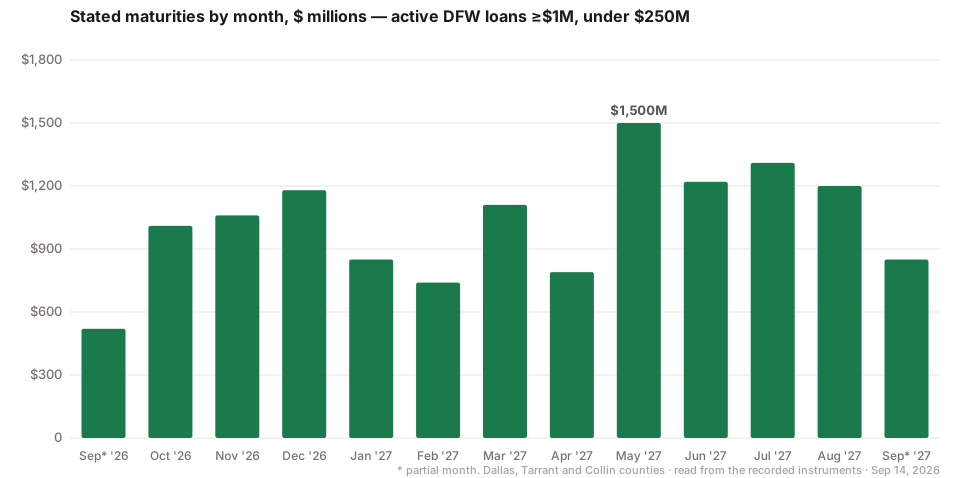
The wall is flatter than New York's, with one crest: May and June 2027 carry $2.72B between them (114 and 98 loans), the busiest two months in the window. The fourth quarter of 2026 — where national CMBS commentary puts the hard-maturity cliff — is ordinary here: $3.25B across October, November and December, in line with the monthly run rate.
Two vintages collide
Sort the same 1,197 loans by the year they were recorded and the shape of the wall explains itself.
| Recorded | Loans | Volume | What they are |
|---|---|---|---|
| 2016–2017 | 302 | $4.28B | Ten-year paper — agency, life-company and conduit loans written at the 2016–17 peak |
| 2022 | 200 | $2.45B | Five-year paper — the last year of cheap floating-rate bridge and bank debt |
| 2025–2026 | 419 | $2.59B | Construction and short bridge loans, 12–24 months, already turning over |
| Everything else | 276 | $4.02B |
The ten-year 2016–17 loans and the five-year 2022 loans were written in different rate regimes, underwritten to different assumptions, and they mature in the same twelve months. The 2022 cohort is the one the CRE CLO market is now flagging: Commercial Observer reported CLO distress jumping from 19% to 28% in August, with Texas, Florida and Georgia holding 44% of the distressed balance. Those loans were recorded as deeds of trust in these counties; the 200 of them with a stated maturity in the window are counted above.
What's coming due, by property type
| Type | Loans | Volume |
|---|---|---|
| Multifamily | 145 | $2,630M |
| Land | 172 | $1,150M |
| One-to-four-family portfolios | 81 | $770M |
| Industrial | 10 | $310M |
| Lodging | 5 | $210M |
| Retail | 9 | $110M |
| Commercial, unspecified by the appraisal district | 368 | $4,030M |
| No appraisal-district classification | 403 | $4,030M |
Property type is the weakest field in this brief, and the table says so rather than hiding it. Texas appraisal districts classify parcels by a state-use code that puts most income property under a single "commercial" heading, and a third of the loans coming due are secured by parcels the instrument's legal description has not yet been matched to a classified parcel at all. The 145 multifamily loans are the ones the record positively identifies as multifamily; the true count is higher and sits inside the two bottom rows.
That matters for one comparison. CRE Daily's Texas newsletter, citing Transwestern, reported on September 9 that "more than $2.0 billion in loan maturities is due during the second half of 2026" in DFW multifamily. Of that, 31 loans, $590M and 5,640 units carry a maturity stated on a recorded instrument in these three counties. The rest, if the estimate is right, is in loans whose instrument states no date — most agency paper, whose maturity lives in the note and the Fannie Mae or Freddie Mac disclosure rather than the deed of trust — or in Denton County, which this brief does not yet cover. The $590M is a floor, not a rebuttal.
The layer underneath: matured, still open
These loans passed their recorded maturity date in the last 12 months and show no release or trustee's deed — the lien is still active on the record.
| County | Loans | Volume |
|---|---|---|
| Dallas | 512 | $5,360M |
| Tarrant | 356 | $4,460M |
| Collin | 165 | $2,690M |
| Dallas–Fort Worth | 1,033 | $12,500M |
The layer is nearly the size of the wall in front of it: $12.50B already past a recorded maturity against $13.35B coming due. Read it honestly. "Open on the record" is the recorder's truth, not proof of default: some of these loans were paid off or refinanced and the release is sitting in the recording queue, and Texas title practice makes an unrecorded release rarer than New York's unrecorded satisfaction, but not rare. Some are formal extensions papered as a modification the index filed under a different name. Each of the 1,033 remains a live lien of record until a release is filed — and for a broker, a loan a year past maturity with no release is a workout, an extension or a refinance that never got recorded, and the first two are the best conversations in the market.
What the record can't see
Three things are deliberately left out of the headline numbers, and each is a story.
Fifteen recordings of $250M or more, $9.5B on paper. A Texas lien is perfected by recording a separate deed of trust against each property it covers, and every one states the full note. A national portfolio financing or a corporate credit facility that happens to include a Dallas warehouse therefore records its entire $900M or $1.8B against that one parcel. The instrument says what the facility is; it does not say what share of it is Texas collateral. Rather than guess, this brief excludes the fifteen and states them here. Add them back and the forward wall reads $22.9B — a number that is true of the paper and false of the market.
The bridge loans whose maturity isn't in the instrument. Collin County instrument 2024000052489: Riley Cityline Property Owner LLC borrowed $53.75M from Argentic Real Estate Finance 2 on April 30, 2024, against a 262-unit property at 3551 Wilshire Way in Richardson. The recorded deed of trust states no maturity date — the term lives in the note and in the CRE CLO the loan was sold into. The Riley appeared on CRED iQ's newly-distressed list in July. The county record shows the loan exists, who made it and when; only the securitization disclosure shows when it comes due. That is the class of loan the 2022 vintage above is made of, and it is why the 20,173 loans with no stated date are excluded rather than modelled: the model would put many of them in the window, and it would be a guess.
Distress, which Texas makes perishable by design. Only 3 of the 1,197 loans coming due carry a recorded distress filing. That is not calm; it is the record. A Texas foreclosure begins with a notice posted at the courthouse 21 days before the first-Tuesday sale, and the notice is withdrawn or overwritten once the date passes — the Dallas County Clerk's own postings live in month folders with no year. Circlemark snapshots them as they appear, but a loan that was posted and then cured last spring leaves no trace today. Trustee's deeds are the only distress record that reaches back, and in Tarrant and Collin they are filed as plain deeds.
Six loans you can check
Every figure in this brief aggregates rows like these — each traced to a recorded instrument.
| Property | County | Type | Loan | Lender | Stated maturity | Instrument |
|---|---|---|---|---|---|---|
| 2752 Gaston Ave, Dallas | Dallas | Multifamily, 480 units | $44.1M | CBRE Capital Markets | Jun 1, 2027 | 201700153753 |
| 3001 Crockett St, Fort Worth | Tarrant | Multifamily | $76.1M | LoanCore Capital Credit REIT | Dec 9, 2026 | D221353778 |
| 4300 N Hardin Blvd, McKinney | Collin | Multifamily | $57.0M | Associated Bank | Jan 23, 2027 | 2023000007116 |
| 3551 Wilshire Way, Richardson | Collin | Multifamily, 262 units | $53.75M | Argentic Real Estate Finance 2 | none stated | 2024000052489 |
| 5307 E Mockingbird Ln, Dallas | Dallas | Multifamily, 211 units | $80.0M | Massachusetts Mutual Life | Feb 1, 2026 · past due | 201600015572 |
| 700 Texas St, Fort Worth | Tarrant | Commercial | $69.9M | Pinnacle Bank | Apr 7, 2026 · past due | D221100926 |
Methodology
- Source. The county clerk's real-property records for Dallas, Tarrant and Collin counties, every deed of trust recorded since 2015, ingested in full and re-read weekly. Releases, assignments, modifications and trustee's deeds are matched back to the original instrument, so a released or foreclosed loan never counts as active. Circlemark currently indexes 44,566 DFW commercial loans, 34,182 of them ≥$1M with an active lien in the three counties.
- Amounts and maturity dates. The clerk's index records neither. Both are read from the scanned instrument — the principal from the granting clause, the maturity from the defined term — or taken from securitization or agency disclosure. Only stated dates are counted. A further 20,173 active loans ≥$1M (59%) state no maturity on any recorded document; term models place many inside the same window, but estimates are excluded throughout. The $13.35B is a floor.
- Unit of count. Loans, counted once each. A financing recorded against several properties — one deed of trust per parcel, each stating the full note — is one loan here; a set of sibling borrower entities that recorded the same amount from the same lender on the same day is one financing; and a facility drawn through sibling entities over time — same lender, same ceiling, same stated maturity, a deed of trust per project — is counted as the facility, not as a loan per project. Recordings of $250M or more are excluded and stated separately above. One re-recording the rule leaves apart was counted once by hand: Collin instruments 2022000096632 and 2022000147571, the same $240M build-to-rent facility re-recorded 102 days later to add collateral, same lender and same maturity.
- Floor and windows. Original principal ≥ $1,000,000. "Next 12 months" = stated maturity Sep 14, 2026 – Sep 13, 2027; "matured, still open" = stated maturity Sep 14, 2025 – Sep 13, 2026, active lien, no release or trustee's deed recorded. Denton County is not yet covered.
- Verification. Any row can be pulled live through Circlemark or checked against the underlying record by instrument number at the county clerk's portal. How the Texas record differs from New York's, and what each does and doesn't hold, is in where commercial mortgage maturity data actually comes from.
Frequently asked questions
- How big is Dallas–Fort Worth's 2026 commercial mortgage maturity wall?
- Counting only maturity dates stated in a recorded deed of trust or a securitization disclosure: 1,197 active commercial loans of $1M or more, totaling $13.35B, come due in the 12 months from September 14, 2026 across Dallas, Tarrant and Collin counties — 573 loans ($5.60B) in Dallas County, 424 ($4.75B) in Tarrant, 200 ($2.99B) in Collin. The median loan is $3.0M. That is a verified floor: a further 20,173 active loans ≥$1M state no maturity in any recorded document and are excluded, not estimated.
- Texas is a non-disclosure state — how can you know the loan amount?
- Non-disclosure covers the sale price: a Texas deed states no consideration. It does not cover the loan. A recorded deed of trust states the original principal, the lender, the borrower and — on roughly two instruments in five — a defined Maturity Date. The county clerk's index carries none of those fields, so they have to be read off the scanned instrument itself, which is what Circlemark does for every commercial deed of trust recorded in the three counties.
- What is a matured-but-open loan?
- A loan whose recorded maturity date has passed with no release or trustee's deed on file — the lien is still active on the record. As of September 14, 2026, DFW has 1,033 such loans ≥$1M ($12.50B) whose stated maturity passed in the last 12 months. Some are workouts or informal extensions; some were paid off and the release was never recorded. The record says the loan is open until a release is filed.
- Why is the DFW floor bigger than New York's $5.9B?
- Because the Texas record states more. A Texas deed of trust defines a Maturity Date on about 41% of DFW's active commercial loans; a New York mortgage states one on roughly 9%, and the consolidations that carry Manhattan's largest loans almost never do. Counting every loan with any maturity, stated or modelled, New York has about twice as many coming due as DFW. The two figures measure how much of each wall can be proved from a document, not how big each wall is.
- Which county has the most loans coming due?
- Dallas County, by both count and dollars: 573 loans, $5.60B, median $2.8M. Tarrant follows with 424 loans ($4.75B, median $3.2M), then Collin with 200 ($2.99B, median $3.8M — the largest typical loan of the three).
Sources
- MBA: 17 Percent of Commercial and Multifamily Mortgage Balances to Mature in 2026 (Feb 9, 2026)
- CRE Daily (Texas): DFW Multifamily Market Shows Signs of Stabilization, citing Transwestern (Sep 9, 2026)
- Commercial Observer: CRE CLO Distress Accelerates in August (Sep 8, 2026)
- Dallas County Clerk — real property records (dallas.tx.publicsearch.us)
- Tarrant County Clerk — real property records (tarrant.tx.publicsearch.us)
- Collin County Clerk — real property records (collin.tx.publicsearch.us)
Read next
- NYC's 2026 maturity wall, borough by borough: $5.9B stated, $2.5B already past due
A per-borough data brief on New York City's 2026 commercial mortgage maturity wall — stated maturities only, read from the recorded instruments: 274 loans and $5.9B coming due in 12 months, 166 loans and $2.5B already matured and still open, 13 already carrying a distress filing. Every number traces to the record.
- Ask Claude which CRE loans mature next year: Circlemark now provides an MCP connector
Commercial mortgage maturity data now answers questions in plain English. How we put over 100,000 NYC loans inside Claude via the Model Context Protocol, what an AI assistant can and can't do with recorded-document data, and why the connector never presents a modelled maturity as a fact.
- Where commercial mortgage maturity data actually comes from
Every CRE maturity date in every data product traces to one of three sources: the county recorder, securitization disclosure, or somebody's model. What each one covers, what each one hides, and the questions to ask any vendor before you trust a date — with New York and Texas as the worked examples.