NYC investor house loans in 2026: 27,000 mortgages over $1M on 1–4 family homes, and when their rates reset
Brooklyn, Queens, the Bronx and Manhattan hold 27,286 active mortgages of $1 million or more on one-to-four family houses — $70.8 billion of investor debt that sits on no commercial loan list. We read the recorded Fixed/Adjustable Rate Riders. Here is who lent, when the fixed periods end, and how a broker works the list with the 10-year at 5%.
By Circlemark · · 10 min read · Figures as of Sep 21, 2026
Key numbers. New York City holds 27,286 active mortgages of $1 million or more on one-to-four family houses — $70.8 billion, median $1.48 million — that no commercial loan list carries and no residential list sizes. Brooklyn has 19,800 of them. Banks wrote 42%, and 39% were sold through MERS. We read the recorded rate riders on the 23,297 recorded since 2015: 5,405 are adjustable loans with a stated reset date, $12.7 billion; 1,614 of those have already reset and are floating today, and with the 10-year Treasury at 5% and the 30-year fixed at 6.95% the dates ahead are the only refinancing events in this market that do not depend on the borrower wanting one.
If you broker investor loans in the outer boroughs, you already know this segment. It is the two-family in Bushwick with a $1.4 million Citizens ARM, the three-family in Astoria on a Chase 7/6, the Park Slope brownstone with a $2.5 million MERS-registered non-QM loan. You work them because they are easier to place than a mixed-use building: more lenders, standard paper, a 30-year term. What you have not had is a list of them with the reset dates on it. This is that list, and this post is how we built it and how we would work it this quarter.
Why these loans are on no list
Three weeks ago we wrote that a third of every NYC "commercial loan" list is somebody's apartment and that we had started excluding homes from our product using the property-type code ACRIS records on every lot. That was right for condo units. For houses it was too blunt, and the brokers who use Circlemark said so within the week.
The reason no list carries them is structural. Commercial data vendors filter on property type and drop anything residential. Residential data vendors size loans by the borrower, not the collateral, and have no idea whether the two-family is owner-occupied. The recorder does not say either — a landlord's mortgage and a homeowner's mortgage on the same block look identical in ACRIS. What the recorder does say is the amount, and above $1 million on a one-to-four family house the collateral is overwhelmingly an investment: either a rental in the outer boroughs, or a Manhattan townhouse whose owner has a private banker. We admit the segment by amount and code, label it Residential 1–4 Units in the product, and keep it off by default so a search for "all types" in Brooklyn still returns commercial collateral only.
| Borough | Loans | Median | Riders read (2015+) | With a stated reset |
|---|---|---|---|---|
| Brooklyn | 19,773 | $1.50M | 16,539 | 3,620 (22%) |
| Queens | 5,115 | $1.22M | 4,410 | 987 (22%) |
| Manhattan | 2,621 | $4.00M | 1,420 | 677 (48%) |
| Bronx | 1,301 | $1.43M | 925 | 121 (13%) |
Active, unmodified mortgages above the borough floor ($2M Manhattan, $1M elsewhere) whose every parcel carries an ACRIS D1–D4 code. Riders read on every instrument recorded 2015 or later, as of September 21, 2026; the 2004–2014 loans are past any first reset and were not read.
Where the reset is written down
A commercial data model breaks on this paper in a specific way. Our default for a bank loan with no stated maturity is a five-, seven- or ten-year term, because that is what New York commercial paper is. On a 30-year residential note that assumption is simply wrong, and on a 30-year fixed the honest answer is that there is no event at all inside any horizon you care about. So we do not print a modelled maturity on a house loan. We read the rider.
The Fixed/Adjustable Rate Rider recorded behind the signature pages states the Change Date — "the initial fixed interest rate I will pay will change to an adjustable interest rate on the first day of March 2028" — the adjustment cadence afterwards, and the index and margin. It sits past page 14 of a typical instrument, which is why the maturity read we ran in August never saw it. We pulled the first three and the last ten pages of each of the 23,297 mortgages recorded since 2015 and read them in batch over one weekend.
What the 23,297 riders say:
| Share | |
|---|---|
| Riders with a stated first rate change | 5,405 loans, 23% ($12.7B) |
| — on credit-union paper | 53% |
| — on bank paper | 32% |
| — on MERS-registered paper | 20% |
| — on debt-fund and hard-money paper | 6% |
| Fixed period: 10 years | 34% |
| Fixed period: 7 years | 32% |
| Fixed period: 5 years | 18% |
| Floating from the start (fixed period under six months) | 9% |
| Adjusts annually after the fixed period | 43% |
| Adjusts every 6 months | 39% |
| Adjusts monthly | 16% |
Two things about the misses. A fixed-rate uniform instrument has no rider, so "no reset found" on a MERS loan is usually the right reading — the loan is a 30-year fixed and has no scheduled event. And the banks and credit unions are where the hit rate is, for the same reason they were in the commercial cohort: the lender recorded its own rider, and its ARM book is the reset book. The hit rate barely moves by vintage — 20 to 31 percent every year from 2015 to 2026, lowest in 2021 when the refinancing boom was almost entirely fixed-rate.
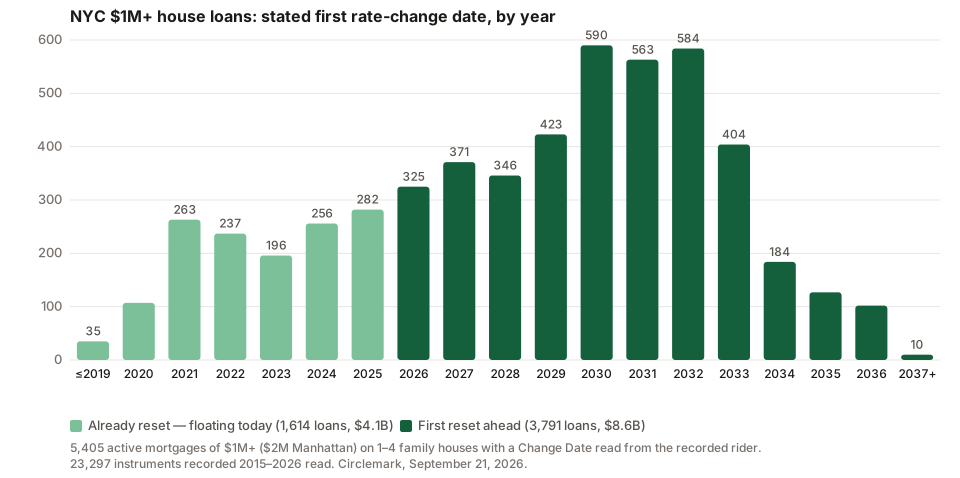 Stated first rate-change dates on NYC $1M+ house loans recorded 2015–2026. The 2030–2032 bulge is the 2020–2022 vintage at seven- and ten-year fixed. The light bars are loans already past their first Change Date and adjusting today.
| First rate change | Loans | Amount |
|---|---|---|
| Already reset (through 2025) | 1,614 | $4.1B |
| 2026 | 325 | $755M |
| 2027 | 371 | $887M |
| 2028 | 346 | $750M |
| 2029 | 423 | $923M |
| 2030 | 590 | $1.24B |
| 2031 | 563 | $1.35B |
| 2032 | 584 | $1.29B |
| 2033 | 404 | $920M |
| 2034–2036 | 413 | $1.02B |
Who holds the paper
| Lender class | Loans | Share | Riders with a reset |
|---|---|---|---|
| Banks — Citizens, JPMorgan Chase, First Republic (now Chase), Wells Fargo, Citibank, Bank of America, Ridgewood, TD, Cathay | 11,512 | 42% | 32% |
| MERS as nominee — agency-eligible and non-QM paper; the originator is behind the nominee | 10,660 | 39% | 20% |
| Debt funds and hard-money lenders | 1,427 | 5% | 6% |
| Credit unions — Bethpage, Municipal, Teachers | 450 | 2% | 53% |
| Unclassified | 3,237 | 12% | 12% |
Among the 5,405 loans with a stated reset, Citizens Bank leads the banks with 431, then JPMorgan Chase 420 plus another 400 written as First Republic, Wells Fargo 381, Citibank 214, Bank of America 101, Bethpage Federal Credit Union 99 and Ridgewood Savings 97. The MERS-registered resets — 1,926 of them — are the non-QM and portfolio ARMs sold to aggregators; the servicer, not the originator, is who the borrower hears from at the Change Date.
The rate backdrop: why the reset is now the event
This week the 10-year Treasury crossed 5% for the first time since 2007, and Freddie Mac's 30-year fixed printed 6.95%, a 19-month high and up from 6.26% a year ago. DSCR money for a New York rental is running 6.5–8%.
The obvious objection to working investor house loans in that market is that nobody refinances a 3% mortgage. That is true. The rate-and-term and cash-out volume that carried outer-borough brokers through 2020–21 is not coming back at a 5% ten-year. Three things cut the other way, and they are the reason to work the reset list rather than the whole list.
The reset is a shock, not a choice. A 2018 origination fixed at 3.75% for ten years goes floating in 2028 at SOFR plus 2.25–2.75%. At today's curve that is a payment step-up in the hundreds of dollars a month per $100,000 of balance, and the borrower has to do something about it: re-fix with the incumbent, refinance elsewhere, or sell. Each of those is a conversation, and the borrower does not get to skip it.
The easy exits close at the margin. A DSCR loan needs the rent to cover the payment. New York's one-to-four family investor stock trades at 4–5% cap rates; at a 7% coupon many of these houses do not cover, and the agency path has its own limits on financed properties per borrower. The loan that was a twenty-minute DSCR approval in 2021 becomes a portfolio-bank conversation in 2028, and portfolio banks are where brokers earn fees.
Bank pullback needs an intermediary. When funding costs rise, the balance-sheet lenders that hold 42% of this paper tighten first. The borrower who falls out of the incumbent bank's box needs someone who knows which of the other banks, credit unions or non-QM shops will take a three-family in Ridgewood at 65% LTV.
None of that is a forecast. It is the mechanics of a stated Change Date meeting a higher index. What we sell on this segment is the date and the origination coupon, not "easier to finance".
How we would work the list this quarter
Three call lists, in this order.
1. Already floating. 1,614 loans, $4.1 billion, passed their first Change Date on or before this year and are adjusting annually or semi-annually at SOFR plus a margin — call it 6.5–7.5% today against a 2015–2019 note rate around 3.5–4%. These borrowers are paying the shock now. The pitch is not "rates might fall"; it is "you are floating, and here is a five-year fixed at a portfolio bank or a credit union, and here is what it saves you at the next adjustment date." Filter: Residential 1–4 Units, next reset within the past 24 months.
2. Resetting within 18 months. 535 loans, $1.2 billion, have a Change Date between now and March 2028. These borrowers have a date on paper and a rate they can still lock ahead of it. Lead with the date and the incumbent's name: "Your Citizens loan on 412 Halsey resets in March; Citizens will offer you a re-fix, and you should know what the alternative is before you take it." Filter: Residential 1–4 Units, next reset in the next 18 months, sorted by lender.
3. The 2023–2025 originations at 7%-plus. Not a reset play — a rate-and-term candidate the moment the curve moves. 9,495 of the segment's loans were recorded from 2023 on, when the 30-year fixed spent most of its time between 6.5% and 7.5%. These are the borrowers who refinance first when the ten-year backs off, and the ones most worth a relationship now. Filter: Residential 1–4 Units, originated 2023 or later, sorted by amount.
On all three, the owner of record and the signer of the instrument are on the property page — most of these borrowers are individuals or single-asset LLCs, which is the segment where public-record contact matching works best. Where the mortgagee is MERS, look up the current servicer on the MERS ServicerID site before you call; the originator on the recorded document is often not who holds the loan.
How it appears in the product
Loans on a single house are in Circlemark under the property type Residential 1–4 Units, and they are off by default: an "all types" search in Brooklyn still returns commercial collateral only, and picking the type adds the houses. A blanket loan over three or more houses — a rental portfolio — shows in every search, as it always did.
Where we have read the rider, the row shows the stated first rate-change date, the fixed period and the adjustment cadence, and the next adjustment date rolled forward from today. Where the rider says the loan is fixed, or there is no rider, the row shows the stated 30-year maturity and nothing else. Where we have not yet read the document, the row shows no date at all. We do not print a modelled five-year maturity on a house loan, because we know it is wrong, and a wrong date presented as a lead costs you a phone call.
New recordings are read weekly, in batch, the Friday after the borough updates land. The method is on the methodology page; the property page cites the document and the page the rider is on. If you find a house loan whose reset date does not match the recorded rider, the CRFN is on the page — send it to us and we will fix the read.
Frequently asked questions
- Is a mortgage on a 1–4 family investment property a commercial loan?
- Legally no. A $1.5 million mortgage on a two-family in Bed-Stuy is a residential mortgage, usually on the Fannie Mae/Freddie Mac New York uniform instrument, even when the borrower is an LLC or a landlord with a dozen houses. Commercially yes: the borrower runs a rental business, the refinancing is a business decision, and at $1 million and up the loan is bigger than most of the small-multifamily loans every commercial list carries without a second thought.
- How many $1M+ mortgages are there on NYC houses?
- 27,286 active, unmodified mortgages of $1 million or more ($2 million in Manhattan) whose every parcel carries a one-to-four family code in ACRIS — $70.8 billion, median $1.48 million. Brooklyn holds 19,800, Queens 5,100, Manhattan 2,600 and the Bronx 1,300. 19,300 were recorded since 2020.
- Who lends on NYC investor houses?
- Banks wrote 42% by count — Citizens, JPMorgan Chase, Wells Fargo, U.S. Bank, Citibank and TD lead — and 39% name MERS as nominee, meaning agency-eligible or non-QM paper sold into the secondary market. Debt funds and hard-money lenders are 5%, credit unions 2%.
- When do NYC investor ARMs reset?
- Of the 5,405 riders with a stated Change Date, ten-year fixed periods are the most common (34%), then seven-year (32%) and five-year (18%); after the fixed period the rate re-sets annually on 43% and every six months on 39%. Because most of these loans were written in 2020–2022, the resets stack up in 2030–2032 at roughly 580 a year. 1,614 have already reset and are floating today, 325 reset in 2026 and 371 in 2027.
- Does a 5% 10-year Treasury help or hurt a broker working these loans?
- It kills voluntary refinancing — a 2021 borrower fixed at 3% has no reason to move — and it makes the scheduled reset the event. A 2017–19 loan fixed at 3.5–4% going floating at SOFR plus 2.25–2.75% is a payment shock the borrower must act on. With the 30-year fixed at 6.95% and DSCR money at 6.5–8%, a NYC house yielding 4–5% no longer covers, so the easy agency and DSCR exits close and the borrower needs someone who knows the portfolio banks.
- Where does the data come from?
- The NYC Department of Finance's ACRIS records (Master, Legals with the per-lot property-type code, Parties) and the scanned recorded instruments themselves, read for the stated maturity and the Fixed/Adjustable Rate Rider's Change Date, initial fixed period and adjustment cadence. Every field on a Circlemark property page cites the document and page it came from.
Sources
- NYC Open Data: ACRIS Real Property Legals (property_type per recorded document)
- NYC Open Data: ACRIS Property Types Codes (D1–D4 = one-to-four family dwelling)
- Fannie Mae: Riders and addenda — Fixed/Adjustable Rate Rider (Change Date, Initial Fixed Interest Rate)
- Fannie Mae Selling Guide B2-2-03: Multiple Financed Properties for the Same Borrower
- CNBC: 10-year Treasury yield tops 5% ahead of the FOMC, highest since 2007 (September 2026)
- Freddie Mac PMMS: 30-year fixed averages 6.95%, a 19-month high (September 17, 2026)
- CoreVest Finance: New York City DSCR loans and rates, 2026
Read next
- NYC's 2026 maturity wall, borough by borough: $5.9B stated, $2.5B already past due
A per-borough data brief on New York City's 2026 commercial mortgage maturity wall — stated maturities only, read from the recorded instruments: 274 loans and $5.9B coming due in 12 months, 166 loans and $2.5B already matured and still open, 13 already carrying a distress filing. Every number traces to the record.
- How to find the owner of a commercial property in NYC (2026)
Find a NYC commercial property owner's name, title, email and phone from public records, even behind an LLC. Four city records, measured on 155,860 loans.
- Why a third of every NYC 'commercial loan' list is somebody's apartment
35% of the mortgages that clear a commercial dollar floor in New York City are condo units, co-ops and one-to-four family houses. Here is why the standard property-centric filter can't see them, the one ACRIS field that can, and what our own data looked like before and after we applied it.