Actovia and PropertyShark alternatives for commercial loan maturities (NYC, 2026)
PropertyShark and Actovia both show a maturity date on a New York mortgage. PropertyShark's own plan page calls its dates estimated; Actovia publishes no method; Crezly, the newest entrant, says plainly that it models them. For a refinancing broker the question is narrower than "which database": which of these dates was read off the recorded instrument, and has a satisfaction been recorded since? Here is what each product's own pages say, a comparison table filled only from them, and one Manhattan loan walked from the instrument to the owner.
By Andrew Zhong, founder of Circlemark · · 13 min read · Figures as of Oct 28, 2026
The short answer. PropertyShark and Actovia both show a maturity date on a New York mortgage. PropertyShark's own plan page calls its dates estimated; Actovia publishes no method. If the job is refinancing, the question is which dates were read off the recorded instrument and whether a satisfaction has been recorded since. In Manhattan, 145 loans of $2 million or more carry a date read from a document that falls inside the next twelve months — $8.2 billion, counted on October 28, 2026.
Skip the search. Type an address and the lookup reads the recorded instrument for you — lender, amount and maturity — free, no account. Or search every loan in your market on a free seat: no card, 10 owner reveals, 60 searches, nothing expires.
This is a comparison for one job: finding the commercial loans in New York City that are coming due, and reaching the person who has to refinance them. For that job the products brokers already pay for — PropertyShark at $59.95 a month, Actovia at $319 to $389 a seat — are not wrong so much as silent about the one thing that decides whether a call is worth making. Everything below about a competitor is quoted from its own pages or a dated published review, with the link in the sources; where we could not verify something, the cell is blank. If you came here from a Reonomy, Crexi or CoStar seat, the national comparison covers those; this post is about the two New York products and the newest entrant, Crezly.
What PropertyShark and Actovia are good at
PropertyShark is a property-records product, owned by Yardi, that is strongest in New York. Its sales-and-financials page lists, for NYC, "Full mortgage history", "Mortgage parties", "Loan amount & type", "Maturity date", "Interest rate" and "Outstanding balance", alongside "scanned sale and mortgage documents", with the note that "Mortgage information is restricted to NYC." Its subscriptions page (read October 28, 2026) sells three plans — Pro at $59.95, Elite at $79.95, Platinum at $169.95 a month — and from Elite up adds "Foreclosures" and "Pre-foreclosures: defaulted mortgages potentially headed for foreclosure", which is the lis pendens list we do not carry. For ownership research, comparable sales, zoning, permits and the scanned deed itself, it is the cheapest serious tool in the city, and its 2025 "Top 10 Real Estate Data Providers" listicle ranks itself first without mentioning commercial mortgages or maturity at all — which is a fair description of what it is for.
Actovia is the New York mortgage broker's tool, and has been since it launched in the boroughs in 2011, which The Real Deal covered that March as a move-over-PropertyShark story. CRE Daily's 2026 review describes a debt tab that lets a user "uncover terms such as Rate, PPP, and expiration date" on Freddie Mac, Fannie Mae, CMBS and balance-sheet loans, "detailed mortgage records, including past and current loans, terms, and payment histories", a CMBS database searchable by "mortgage expiration date", owner and lender contacts with portfolio views, an API and bulk data, and "hands-on support, including direct access to the founder." Pricing in the same review is "$319 to $389 per user per month", month to month, with discounts for annual payment; the one limitation it names is that outside New York "Actovia has contact data on portfolios with 10 or more properties." Actovia's own 2026 maturities insight analyses "commercial mortgages expiring between July and December 2026" by rate band, property type and size. It is the closest product to ours in intent, and it has fourteen years of New York relationships we do not.
Crezly is new. Its data page describes "recorded owner debt and loan maturities" for the five boroughs and a national property map, "Data sourced from NYC Open Data", with owner-debt summaries "free to view" and "skip-traced owner contact details" behind a plan. Its learn page is the most candid sentence any vendor in this comparison has published about maturity: "ACRIS does not publish a maturity field directly; maturity is modeled from the recording date" using "typical 5-, 7- and 10-year commercial loan terms", followed by "Always verify against the underlying mortgage document." That is exactly right, and it is the whole argument of this post made by a competitor.
Does PropertyShark show mortgage maturity dates?
Yes, and it is worth being precise about this, because the listicles that rank for "PropertyShark alternative" — Dwellsy's nine-tool guide from June 2026, the directory page refreshed on October 25 — never mention maturity, which leaves the impression that no property-records product has one. PropertyShark's data-points table has a "Maturity date" row (availability "limited nationwide"), and its "Active mortgage maturity" feature, included in every plan, gives "an overview of when current loans are due with estimated maturity dates."
The word to read twice is estimated. New York's recorder, ACRIS, publishes the parties, the amount, the document type and the dates of recording and execution for every mortgage — and no maturity. The maturity is inside the scanned instrument, if the lender's form printed one, and on a plain mortgage it did so about 47% of the time in our reading; on a consolidation agreement (the AGMT that governs a CEMA refinance, which is how New York refinances) about 6%; on Manhattan's twenty largest office loans, none of twenty.
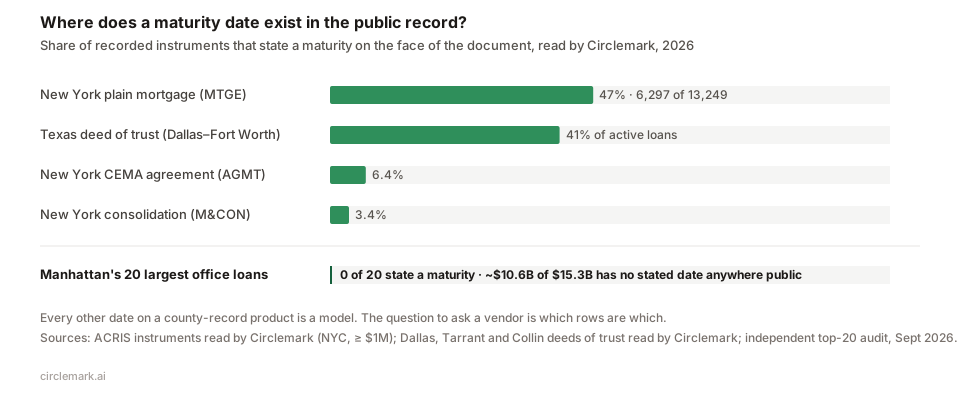
So every New York product has three ways to put a date on a loan: read the scanned document, match the loan to a securitization disclosure that states it, or assume a term from the origination date. PropertyShark says it does the third. Crezly says it does the third, with 5-, 7- and 10-year terms. Actovia's pages describe an "expiration date" field and a maturities analysis without saying which of the three produced them. Ours does all three and labels each row with which one it was: a read date in bold with a citation to the document and the pages read, a disclosure date with the deal it came from, and a modelled date shown as ≈ 5-yr with the term it assumes — never as a bare date. The methodology page has the counts by instrument type, and the chart above is from it.
A note on fairness: an estimate is not a defect. A $3 million walk-up loan from a community bank is, in the great majority of cases, five-year paper, and a product that guesses five years from the recording date will be right about the year more often than not. The defect is a product that shows the guess and the read date in the same column with no way to tell them apart, because the broker who emails an owner about "your loan maturing in March" when March was a guess is the one who looks uninformed. PropertyShark avoids that by saying estimated on the plan page. We avoid it on every row.
Actovia vs PropertyShark: which one for a mortgage broker?
If the choice is only between the two, the split is clean. PropertyShark is the property tool: who owns it, what it sold for, what the deed says, what is in pre-foreclosure, for $60 a month. Actovia is the loan tool: who lent, at what rate, with what prepayment penalty, expiring when, with the borrower's other buildings and a phone number, for $319 to $389 a seat. A New York debt broker who pays for one of them pays for Actovia, and CRE Daily's "best for brokers, lenders, investors, and service professionals looking to canvas leads" is the same verdict.
The three questions neither product's pages answer are the ones that decide whether a lead is real:
- Was this date read from the document or estimated? PropertyShark's answer is "estimated", on the plan page. Actovia's pages do not say. Neither shows it per loan.
- Is the loan still open? Both describe "current" or "past and current" loans, which means both decide somewhere which recorded mortgages are still live. Neither publishes how. In New York that decision is harder than it looks: a satisfaction cites the old notes a consolidation folded in, never the consolidation agreement itself, and a CEMA refinance consolidates the prior note into a new agreement instead of satisfying it. A product that keys satisfactions to the document they name leaves the agreement — the row it lists — open forever. Our own version of that mistake left 5,826 paid-off New York loans (3.7% of the corpus) listed as active until September 21, 2026; the fix, and the twenty-of-twenty hand check, are dated on the methodology page.
- Can I see the page? PropertyShark sells the scanned document, which is the right instinct. What neither product does is cite the date to the page it was read from, so that a broker can check it in ten seconds before making the call.
Those are the rows that matter in the table below, and they are why "alternative" is the wrong frame. A broker does not need a replacement for Actovia's filters or PropertyShark's deed images. They need to know which of the dates in front of them are facts.
Comparison: PropertyShark, Actovia, Crezly, Reonomy and Circlemark
Only facts we could verify from each vendor's own pages or a dated published review; a blank cell means we could not confirm it, not that the product lacks it.
| PropertyShark | Actovia | Crezly | Reonomy (Altus) | Circlemark | |
|---|---|---|---|---|---|
| Markets for mortgage data | NYC ("Mortgage information is restricted to NYC"); maturity, lender and origination "limited nationwide" | NYC since 2011; "all commercial property and mortgage types across the United States" (CRE Daily, 2026) | Five boroughs; national property map | National | NYC (four ACRIS boroughs) and the Texas metros only |
| Source of the maturity date | Estimated: "estimated maturity dates" (subscriptions page) | "Expiration date" shown; source not published | Modelled: "maturity is modeled from the recording date", 5/7/10-year terms (learn page) | Not published | Read from the recorded instrument, or the securitization disclosure matched to it, or modelled — labelled per row |
| Says which dates are estimates | On the plan page, not per loan | No | On the learn page, not per loan | No | Yes, on every row, with the term assumed |
| Open or paid off | "Current loans" identified; method not published | "Past and current loans"; method not published | Ingests satisfactions; method not described | Not published | Weekly per county: satisfied (following the cited notes), superseded by a later consolidation, modified, foreclosed, distressed; a later lien on the same parcel is flagged |
| Citation to the document | Scanned document sold; date not cited to a page | Not published | "Always verify against the underlying mortgage document" | Not published | Every read date links the ACRIS document and names the pages read |
| Owner behind the LLC | Owner search; "Mortgage parties" | Owner and lender contacts, portfolios; nationwide contacts only on 10+ property portfolios (CRE Daily) | "Skip-traced owner contact details" on a paid plan | Contact graph rebuilt Sep 2026 | Public-record people (HPD officers, DOB owners, instrument signer, assessor) with source and tier per name; every unlock reads the signature page |
| Claude / ChatGPT access | Markets an "AI data feed & API" (own page, 2026) | API | MCP connector: the same search, property, lender and reveal tools inside Claude or ChatGPT | ||
| Says what it last found wrong, and when | No | No | No | No | Yes: every correction that moved a count is dated on /data-notes |
| Listed price | $59.95 / $79.95 / $169.95 a month | $319–$389 per user per month (CRE Daily, 2026) | Free summaries; plans not listed on the data page | From $400/mo (annual) (Altus, May 2026) | $149/mo (data), $299/mo (data + outreach); free seat with a lifetime budget |
The honest reading of the table is the same as in our national comparison: for securitized loans the servicer's disclosure knows more than any county record, and Actovia's CMBS database and Trepp's are the right place to look. For the bank, credit-union and private loans that are the majority of New York's maturities, the county record is the only source there is, and the differences between products come down to which of the three questions above they chose to answer.
One Manhattan loan, from the instrument to the owner
Take 522 West 134th Street, a 24-unit walk-up in Hamilton Heights built in 1905, Department of Finance class C1, with 19 rent-stabilized units registered on the 2024 tax bill. The record on it, read top to bottom:
- July 25, 2005 — Miron Plaza LLC buys the building for $2,430,000 and records a $1,822,500 purchase-money mortgage from Washington Mutual. The mortgage states no maturity; we show it as
≈ 5-yr, an estimate. - October 10, 2008 — Signature Bank consolidates to $2,400,000 (an M&CON). No maturity on the face of it; estimated.
- October 14, 2016 — Greystone Servicing records a $2,500,000 agreement, a Freddie Mac small-balance loan. The securitization disclosure we matched to it (FRESB 2017-SB28) states a maturity of November 1, 2036.
- March 14, 2022, recorded March 31 — Webster Bank records a $2,900,000 consolidation agreement, CRFN 2022000136867: a CEMA refinance that folds the Greystone note into a new 61-month loan. Our reader found the maturity on the face of the agreement, within its first six pages: April 1, 2027. The row shows it in bold, cites the document, and links the ACRIS scan.
Three things fall out of that list. First, the only date on the property that was read is the 2027 one; the two earlier bank loans carry estimates and say so. Second, the 2036 maturity is real — it is stated in a disclosure — and it is also no longer the loan's maturity, because ACRIS shows the note it describes was consolidated into Webster's 2022 agreement. A product that reads the agency feed alone lists a 2036 date; a product that reads ACRIS alone without following the citation lists two open loans on a building that has one. Third, the loan is a refinancing conversation in the first half of 2027, and the card shows three people on record behind the LLC — from the HPD property registration, which names the entity's officers, and a Department of Buildings filing — before anyone spends a credit. An unlock queues a read of the 2022 agreement's signature page, to see who signed for the borrower, and looks for that person's work email first; a phone number is charged only if one lands.
Anyone can repeat the walk for free: search block 1987, lot 51 in ACRIS, open the four documents, and read the 2022 agreement's maturity clause. That is what the product does, on every loan, every week.
When PropertyShark is still the right tool, and when Actovia is
PropertyShark, for anything that is about the property rather than the loan: a comparable-sales pull, the scanned deed, the zoning and permit history, a residential owner lookup, a pre-foreclosure list, and any of the counties outside New York where its records are "limited nationwide" and ours are absent. It is also the right answer at $59.95 for an investor who looks up a building a few times a month.
Actovia, for a New York debt desk that already runs on it: the prepayment-penalty windows, the CMBS loan database, the portfolio view, the relationships, and the contacts on large portfolios. If the desk's complaint is "the expiration dates are sometimes wrong", the fix is not a different product; it is asking which of them were read, which we show and Actovia's pages do not.
What we do not do is also worth saying. We cover New York City and the Texas metros, not the country. Lis pendens lives with the courts, not the recorder, and we do not have it. About half of plain mortgages and almost no consolidation agreements state a maturity, so the rest carry a labelled estimate — the Reonomy post reports the early bias we measured in our own estimate on securitized paper. And Staten Island is not in ACRIS and not in Circlemark.
If you broker commercial refinancings in New York, the search is open — the free seat is a lifetime budget rather than a trial, and every row says where its date came from. If you have a building where PropertyShark, Actovia or Crezly shows a different maturity from ours, we would like to know which one is right; that is how this post gets its next correction, dated.
Frequently asked questions
- Does PropertyShark show mortgage maturity dates?
- Yes. PropertyShark's data-points table lists 'Maturity date' (with 'limited nationwide' availability), 'Loan origination date', 'Lender name', 'Interest rate' and 'Remaining balance', and its page notes that 'Mortgage information is restricted to NYC.' Every plan from Pro ($59.95 a month) up includes 'Active mortgage maturity', which its subscriptions page describes as 'an overview of when current loans are due with estimated maturity dates.' The dates are shown; PropertyShark itself calls them estimated. ACRIS, the city's recorder, has no maturity field, so any New York date that was not read off the scanned instrument or a securitization disclosure is an estimate from the origination date and an assumed term.
- What is the difference between Actovia and PropertyShark?
- PropertyShark is a property-records product — ownership, sales history, scanned title documents, comparable sales, pre-foreclosure (lis pendens) lists, a mortgage summary — sold to investors, agents and appraisers from $59.95 a month, strongest in New York. Actovia is a mortgage-and-ownership prospecting product built for New York commercial and mortgage brokers since 2011: a debt tab that CRE Daily's 2026 review says shows 'Rate, PPP, and expiration date', owner and lender contacts, portfolio views, and a CMBS search that filters by 'mortgage expiration date', at $319–$389 per user per month. Neither publishes whether a maturity date was read from the document or estimated.
- Is there a free PropertyShark alternative for New York mortgage records?
- ACRIS itself is free: every recorded mortgage, agreement, assignment and satisfaction in the four ACRIS boroughs, searchable by block and lot, with the scanned document. It has no maturity field and no notion of which loans are still open, so the work is yours. Crezly's NYC owner-debt summaries are free to view, with contact details behind a paid plan, and its own page says maturity 'is modeled from the recording date.' Circlemark's free seat has a lifetime budget — 60 searches and property views and 10 contact reveals — rather than a monthly allowance, and shows which dates were read and which are modelled.
- Which commercial real estate database shows loan maturity dates?
- All of them show a date; the difference is where it came from. For securitized loans (CMBS, Freddie Mac and Fannie Mae pools) the servicer's disclosure states the maturity, and Trepp, CRED iQ, CoStar's CMBS slice, Actovia's CMBS database and Circlemark's matched ABS-EE and agency rows carry it. For the bank, credit-union and private loans that make up the majority of New York's maturities, no public feed states a date: it is either read off the scanned instrument, which states one on about 47% of plain New York mortgages and about 6% of consolidation agreements, or it is modelled. PropertyShark says its dates are estimated; Crezly says its are modelled from 5-, 7- and 10-year terms; Actovia, Reonomy and CoStar do not say. Circlemark labels each row read or modelled and cites the page.
- Does Actovia cover Texas or other markets outside New York?
- Its review coverage says it 'rolled out to the NYC market in May 2011 and now covers all commercial property and mortgage types across the United States', with NYC and Nationwide versions and contact data nationwide 'on portfolios with 10 or more properties.' We have not tested its Texas coverage and make no claim about it. Circlemark covers New York City and the Texas metros (Dallas–Fort Worth, Houston, Austin, San Antonio) from the county recorder, and nowhere else.
- Why would a maturity date be wrong on a loan that is still listed?
- Two different failures. A wrong date is usually a modelled one presented as read: the product assumed a term. A loan that should not be listed at all was usually retired indirectly — in New York a satisfaction cites the notes a consolidation folded in, never the agreement a product lists, and a CEMA refinance consolidates the old note into a new agreement rather than satisfying it. A product has to follow the citations to know which rows are still open. On 522 West 134th Street, below, the securitization disclosure's 2036 maturity belongs to a note that ACRIS shows was consolidated into a 2022 agreement maturing in 2027.
Sources
- PropertyShark: Property Sales History, Mortgages & Tax Data — data-points table (read Oct 28, 2026)
- PropertyShark: Subscriptions — 'Active mortgage maturity … estimated maturity dates' (read Oct 28, 2026)
- PropertyShark: Lis Pendens, Pre-Foreclosure Listings in New York City
- PropertyShark: Top 10 Real Estate Data Providers (Oct 2, 2025)
- CRE Daily: Actovia 2026 review — details, pricing and features
- Actovia: 2026 commercial mortgage maturities — refinancing insights
- Actovia: NYC real estate AI data feed and API
- The Real Deal: Move over PropertyShark.com, Actovia's in the boroughs (Mar 27, 2012)
- CB Insights: Compare Actovia vs PropertyShark
- Crezly: How NYC owner-debt data works — 'maturity is modeled from the recording date'
- Crezly: NYC commercial property data — owner debt, deeds, liens
- Dwellsy IQ: Best Alternatives to PropertyShark (Jun 2, 2026)
- cresoftware.tech: Best PropertyShark Alternatives & Competitors (updated Oct 25, 2026)
- Altus Group: Reonomy self-serve pricing (May 27, 2026)
- Altus Group: Reonomy — a stronger foundation for company and contact intelligence (Sep 11, 2026)
- NYC Open Data: ACRIS Real Property Master
- ACRIS: agreement recorded Mar 31, 2022 against 522 West 134th Street (CRFN 2022000136867)
Check one building
Type an address and see the mortgages recorded on it — lender, amount and the maturity read from the instrument. Free, no account.
Searches New York City. Only the house number and street matter — leave off the unit.
Read next
- How to find maturing commercial loans in 2026: the three sources, the tools that search them, and a list you can pull today
Every maturing-loan list is built from the same three sources: the county recorder, securitization disclosure, and a model. This is how to search each one yourself, what each can and cannot tell you, how the tools that package them compare on price and on whether they admit which dates are guesses, and where to pull a list for New York or Texas without an account.
- Reonomy alternatives for CRE loan data: why the loans go missing, stale or wrong (2026)
Brokers, lenders and investors who compared Circlemark with Reonomy, Crexi Intelligence and Capitalize.io kept describing the same four failures: loans that aren't there, loans paid off years ago still listed, maturity dates that were never in the record, and contacts for the wrong person. Each one has a mechanical cause inside the county record. Here is what it is, how to test any vendor for it, and how we handle it — including what we found wrong in our own list, and when.
- NYC ARM resets in 2027: what the riders say the rate becomes
ICE counts 186,020 adjustable-rate mortgages resetting nationally in 2027. In New York City the recorded Fixed/Adjustable Rate Riders say what those loans re-set to: the initial rate, the index, the margin and the caps on 5,563 active $1M+ loans with a stated first rate change — 384 of them in 2027 and 361 in 2028. The margins, the cap forms that decide the first year, and the 1,346 riders that still name one-year LIBOR.
More on New York City
- How the New York City record is read — what is different about the market's public record, what we cover there, and the live counts.
- Loans maturing by county: Manhattan · Bronx · Brooklyn · Queens — each county's maturity windows, collateral mix and the lenders behind the loans coming due, counted from the record.
- Every New York City post
Guides to the public record
The rest of the series — how brokers find loans, owners and maturities in the county record.
- How to find maturing commercial loans
- Loan maturity leads: sourcing refinance deals before the balloon
- Is this commercial loan in default?
- Past maturity, no payoff recorded: what it means
- Where maturity data comes from
- How NYC loan maturities are monitored
- Find the owner behind an LLC (New York)
- Find the owner behind an LLC (Texas)
- Search ACRIS for commercial mortgages
- How to read a recorded mortgage or CEMA
- How to read a blanket mortgage in ACRIS
- Who lends on NYC commercial real estate
- Who lends on Texas commercial real estate
- Reonomy alternatives for loan data