Extended or paid off? What the New York record shows after a commercial mortgage matures
CMBS reports its maturities and its performance; the bank book reports neither. But in New York every mortgage is recorded, the instrument usually prints its maturity, and what happens next is recorded too. Of 436 commercial mortgages of $2 million or more whose written maturity passed between August 2024 and July 2026, the record shows a payoff on 32, a refinancing on 64, an extension or modification agreement on 13 — and nothing at all on 275. The twelve-month ledger of every recorded resolution: 1,579 payoffs, 2,021 consolidations, 236 extension or modification agreements, 165 foreclosures. The first loan-by-loan count of recorded extensions we know of, with its floor stated.
By Andrew Zhong, founder of Circlemark · · 13 min read · Figures as of Nov 2, 2026
Key numbers. 436 commercial mortgages of $2 million or more in New York City passed the maturity written on their recorded instrument between August 2024 and July 2026. What the record shows next: a satisfaction on 32, a consolidation with a new note on 50, a restatement under a new holder on 14, an extension or modification agreement by the original lender on 13, and a later filing our index closed them under but could not pair with its instrument on 48. On 275 of the 436, 63%, the record shows nothing. Over the same twelve months to July 2026 the city recorded 236 extension or modification agreements on $2 million-plus commercial mortgages, $6.77 billion of original principal, against 1,579 satisfactions, 2,021 consolidations and 165 foreclosures. Counts as of November 2, 2026.
Last week Constantine Korologos put the maturity wall in one line: CMBS is the window, the banks are the house. Trepp can count $17.9 billion of fixed-rate CMBS coming due inside six months because securitized loans report on themselves, loan by loan, monthly. Banks hold three times as much commercial mortgage debt and report none of it that way. We replied that the house has a window too, at the county clerk: in New York every bank mortgage is recorded and the instrument usually prints its maturity. He came back with a question. New York also records its extensions and modifications, CEMAs especially. If we index those, could we count, loan by loan, how many maturities are being extended rather than paid off? The FDIC reports modifications in aggregate and that is all anyone has. A recorded count would be the first public measure of it he knew of.
This is that count. It is smaller than the question deserves, for a reason the second section explains, and it is a floor. We say both before the tables.
Four things the record can show after a maturity
A New York commercial mortgage that reaches its written maturity leaves one of four marks on ACRIS, or none.
A satisfaction (SAT, PSAT, REL) cites the filing and discharges it. The loan was paid off.
A consolidation with a new note is how New York refinances. The lender records a new gap mortgage for the new money and a Consolidation, Extension and Modification Agreement that folds it into the old notes, so mortgage recording tax is paid only on the gap (Tax Law § 255). ACRIS files the agreement as an AGMT and the gap note as a MTGE in the same filing. If the agreement's lender is the old lender it is the same bank writing new money; if not, it is a takeout.
A lone agreement is the same AGMT with no new note beside it: the existing debt restated on new terms by the lender that holds it. Add the Declarations of Modification (DEMM) and the cross-filing agreements that change a loan's terms without superseding its lien, and you have the recorded extension. That is the thing the FDIC counts in aggregate and the county counts one at a time. The same lone agreement recorded by a different lender is the notes assigned and restated under a new holder, a transfer without new money. We report it on its own line and never as an extension.
Or nothing. The written date passes and the county has no filing for the loan. We call this open on the record and nothing else. An extension option exercised under the original loan documents files nothing. A forbearance by side letter files nothing. A payoff whose release the title company has not yet recorded files nothing for a while. And an outright default files nothing until a lis pendens, which is not in ACRIS, or a referee's deed years later. So the "nothing" bucket holds the quiet extensions and the quiet defaults together, and nothing in the record separates them. The recorded extension count below is therefore a floor on the real one, and the open-on-the-record share is a ceiling on it.
The loans whose written maturity passed
The cohort is every active-at-maturity commercial mortgage of $2 million or more in the five boroughs whose maturity is written on the recorded instrument or in its securitization or HUD disclosure, and fell between August 1, 2024 and July 31, 2026. The last three months are left out because ACRIS publishes two to three weeks after recording and a payoff is recorded weeks after it happens; the quarter table runs to today so the lag is visible. A loan whose maturity we only model from its origination date and lender type is not in the cohort, which is why it is 436 loans and not four thousand: New York states the date on about 4% of the loans our model places in any window, because a consolidation agreement rarely restates it. 395 of the 436 are in Manhattan, where the larger loans that do state a date sit.
| What the record shows next | Loans | Share | Original principal | Bank loans |
|---|---|---|---|---|
| Open on the record, nothing filed | 275 | 63% | $3.32B | 198 |
| Superseded by a later filing, instrument not paired | 48 | 11% | $1.93B | 33 |
| Refinanced with a new note, new lender | 37 | 8% | $522M | 22 |
| Paid off, satisfaction recorded | 32 | 7% | $1.35B | 22 |
| Restated under a new holder, no new note | 14 | 3% | $164M | 7 |
| Extended or modified by agreement, same lender | 13 | 3% | $162M | 13 |
| Refinanced with a new note, same lender | 13 | 3% | $175M | 9 |
| Assumed by a new borrower | 2 | 0% | $248M | 1 |
| Open, with a distress filing on record | 2 | 0% | $758M | 0 |
| All | 436 | $8.63B | 305 |
$2M+ commercial mortgages in NYC with a written maturity between August 1, 2024 and July 31, 2026, by what ACRIS records for the loan after it, as of November 2, 2026. Facility members, re-recordings and per-unit restatements are excluded; one loan counts once. "Superseded, instrument not paired" is a loan our index closed under a later consolidation whose instrument it could not match, so we cannot say whether that filing carried new money.
Read the bank line first, since the banks are the house. 305 of the 436 are bank loans. The record shows a payoff on 22, a consolidation with new money on 31, a restatement under a new holder on 7, an extension or modification by the same bank on 13, and nothing on 198 — 65% of the bank loans that reached a written maturity left no mark on the record. Every one of the 13 same-lender extensions in the cohort is a bank's.
Then read when the marks were made. Of the 32 payoffs, 16 were recorded more than 90 days before the written date and 7 within 90 days of it. Of the 50 consolidations with a new note, 30 were recorded more than 90 days early. And of the 13 extension agreements, 8 were recorded more than 90 days before the maturity, most of them years before: a bank modifying a 2015 loan in 2019 or 2020, with the original 2025 date still on the first instrument. At the written date or after it, the cohort shows an extension agreement on 5 loans. The loans that resolve on the record mostly resolve early, and the loans that reach the date mostly go quiet.
| Quarter of written maturity | Loans | Paid off | Refinanced | Extended or modified | Open on the record |
|---|---|---|---|---|---|
| 2024 Q3 (Aug–Sep) | 20 | 5 | 5 | 0 | 8 |
| 2024 Q4 | 55 | 6 | 10 | 0 | 28 |
| 2025 Q1 | 63 | 7 | 9 | 1 | 34 |
| 2025 Q2 | 77 | 6 | 13 | 10 | 43 |
| 2025 Q3 | 54 | 2 | 9 | 0 | 38 |
| 2025 Q4 | 52 | 0 | 6 | 0 | 41 |
| 2026 Q1 | 49 | 2 | 2 | 0 | 42 |
| 2026 Q2 | 50 | 3 | 7 | 2 | 32 |
| 2026 Q3 (to date) | 53 | 3 | 6 | 0 | 34 |
Refinanced = a consolidation with a new note or a restatement under a new holder. The 2025 Q2 extensions are ten agreements on one lender's 2015 loans, recorded in 2019–2021. The remainder of each row is the unpaired, assumed and distress lines.
The open share rises through the window: 40% of the loans due in the last months of 2024 are still unmarked, more than four in five of those due in the first quarter of 2026. Some of that is lag. A satisfaction is recorded when the title company gets to it, and the quarter just past will fill in. But the late-2024 and early-2025 rows have had eighteen months or more, and about half of them are still silent.
The twelve-month ledger
The cohort answers "what happened at the date" and is small because the date is rarely written. The ledger answers the other half of the question: how many extensions does New York actually record in a year, against the other ways a loan leaves the book? It counts every $2 million-plus commercial mortgage in the five boroughs whose record was resolved between August 1, 2025 and July 31, 2026, whatever its maturity basis.
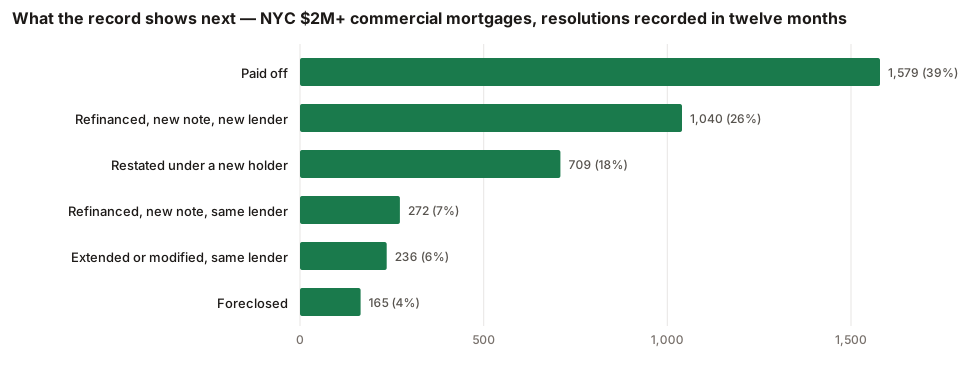
| Resolution recorded, Aug 2025 – Jul 2026 | Loans | Share | Original principal | Bank loans | Bank principal |
|---|---|---|---|---|---|
| Paid off, satisfaction recorded | 1,579 | 39% | $23.92B | 933 | $12.00B |
| Refinanced with a new note, new lender | 1,040 | 26% | $27.71B | 698 | $11.80B |
| Restated under a new holder, no new note | 709 | 18% | $19.52B | 486 | $9.14B |
| Refinanced with a new note, same lender | 272 | 7% | $11.94B | 207 | $8.11B |
| Foreclosed, referee's deed | 165 | 4% | $2.79B | 79 | $777M |
| Extended or modified by agreement, same lender | 139 | 3% | $5.26B | 116 | $4.43B |
| Modified, lien still open (DEMM or agreement) | 97 | 2% | $1.51B | 35 | $492M |
| Assumed by a new borrower | 13 | 0% | $464M | 10 | $329M |
| Spreader agreement, collateral added | 6 | 0% | $281M | 4 | $27M |
| All | 4,020 | $93.40B | 2,568 | $47.1B |
Every $2M+ NYC commercial mortgage with a satisfaction, consolidation, agreement, declaration of modification, assumption or referee's deed recorded against it between August 1, 2025 and July 31, 2026, by the type of filing. "New lender" and "same lender" compare the institution on the two instruments, with name variants and known successors folded together. 142 of the 4,020 had a written maturity; the rest are in the ledger by their filings alone.
So the sentence the question asked for: New York recorded 236 extension or modification agreements on $2 million-plus commercial mortgages in the twelve months to July 2026, $6.77 billion of original principal, 151 of them on bank loans ($4.92 billion). Over the same months it recorded 1,579 payoffs, 1,312 consolidations with new money, 709 restatements under a new holder and 165 foreclosures. Of every resolution a bank loan left on the record, 5.9% was a recorded extension or modification; 36% was a payoff, 54% a refinancing of one kind or another, 3% a foreclosure.
That is the recorded number, and it is low. Two readings are open and the record does not choose between them. One is that New York banks extend less than the aggregate statistics suggest, because the city's refinancing machinery — the consolidation agreement, the recording-tax saving, a deep bench of lenders willing to take a $10 million multifamily loan off another bank's book — turns what would be an extension elsewhere into a refinancing here. The 1,040 loans refinanced by a different lender in one year say that machinery was running: 490 of the bank loans that left went to another bank, 81 to a debt fund, 27 to a life company, 26 into CMBS, 20 to an agency. The other reading is that the extensions are happening and are not being recorded, because an extension that changes nothing about the lien has no reason to be. The 275 silent loans in the cohort are consistent with either. What the record rules out is a wave of recorded extend-and-pretend: it is not on the page.
Two more things the ledger says. The agreements are not mostly on old paper. 96 of the 236 modify loans originated in 2024, 2025 or 2026, which is construction and bridge debt being reworked inside two years; 38 are on 2019–2020 loans and 36 on 2015–2016 loans, the two vintages that reach a five- or ten-year maturity in the window. And the agreements almost never print a new maturity: one of the 236 does. The note that carries the new date is an unrecorded exhibit. So the record can say that a loan was extended far more reliably than how far, which is why no table here says how far.
Who extends, on the record
By lender type, in the ledger year: banks 151 extensions against 933 payoffs and 1,391 refinancings; debt funds 46 against 142 and 249; life companies 3 against 14 and 46; the agencies and CMBS trusts none that reached the record. The originators with the most recorded extensions, with their payoffs and refinancings beside them so that no one is painted as extend-and-pretend on three loans:
| Originator | Extended or modified | Refinanced, same lender | Refinanced away | Paid off |
|---|---|---|---|---|
| JPMorgan Chase | 30 | 70 | 22 | 115 |
| M&T Bank | 9 | 2 | 17 | 16 |
| Apple Bank for Savings | 7 | 1 | 6 | 3 |
| Wells Fargo | 5 | 6 | 7 | 71 |
| Bank of America | 5 | 1 | 3 | 53 |
| Citibank | 4 | 11 | 4 | 44 |
| Cathay Bank | 4 | 3 | 2 | 15 |
| S3 Capital (its lending vehicles) | 9 | 2 | 7 | 11 |
| BCC Funding | 5 | 0 | 2 | 1 |
Resolutions recorded Aug 2025 – Jul 2026 on $2M+ NYC commercial mortgages the originator wrote, by the institution on the original instrument. Loans recorded under a name that has since merged are counted where the record names them.
JPMorgan's 30 is the largest count and the least remarkable: it is the most active originator in the city, and 30 extensions sit beside 70 same-bank refinancings and 115 payoffs. The rows to read are the ones where extensions outnumber payoffs, Apple Bank and the bridge lenders, and even there the counts are single digits over a year.
What this count cannot tell you
It cannot tell you about the 275. A loan with no filing after its written maturity is open on the record and that is the whole of what we know; this post never calls it past due, in default or extended, and the methodology says why. It cannot pair most agreements with a maturity: 7 of the 236 agreements in the ledger year were on a loan whose maturity is written anywhere we can read, so "extended at maturity" versus "modified mid-term" is a distinction the record supports on the cohort and not on the ledger. It cannot see the 48 loans our index closed under a later filing it could not match to an instrument, so those sit on their own line rather than inside "refinanced". And it is Manhattan-heavy, because Manhattan's large loans are the ones whose instruments or disclosures print a date.
What it can do is be repeated. The same count runs every week as the record updates, and the maturity cohort and the ledger will both be in the December Maturity Index reading, so the next question — whether the recorded extension count is rising — has a dated baseline to be measured against. Every loan in both tables is on its property record with the filing that resolved it, or the absence of one, cited to the document.
Frequently asked questions
- Is a CEMA a refinancing or an extension?
- It depends on what is in the filing. A Consolidation, Extension and Modification Agreement recorded with a new gap mortgage is a refinancing: new money, with New York's mortgage recording tax paid only on the gap. The same agreement recorded alone, by the same lender, with no new note, is the existing debt restated on new terms — an extension or modification. ACRIS records both as an AGMT, and only the documents recorded with it say which. This count separates the two: 1,312 consolidations with a new note in the twelve months to July 2026, against 139 lone agreements by the original lender.
- Does New York record loan modifications?
- Often, and more than any other market. A modification that changes the lien — the maturity, the principal, the collateral — is recorded as an agreement or a declaration of modification (DEMM) so that it binds later purchasers and lienors. A modification that changes nothing about the lien, such as an extension option exercised under the original loan documents or a forbearance by side letter, is usually not recorded. So the recorded count is a floor on the true number of extensions, and this post treats it as one.
- What does 'open on the record' mean?
- The maturity written on the recorded instrument has passed and the county has no satisfaction, no consolidation and no agreement on file for the loan. It does not mean the loan is in default or past due. Some of those loans were extended by an unrecorded agreement, some were paid off and the release not yet filed, some are being worked out. The record says the lien is open, and that is all this post says.
- Does the FDIC publish loan modifications by loan?
- No. Banks report modifications to borrowers experiencing financial difficulty in aggregate on their Call Reports (Schedule RC-C, Part I, Memorandum item 1), and the FDIC's Quarterly Banking Profile aggregates those further by loan category. Neither identifies a loan, a property or a maturity date, and neither counts an extension that is not a modification for a borrower in difficulty. The county record is the only public source that names the loan.
- Where does the data come from?
- The NYC Department of Finance's ACRIS records: every mortgage, consolidation agreement, satisfaction, assignment, declaration of modification, assumption and referee's deed recorded in the five boroughs, matched to the loan each one cites. Maturities are read off the recorded instrument where it prints one, or taken from the loan's securitization or HUD disclosure; a loan whose maturity is only modelled is not in the cohort. Counts are as of November 2, 2026.
Sources
- Constantine Korologos: The Window and the House (LinkedIn, October 2026)
- FDIC Quarterly Banking Profile
- New York Tax Law § 255: supplemental mortgages (why the consolidation agreement exists)
- NYC Open Data: ACRIS Real Property Master (document types, amounts, dates)
- Circlemark Maturity Index, October 2026 (the stated-maturity floor by county)
- Circlemark methodology: default and distress
Check one building
Type an address and see the mortgages recorded on it — lender, amount and the maturity read from the instrument. Free, no account.
Searches New York City. Only the house number and street matter — leave off the unit.
Read next
- NYC's 2026 maturity wall, lender by lender: the bank with the most loans coming due is the one pulling back from New York
A data brief on the lenders behind New York City's 2026 maturity wall: 139 commercial mortgages of $5 million or more, $8.70B, whose maturity date is written into the recorded instrument and falls in the next twelve months, ranked by the institution that originated them and bucketed by lender type. One loan, the GM Building's, is a quarter of the dollars; by count the leader is Flagstar Bank, the former New York Community Bank — while it shrinks its New York book, the Fed raises rates and the city freezes stabilized rents.
- NYC's 2026 maturity wall, borough by borough: $5.9B stated, $2.5B already past due
A per-borough data brief on New York City's 2026 commercial mortgage maturity wall — stated maturities only, read from the recorded instruments: 274 loans and $5.9B coming due in 12 months, 166 loans and $2.5B already matured and still open, 13 already carrying a distress filing. Every number traces to the record.
- How we monitor NYC commercial mortgage maturities for brokers in 2026 (and why ACRIS makes it hard)
Where commercial mortgage maturity data actually comes from, why New York City's public records don't contain a maturity date, and how Circlemark turns recorded documents into a verified, weekly-refreshed list of loans coming due.
More on New York City
- How the New York City record is read — what is different about the market's public record, what we cover there, and the live counts.
- Loans maturing by county: Manhattan · Bronx · Brooklyn · Queens — each county's maturity windows, collateral mix and the lenders behind the loans coming due, counted from the record.
- Every New York City post
Research from the county record
The rest of the briefs — one market, one lender or one cohort, counted from the recorded instruments and dated to the pull.
- Circlemark Maturity Index: October 2026
- Gas station, convenience store and car wash loans
- NYC ARM resets in 2027: what the riders say
- The debt behind Austin's renters' market
- Are banks back in commercial real estate lending?
- NYC rent-stabilized building loans coming due
- Why Texas files every warehouse as "commercial"
- NYC's 2026 maturity wall, lender by lender
- NYC investor house loans and the ARM wall
- DFW's 2026 maturity wall, county by county
- NYC's 2026 maturity wall, borough by borough
- A third of every NYC commercial loan list is an apartment