Glossary
What is loan maturity intelligence?
Loan maturity intelligence is property-level data on when commercial mortgages come due, who owns the borrower, and whether each loan is still open, with every date labelled as read from the recorded document or estimated by a model. Brokers and lenders use it to reach owners before a refinance, sale or default forces their hand.
By Andrew Zhong, founder of Circlemark · Updated · 5 min read · Live figures as of Nov 26, 2026
$200 million, due November 6, 2026, written on a mortgage recorded in New York City in 2016, and in special servicing since July 29. That one line, about the loan on 1460 Broadway in Manhattan, is loan maturity intelligence: when a specific commercial loan comes due, how we know, and what has happened to it since. The date came off the recorded instrument (CRFN 2016000397622), and the servicing status came from the loan's securitization reporting.
Stated versus estimated maturity, and why the label matters
Most "maturity data" is a model. A vendor takes the origination date from the county index, adds a typical term of five, seven or ten years, and prints the result as the maturity date. That works for a bank's five-year balloon. It fails on a 33-month bridge loan, on a 30-year bank note with a five-year rate reset, and on a consolidation that rolled three older loans into one.
A stated maturity is printed in a document: the mortgage, the deed of trust, or the loan's securitization disclosure. An estimated maturity is arithmetic. Both are useful, but they are not the same kind of fact, and a call list that mixes them without saying so sends you after owners whose loans were refinanced years ago.
How much of the market has a date you can read depends on where you are:
- In New York City, 276 of the 6,727 commercial loans we place in the next twelve months have a stated maturity: 4%.
- In Dallas–Fort Worth, it is 1,311 of 3,812: 34%.
Counted daily from the county record, loans above each county's floor ($1 million; $2 million in Manhattan). These are the same counters the county pages and the Circlemark Maturity Index publish, so the figures above move with them.
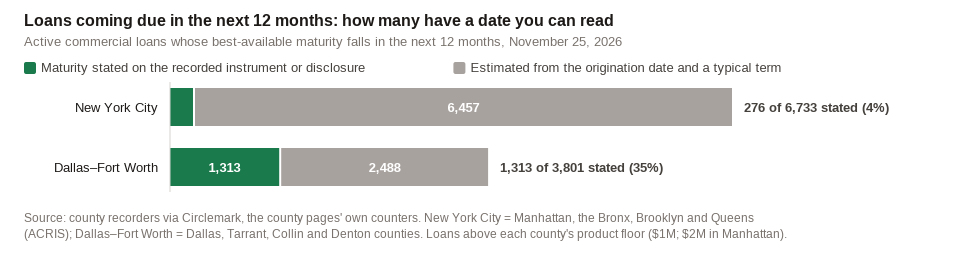
The gap is a recording habit, not a difference in the loans. A Texas deed of trust usually describes the note, maturity included, on its first page. A plain New York mortgage prints its maturity about 47% of the time (6,297 of 13,249 instruments we read, measured September 2026). But most large New York loans are refinanced by consolidation agreement, and that document states a maturity 6.4% of the time, because the amended note is an exhibit nobody records. The loans coming due in New York are mostly that kind.
Where the data comes from
Loan maturity intelligence is assembled from three kinds of source, and a good dataset tells you which one each fact came from:
- County recorder instruments. The mortgage, deed of trust, assignment, modification, consolidation and satisfaction, as recorded. This is the only source that covers bank, credit-union, life-company and private loans as well as securitized ones.
- Securitization and agency disclosures. CMBS servicer reporting, SEC loan-level filings, and Freddie Mac and HUD data. These state the maturity and add special-servicing and delinquency status, but only for loans that were securitized or agency-financed.
- Models. A term assumed where the documents are silent. Necessary, and always an estimate.
The method difference that matters is per-document citation versus entity rollup. A rollup tells you a borrower "has $40 million of debt maturing in 2027". A per-document record tells you which instrument says so and links to it, so you can check it before you call. Where commercial mortgage maturity data comes from walks through each source and what it hides.
What it adds beyond a maturity date
A maturity date on its own is not a lead. The loan may already be paid off, refinanced or folded into a consolidation. Loan maturity intelligence adds four checks:
- Is the loan still open? The record is re-read for a satisfaction, a newer mortgage or a sale. When we checked apartment loans past their stated maturity, two in five already carried a newer mortgage on the same lot: refinanced, with the old release never filed.
- Is it past due on the record? A loan past its stated maturity with nothing recorded since is the group worth calling first. In October we counted 3,134 of them across New York City and three Texas metros; only 33 carried a recorded modification.
- Is there a distress signal? A special-servicing transfer, a delinquency report or a foreclosure filing, each cited to the report or instrument that raised it.
- Who is behind the borrower? Most commercial borrowers are single-asset LLCs. The person who signs for one is on public records, by a different route in New York and in Texas.
1460 Broadway shows why the checks matter. Its stated date passed on November 6. As of November 25 the record shows no satisfaction and no newer mortgage on the lot, so the loan is past its date and still open. Whether that ends as a refinance, a workout or a sale depends on what is recorded next, which is why the record has to be re-read every week and not read once.
Who uses it
- Debt and mortgage brokers, to reach an owner 12 to 18 months before a balloon and not the week the lender calls.
- Originators and lenders, to see which competitors' loans are coming due in their footprint.
- Special servicers and note buyers, to size a workout pipeline before it reaches a servicer report.
- Investment-sales brokers, because a maturity with no refinance path is often a sale.
What it cannot tell you
The limits are part of the definition. An extension agreed by letter is never recorded, so the record can show a passed date on a loan that was quietly extended. Satisfactions are filed late, sometimes by months, so "no payoff on file" is not the same as unpaid. The lender named on a recorded mortgage is the one that made the loan, not always the one that holds it today. And an estimated date is only as good as the term assumed. A dataset that states these limits beside its numbers is easier to trust than one that shows a date for every loan.
See how to find maturing commercial loans for the method step by step, the CRE maturity wall for what the national figure is made of, or look up one building to see the label on a real loan.
Frequently asked questions
- What does loan maturity mean?
- The maturity date is the day a loan's remaining balance falls due. Most commercial mortgages do not pay themselves off over their term, so the balance left at maturity is a balloon: the borrower has to refinance, sell the property, pay it down or negotiate an extension with the lender before that date.
- What is the difference between a stated and an estimated maturity?
- A stated maturity is written in a document: the recorded mortgage or deed of trust, or the loan's securitization disclosure. An estimated maturity is arithmetic, the origination date plus a term the lender type usually writes. A stated date can be checked against the county record. An estimate is a reason to look, and a good dataset labels each one.
- Can you find a commercial loan's maturity date in public records?
- Sometimes. County recorders index the parties, the amount and the recording date, but no maturity field. The date is on the scanned instrument when the lender's form prints it: about 47% of plain New York mortgages and 41% of Texas deeds of trust do, and New York consolidation agreements almost never do. Where it is not printed, any date you see is an estimate.
- How much commercial real estate debt matures in 2026?
- The Mortgage Bankers Association counts $875 billion of commercial and multifamily mortgages maturing in 2026, 17% of the $5.0 trillion outstanding. That is a national survey of lenders and servicers. It says how large the wave is, and nothing about which buildings are in it, which is the question loan maturity intelligence answers.
- What happens when a commercial loan matures and is not paid off?
- The lender can extend, modify, sell the note or enforce. On the public record the usual trace is silence: a maturity date that passed with no satisfaction recorded after it. That is not proof of default, because an extension agreed by letter is never recorded and a release is often filed months late. It is the list worth checking first.
Sources
- Mortgage Bankers Association: 17 percent of commercial and multifamily mortgage balances to mature in 2026 (February 9, 2026)
- NYC Open Data: ACRIS Real Property Master (the recorder's index: document types, amounts, dates, no maturity field)
- Circlemark methodology: how a maturity is read off the instrument and how an estimate is labelled
- Circlemark Maturity Index: the monthly count of stated maturities by county
Check one building
Type an address and see the mortgages recorded on it — lender, amount and the maturity read from the instrument. Free, no account.
Read next
- How to find maturing commercial loans in 2026: the three sources, the tools that search them, and a list you can pull today
Every maturing-loan list is built from the same three sources: the county recorder, securitization disclosure, and a model. This is how to search each one yourself, what each can and cannot tell you, how the tools that package them compare on price and on whether they admit which dates are guesses, and where to pull a list for New York or Texas without an account.
- Where commercial mortgage maturity data actually comes from
Every CRE maturity date in every data product traces to one of three sources: the county recorder, securitization disclosure, or somebody's model. What each one covers, what each one hides, and the questions to ask any vendor before you trust a date — with New York and Texas as the worked examples.
- Commercial loans past their maturity date with no payoff recorded: why it happens and what to do about it (2026)
In New York City, Dallas–Fort Worth, Austin and San Antonio, 3,134 commercial mortgages are past the maturity date printed on the recorded instrument and no satisfaction or release has been filed. About a quarter are refinanced loans whose release never reached the clerk. The rest are extensions nobody recorded, workouts nobody announced, and a few real maturity defaults. How to tell them apart from the county record, and what a broker should say when calling.
- Loan maturity leads: how CRE brokers source refinance deals before the balloon (2026)
A loan maturity lead is a commercial mortgage coming due on a property whose owner you can reach. Lead vendors sell them by the month or by the piece; the county record gives them away, with the one fact no vendor shows — whether the loan is still there. Of 130 Dallas–Fort Worth apartment loans past a stated maturity this year, 62 already carry a newer mortgage on the same lot; in New York, where few instruments print a date, it is 19 of 49. How to source the leads, which are real, and when to call.
More from the glossary
- What is the CRE maturity wall?
The CRE maturity wall is the volume of commercial real estate loans scheduled to come due in a short window: $875 billion in 2026, by the Mortgage Bankers Association's count. Most commercial mortgages end in a balloon, so each of those loans has to be refinanced, sold, paid down or extended at today's rates when its date arrives.